
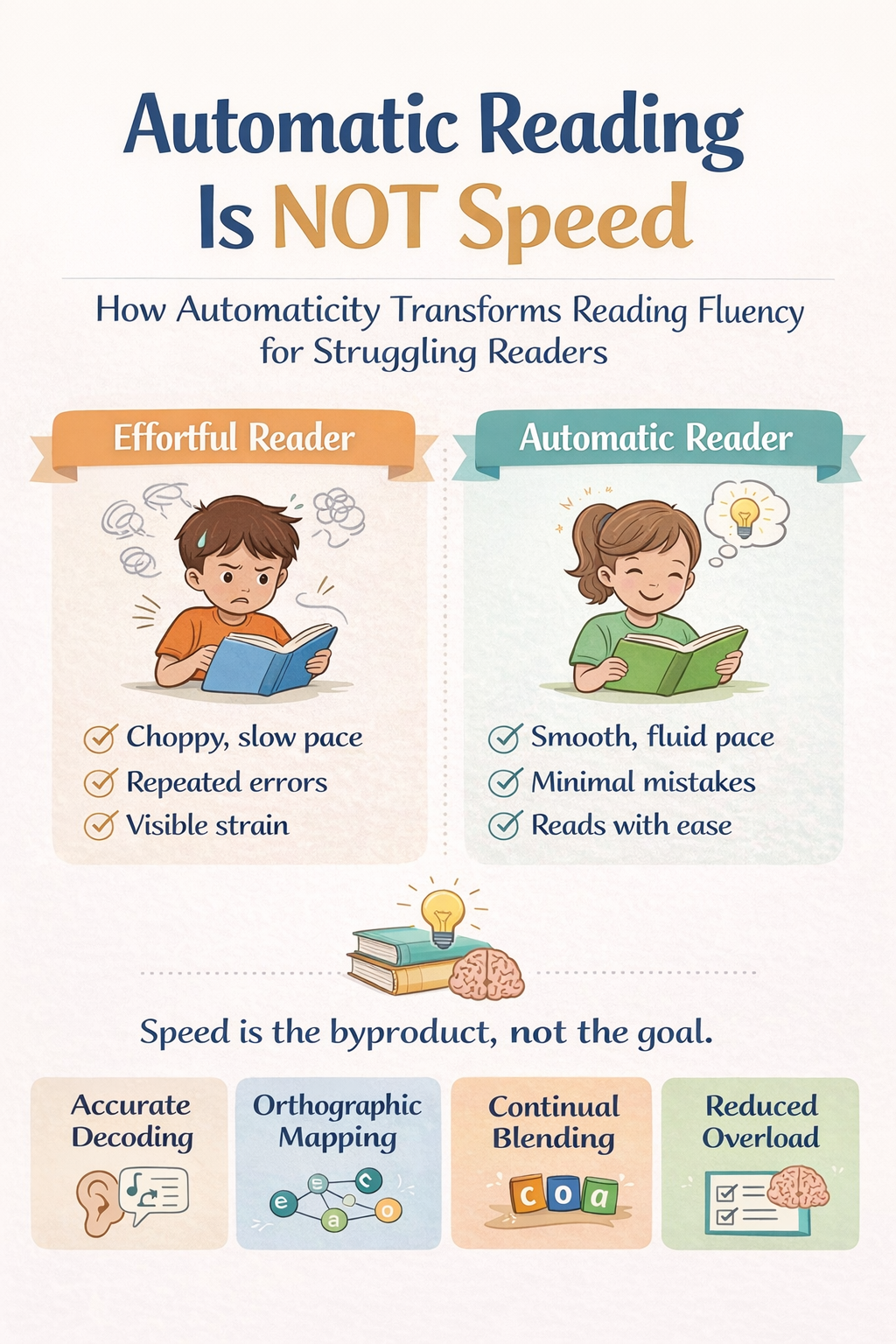
Automatic Reading Is Not Speed(And Why That Distinction Changes Everything)
If your child reads slowly, speed may not be the real issue. Automatic reading depends on orthographic mapping, accurate decoding, and reduced cognitive strain. In this article, you’ll learn why fluency stalls for struggling readers and how building automaticity — not pushing speed — transforms comprehension and confidence.
Many parents tell me:
“She reads so slowly.”
“He needs to read faster.”
“The school says her words per minute are low.”
Speed feels like the problem.
But here’s the truth:
Automatic reading is not speed.
Speed is a byproduct of something deeper.
If we focus only on speed, we miss the real work the brain must do to become a fluent reader.
What Automatic Reading Actually Means
Automatic reading means the brain recognizes words with very little conscious effort.
It includes:
Accurate decoding
Smooth blending
Words stored securely in memory
Minimal mental strain
Stronger comprehension
When reading is automatic, the child is not thinking through every step.
They are not pausing to apply a rule.
They are not guessing.
They are not working through letters one by one with visible effort.
The word simply connects.
And when that happens consistently, speed naturally improves.
Why Speed Alone Is Misleading
Two children can read at the same words-per-minute rate and be having completely different experiences.
One child:
Reads smoothly
Understands what they read
Feels confident
The other:
Strains through every word
Barely remembers the sentence
Feels exhausted afterward
Speed does not tell you how much cognitive energy was required.
And for struggling readers, that energy cost matters.
What’s Really Happening in the Brain
Reading requires the brain to:
Hear and isolate the sounds in a word
Connect those sounds to letters
Blend them smoothly
Store the word in long-term memory
Recognize it automatically next time
If any of those steps are fragile, reading stays effortful.
And when reading is effortful, automaticity doesn’t develop.
Instead, you may see:
Slow, choppy reading
Repeated errors on familiar words
Guessing based on first letters
Avoidance
Fatigue
This is not laziness.
It is load.
The Role of Orthographic Mapping
Automatic reading depends heavily on orthographic mapping.
This is how words become permanently stored in memory.
When orthographic mapping is strong:
The child doesn’t re-decode the same word repeatedly
Words feel familiar instantly
Blending becomes smoother
Reading pace increases naturally
When mapping is incomplete:
Words feel new every time
Reading stays slow
Fluency stalls
Speed drills won’t fix weak mapping.
Foundational skill work will.
Why Fluency Improves When Automaticity Improves
When decoding becomes automatic:
Working memory is freed
Attention can shift to meaning
Comprehension strengthens
Endurance increases
Confidence grows
That’s when reading starts to look fluent.
Not because we forced speed —
but because we reduced strain.
What Actually Builds Automatic Reading
If your child is stuck reading slowly despite knowing phonics, the solution is not “read faster.”
It’s strengthening the system that creates automaticity:
Phonemic awareness
Sound-to-print connections
Continuous blending
Strategic spelling integration
Structured repeated reading
Reduced cognitive overload
When these are in place, automatic reading develops.
And once automatic reading develops, speed follows.
If You’re Watching Your Child Struggle
If reading still feels hard even though your child “knows the rules,” the question isn’t:
“How do we make them faster?”
The better question is:
“Is their reading automatic yet?”
If not, the work is still foundational — not motivational.
And that is fixable.
Next Steps
If you’re unsure whether your child’s reading is automatic or still effortful, you can:
• Download the free Reading Root-Cause Checklist
• Book a free Reading Clarity Call
• Learn more about the 12-Week 1:1 Reading Therapy Program
When reading becomes automatic, everything changes.
Speed.
Confidence.
Comprehension.
Peace at the kitchen table.
Automatic reading is not speed.
It is ease.
And ease can be built.
www.blossomingskillsreadingtherapy.net
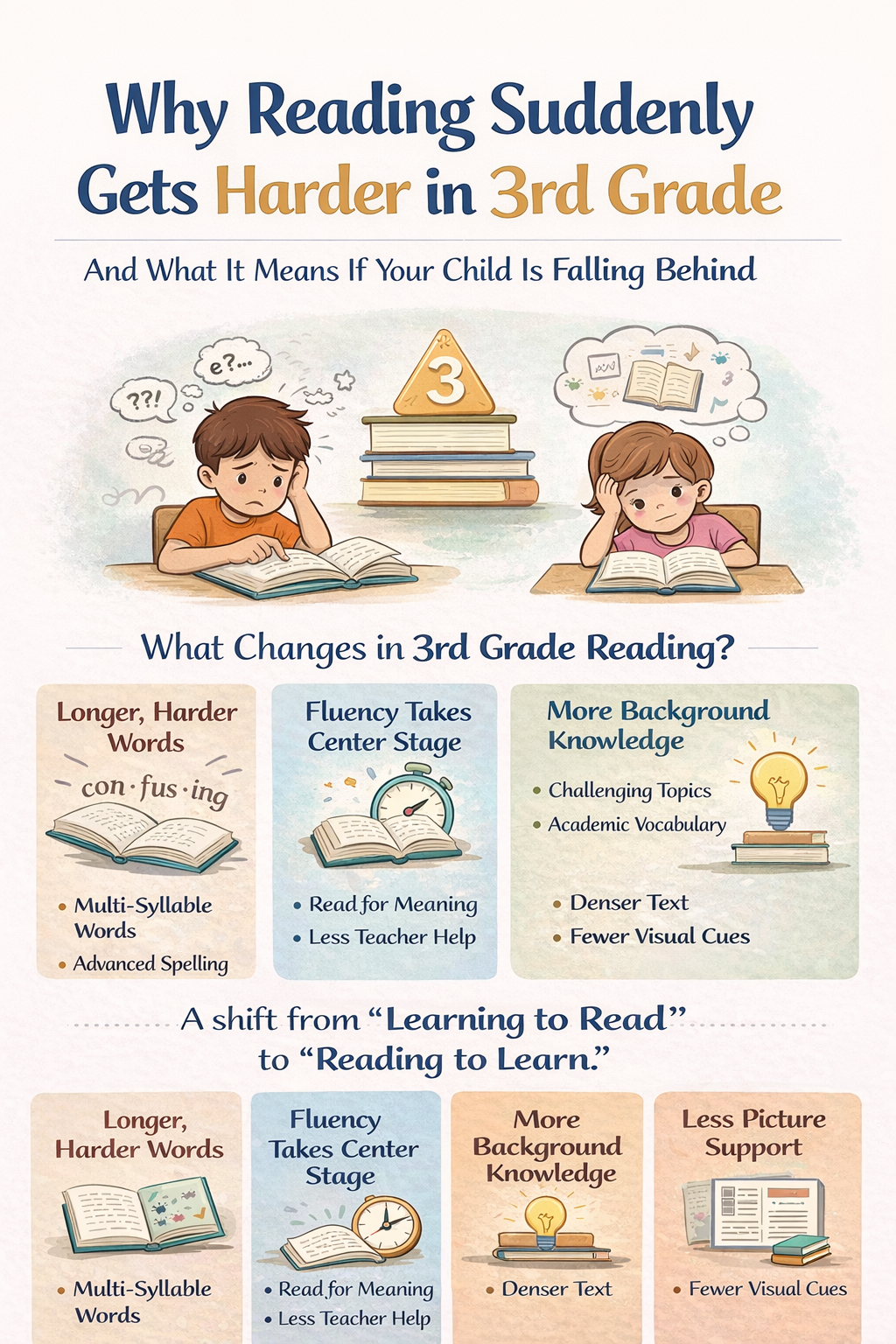
Why Reading Suddenly Gets Harder in 3rd Grade (And What to Do If Your Child Is Falling Behind)
Reading often feels harder in 3rd grade because the demands change. Text becomes longer, vocabulary grows more complex, and fluency becomes essential for comprehension. If your child suddenly seems to be falling behind, the issue may not be motivation — it may be foundational decoding and automaticity gaps that are now being exposed.
Many parents tell me the exact same story:
“My child did okay in 1st and 2nd grade… but 3rd grade hit and everything fell apart.”
Homework that used to take 15 minutes now drags on for an hour. Reading time turns into tears and meltdowns. Your once-confident child starts saying, “I’m just not smart” or “I hate reading.”
If this is your child right now, please know — you are not failing, and your child is not broken. This is incredibly common, and there’s a real reason it happens.
The Big Shift in 3rd Grade
In early grades, kids are “learning to read.” Books are short, pictures help, and teachers give lots of support.
Starting in 3rd grade, everything changes. Kids are now expected to “read to learn.” They have to pull information from longer chapter books, science texts, and social studies with almost no help.
This new stage requires:
Fast, automatic word reading
Strong fluency
The ability to understand and remember what they just read
When those skills have small gaps, reading suddenly feels exhausting and overwhelming.
Why Most Phonics Programs Make It Worse
Here’s something most parents don’t realize:
A lot of traditional reading programs teach kids to memorize phonics rules and all their exceptions, then try to apply them while reading.
This puts a huge load on working memory — and that’s simply not how brains are wired to learn.
When a child has to stop and think about rules on almost every word, there’s almost no brainpower left for actually understanding the story. That’s why so many kids can “know their phonics” but still guess, slow down, or melt down.
The Better Way: Speech-to-Print
My brand new packets use a completely different approach called speech-to-print.
Instead of memorizing confusing rules and exceptions, kids learn to map sounds to letters the natural way the brain actually processes language. This reduces cognitive overload and makes reading start to feel automatic and easy.
You’re Not Too Late
The great news? Most kids who hit this wall catch up quickly once they get the right kind of support.
Ready to Help Your Child Move Forward?
Here are the easiest next steps you can take today:
1. Download my Free Struggling Reader Checklist. Find out exactly what’s holding your child back (takes just 2 minutes)
2. Grab my brand new Long E Packet The perfect starting point for building strong speech-to-print skills (currently on special launch pricing)
3. Book a Free Reading Clarity Call. Let’s talk about your child’s specific situation and make a clear plan
You’ve got this, mama. Your child’s reading story isn’t over — it’s just entering a new chapter, and the right support can make all the difference.
Catherine Mitchell Blossoming Skills Reading Therapy www.blossomingskillsreadingtherapy.net
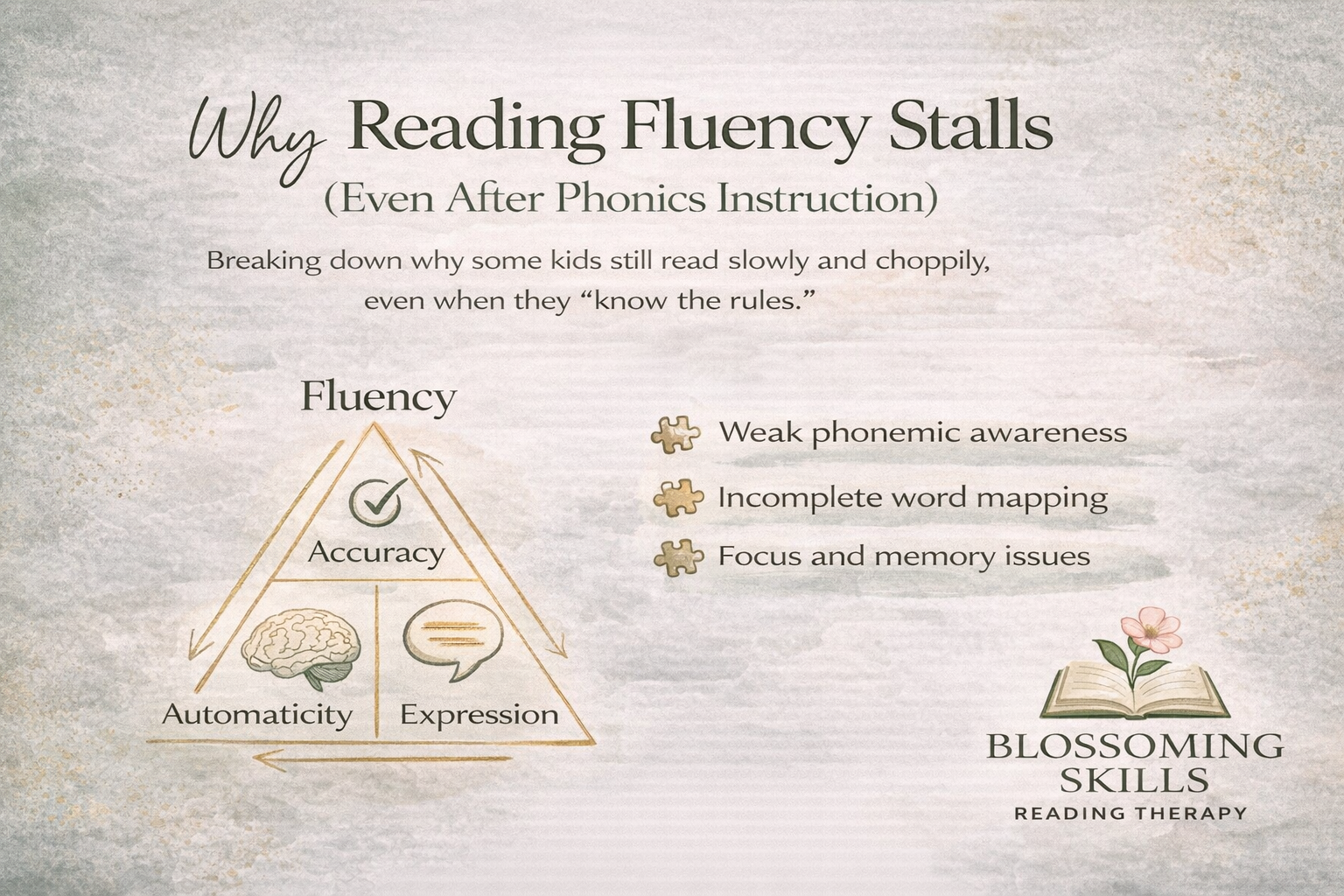
Why Reading Fluency Stalls (Even After Phonics Instruction)
Why is your child still reading slowly even after phonics instruction? If decoding is accurate but fluency hasn’t developed, the problem is rarely “they just need to read more.” Reading fluency stalls when automaticity, phonemic awareness, orthographic mapping, or working memory are fragile. In this article, you’ll learn the real reasons fluency plateaus — and what actually helps struggling readers move from effortful decoding to confident, automatic reading.
If your child can sound out words…
but still reads slowly, choppily, or with little expression…
You’re not imagining it.
Fluency can stall — even after phonics instruction.
And the reason is rarely “they just need to read more.”
Let’s break down what’s really happening.
What Is Reading Fluency — Really?
Fluency is not just speed.
True fluency includes:
Accuracy (reading words correctly)
Automaticity (reading without effortful decoding)
Prosody (natural phrasing and expression)
Cognitive endurance (sustaining attention across text)
Speed is a symptom of automaticity.
When automaticity is fragile, speed never fully develops.
1. Weak Phonemic Awareness (Even If Phonics Was Taught)
A child can be taught phonics patterns and still have shaky phonemic awareness underneath.
If they:
Struggle to quickly segment sounds
Blend slowly
Need extra time to hold sounds in memory
Have difficulty manipulating sounds in words
Then decoding remains effortful.
Effortful decoding means the brain is working too hard at the word level.
When that happens, there’s not enough cognitive space left for smooth reading.
Fluency stalls.
2. Incomplete Orthographic Mapping
Orthographic mapping is how words become permanently stored in long-term memory.
If this process isn’t solid:
Words don’t “stick”
The same word feels new each time
The child decodes it over and over again
This is where spelling matters more than most people realize.
Spelling strengthens the brain’s sound-to-print connections.
When spelling is weak, word recognition stays slow.
Fluency cannot outgrow unstable word storage.
3. Overloaded, Rule-Heavy Instruction
Some reading instruction focuses heavily on:
Memorizing rules
Remembering exceptions
Managing multi-step decoding strategies
Large sight word lists
For children with working memory weaknesses, ADHD, or processing differences, this creates cognitive overload.
Fluency requires freed working memory.
If reading feels procedural — “step one, step two, apply the rule” — it won’t feel automatic.
And automaticity is what drives fluency.
4. Fluency Is Measured… But Not Taught
Many schools measure words per minute.
But measuring is not the same as teaching.
Effective fluency instruction includes:
Guided repeated reading
Modeling prosody
Phrase marking
Accuracy-first rereading
Short passages practiced intensively
Immediate corrective feedback
Without structured practice, fluency rarely improves on its own.
5. ADHD and Working Memory Weakness
This is often overlooked.
If your child:
Loses their place while reading
Stares off during longer passages
Forgets what they just read
Struggles to copy information accurately
This may reflect cognitive load — not effort.
Fluency is fragile when attention and working memory are fragile.
Standardized tests amplify this because they require sustained, single-pass performance with no scaffolding.
That doesn’t mean progress isn’t happening.
It means endurance hasn’t caught up yet.
6. Text That Is Too Difficult
If a child is constantly reading grade-level text independently before automaticity is stable, they will look permanently disfluent.
They need:
Controlled text
Supported ramping
Repeated success
Gradual release
You build fluency by reducing strain — not by increasing pressure.
7. Processing Speed Differences
Some children process language more slowly.
This does not reflect intelligence.
It means automaticity takes longer to consolidate.
When speed is pushed too early, anxiety increases and comprehension drops — which actually slows progress further.
So What Actually Moves Fluency Forward?
Instead of “read more,” effective intervention includes:
Strengthening phonemic awareness
Integrating spelling with reading
Reducing cognitive overload
Structured repeated reading
Modeling expression
Short, focused practice bursts
Accuracy before speed
Fluency improves when decoding becomes effortless.
Effortless reading doesn’t happen through exposure alone.
It happens through intentional, brain-aligned instruction.
If Your Child Can Decode but Isn’t Fluent…
Fluency hasn’t failed.
The system is still integrating.
When the right supports are in place, automaticity builds — and once it does, fluency begins to shift in a noticeable way.
If you’re wondering whether your child’s fluency has stalled — or if something deeper is happening — you don’t have to figure it out alone.
You can learn more about my structured, root-cause reading intervention here:
Or schedule a consultation to discuss your child’s specific profile:
Homepage
Catherine Mitchell
www.blossomingskillsreadingtherapy.net
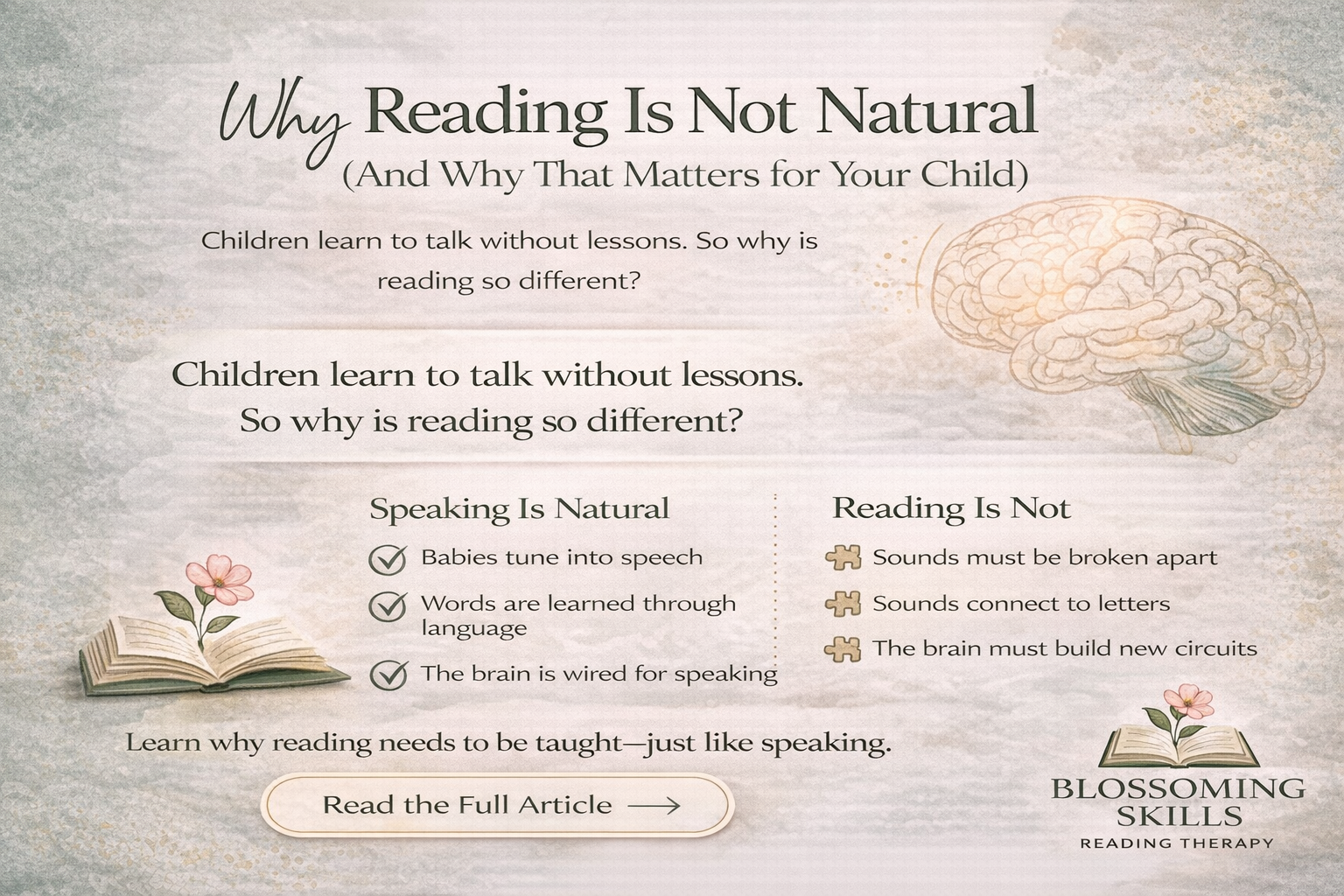
Why Reading Is Not Natural (And Why That Matters for Your Child)
Why isn’t reading natural for many children — especially struggling readers? While speaking develops automatically, reading requires explicit, structured instruction that aligns with how the brain maps sounds to letters. When children are taught through memorization, guessing strategies, or rule-heavy phonics, progress often stalls. Learn why reading must be taught differently — and what brain-aligned instruction actually looks like for dyslexia and reading difficulties.
Many parents assume reading develops the way speaking does.
Children learn to talk without formal instruction. So when reading doesn’t develop easily, it feels confusing.
But here’s the truth:
Reading is not natural.
It must be taught — and taught in a way that aligns with how the brain actually learns language.
Understanding this changes everything.
Speaking Is Natural. Reading Is Not.
Humans are biologically wired for spoken language.
Babies are born with brains prepared to:
hear speech sounds
detect patterns in language
imitate and produce words
build vocabulary naturally through conversation
Reading is different.
Reading requires the brain to:
break spoken words into individual sounds
connect those sounds to letters
blend those sounds back into words
store those words for automatic recognition
The brain must build a new system that does not exist automatically.
What Happens When Reading Is Taught Out of Order
When reading instruction does not match how the brain processes language, students often:
memorize words instead of decoding
guess based on the first letter
rely on picture clues
struggle to remember phonics rules
read slowly and choppily
feel overloaded during reading
This is not a motivation issue.
It is an instructional alignment issue.
Why Phonics Rules Alone Don’t Solve the Problem
Many children are taught reading through phonics rules.
The challenge?
English contains many spelling patterns with multiple exceptions.
When students try to hold:
the rule
the exceptions
and the word
…all at the same time, working memory becomes overloaded.
Overload leads to hesitation.
Hesitation leads to guessing.
Guessing becomes a habit.
Why Memorizing Words Creates Bigger Problems
Some instruction relies heavily on memorizing sight words.
Memorization is not the same as automatic reading.
When students memorize many words:
they begin memorizing unfamiliar words
they skip decoding
they avoid sounding out
they struggle when text becomes more complex
This often shows up later as:
stalled progress
slow fluency
weak spelling
difficulty transferring skills to real books
The Brain Learns Through Speech First
The brain processes spoken language before written language.
Effective reading instruction builds from that foundation.
Instead of starting with memorization, instruction should:
Strengthen awareness of individual sounds in words
Connect those sounds to spellings
Build smooth, continuous blending
Develop automatic word recognition
Train fluency directly
This approach aligns reading with how the brain naturally stores language.
Why Some Children Struggle More Than Others
Some children:
process sounds less clearly
have weaker phonemic awareness
struggle with working memory
become overwhelmed by complex rule systems
need more direct fluency coaching
When instruction does not match their learning profile, progress slows.
When instruction aligns with the brain, progress accelerates.
What Automatic Reading Actually Looks Like
Automatic reading is not speed.
It is:
accurate decoding
smooth blending
effortless word recognition
strong spelling connections
comprehension that improves because decoding is easier
When the brain no longer has to work so hard to read each word, meaning becomes accessible again.
What Parents Should Watch For
If your child:
guesses at words
reads slowly despite knowing phonics
forgets patterns they have been taught
struggles to transfer skills into real books
understands language well but struggles when reading independently
…it may not be about effort.
It may be about alignment.
The Bottom Line
Reading is not natural.
It requires:
structured instruction
sound-to-spelling connections
fluency coaching
and a method that matches how the brain processes language
When instruction aligns with the brain, reading becomes less effortful, more automatic, and more confident.
If your child is not progressing, the question is not “How much more practice?”
The better question is:
Is the method aligned with how the brain actually learns to read?
Schedule a free Reading Breakthrough Call: https://calendar.app.google/SFCcnF8k5WytCiFeA
www.blossomingskillsreadingtherapy.net
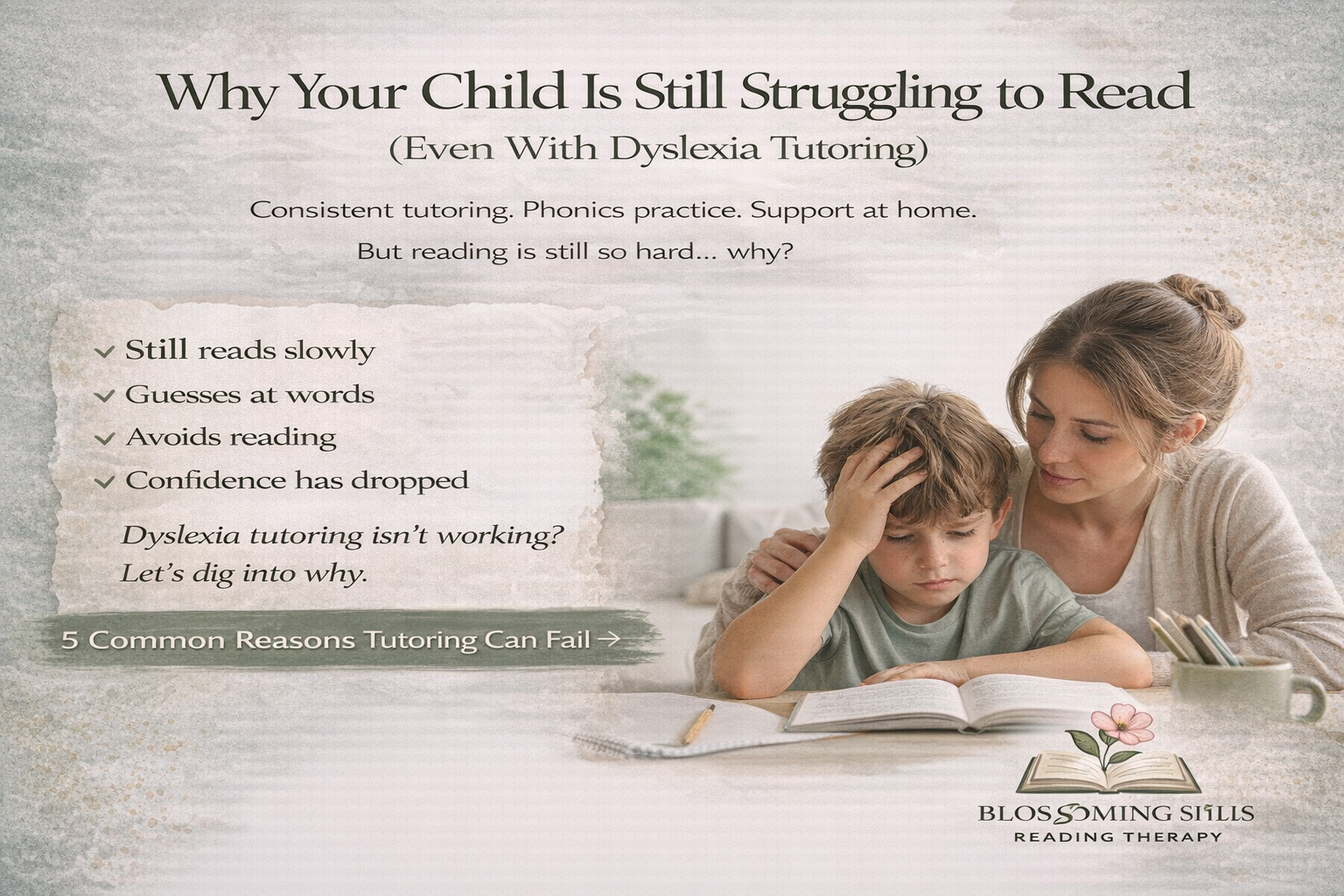
Why Your Child Is Still Struggling to Read (Even With Dyslexia Tutoring)
If your child has been in dyslexia tutoring for months or even years and reading is still slow, effortful, or filled with guessing, you are not alone. Many struggling readers learn phonics rules but never develop automatic word recognition in real text. When instruction doesn’t build sound-to-print mapping, fluency, and true automaticity, progress stalls. In this article, you’ll learn why dyslexia tutoring sometimes fails — and what actually helps struggling readers make lasting gains.
If your child has been in tutoring for months or even years and reading is still hard, you’re not alone.
Many parents come to me feeling:
confused
exhausted
discouraged
and worried that their child will never catch up
They’ve done what they were told to do:
consistent tutoring
structured programs
phonics practice
reading support at home
And yet…
your child still guesses
reading is slow and effortful
fluency won’t build
confidence is shrinking
So what’s going on?
First, let’s clear something up: your child is not lazy
Most struggling readers are trying incredibly hard.
They are often:
bright
thoughtful
motivated
sensitive
and painfully aware they’re behind
Reading struggles are rarely about effort.
They’re almost always about missing foundational skills and an approach that doesn’t match how the brain learns language.
Why dyslexia tutoring doesn’t always work (even when it’s “good” tutoring)
Many families assume that if they choose a well-known dyslexia tutoring approach, their child will automatically become a fluent reader.
But the truth is, not all dyslexic children respond to the same methods.
Even evidence-based programs can fail when:
the instruction is too slow
the child is overwhelmed
key skills are missing
or the method doesn’t build automatic reading in real text
Here are the most common reasons I see.
1. Your child may know phonics… but still can’t read
This surprises many parents.
A child can often:
learn letter sounds
learn phonics patterns
decode in word lists
and do well during lessons
But then reading on their own looks like a completely different child.
This is because reading isn’t just knowing phonics.
Reading requires automatic integration.
If the brain has to work too hard to decode each word, the child:
slows down
loses the sentence
becomes exhausted
and begins guessing
2. Guessing is a coping strategy, not a character flaw
Many struggling readers guess because it feels like the only way to survive.
They may:
look at the first letter and guess
skip unknown words
substitute a word that “kind of fits”
rely on context instead of decoding
Guessing isn’t a bad habit.
It’s a sign that reading feels too hard and too slow.
When the missing skills are built properly, guessing fades naturally.
3. For many kids, Orton-Gillingham becomes cognitive overload
This is one of the biggest reasons families come to me after years of tutoring.
Orton-Gillingham (and OG-based programs like Barton or Wilson) can be helpful for many children.
But for some struggling readers, it becomes overwhelming because it often requires children to hold too much in their working memory.
They may be asked to memorize:
phonics rules
syllable types (open, closed, vowel team, r-controlled, etc.)
rule exceptions
sight words
spelling generalizations
and multiple steps for decoding multisyllable words
Then they’re expected to apply all of it during real reading in real time.
For a dyslexic brain, that can feel like trying to solve a puzzle while running.
The child may understand the lesson, but when they read independently:
the rules don’t transfer
the strategy disappears
and fluency never builds
Reading requires automaticity.
If the process is too complex, the brain can’t apply it fast enough.
4. Many tutoring programs don’t build true word recognition
One of the most overlooked skills in reading is automatic word recognition.
Fluent readers do not sound out every word.
They recognize thousands of words instantly because their brain has mapped:
the sounds
to the letters
to the meaning
Many struggling readers never develop this mapping automatically.
So even if they’ve “learned phonics,” reading still feels slow and fragile.
5. Your child may have deeper language-based gaps
Some children also have challenges with:
phonemic manipulation
speech-to-print skills
rapid naming
language processing
working memory
vocabulary and background knowledge
If these are not addressed directly, progress can stall.
And parents are left thinking:
“We’re doing everything… why isn’t it working?”
What actually helps dyslexic and struggling readers make real progress
Real progress happens when reading instruction is:
✔ Root-cause based
Not just “more phonics,” but identifying the missing pieces.
✔ Brain-aligned
Less memorizing. More mapping and automaticity.
✔ Structured and explicit
Clear steps, taught in the right order.
✔ Intensive enough to create change
Not stretched thin over years.
✔ Built for transfer into real reading
Not just isolated drills.
A simpler way: reading should be mapped, not memorized
Many struggling readers don’t need more rules.
They need a process that helps their brain store language more efficiently.
This includes:
phonemic awareness and manipulation
sound-to-print mapping
structured practice that builds automaticity
controlled text for accuracy-first fluency
repetition that strengthens word recognition
When the brain is taught in a way that reduces cognitive overload, reading becomes easier, faster, and more confident.
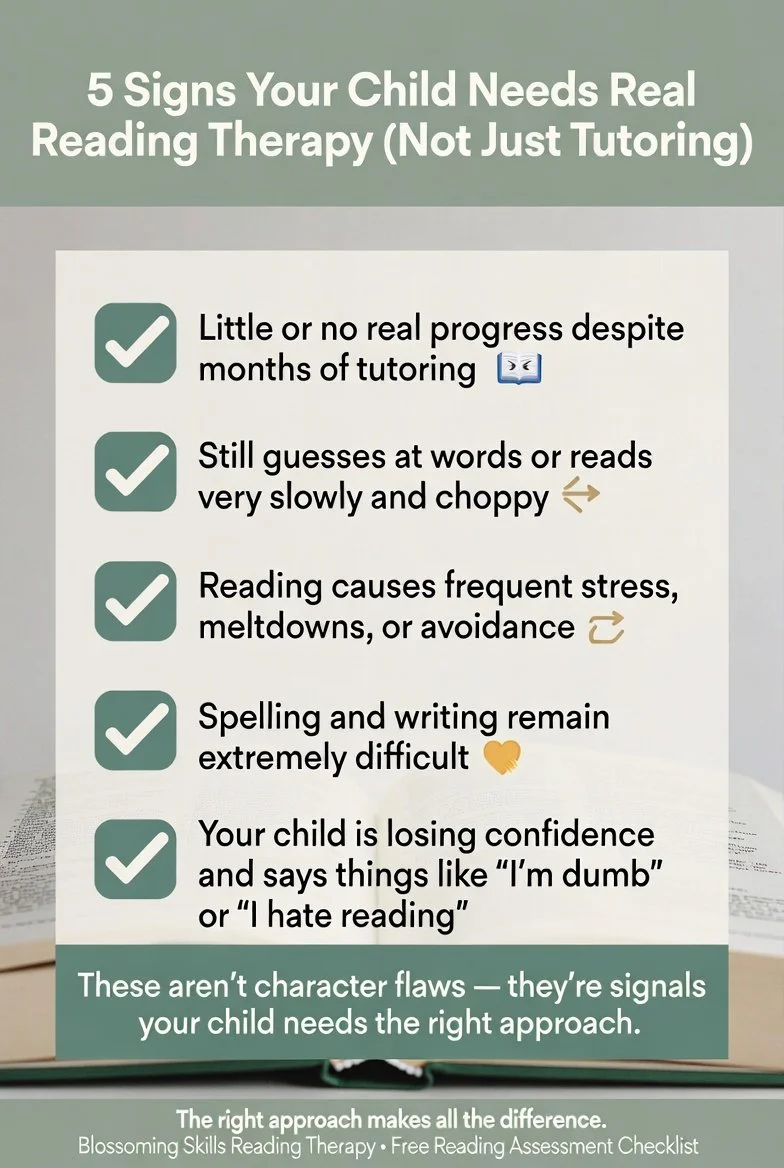
Signs your child needs a different approach
If your child has had tutoring but still:
guesses frequently
reads slowly and laboriously
avoids reading
struggles with fluency
can decode in practice but falls apart in real reading
has done OG tutoring for years without becoming fluent
…it may be time for a different plan.
It’s not too late (even if your child is older)
I work with children ages 7 and up, including many who have struggled for years.
When the right approach is used, I often see:
increased confidence within weeks
measurable gains within months
and real changes in fluency and accuracy
Reading doesn’t have to take years to improve.
What to do next
If you’re feeling stuck, here’s what I recommend:
Stop blaming yourself or your child
Look deeper than surface-level tutoring
Get clarity on what’s actually missing
If you’d like help understanding why reading still isn’t clicking for your child, I offer a free Reading Breakthrough Call.
On this call, we’ll talk through:
what your child is struggling with
what you’ve already tried
and whether my 1:1 online reading therapy program is the right fit
If it’s not, I’ll tell you honestly.
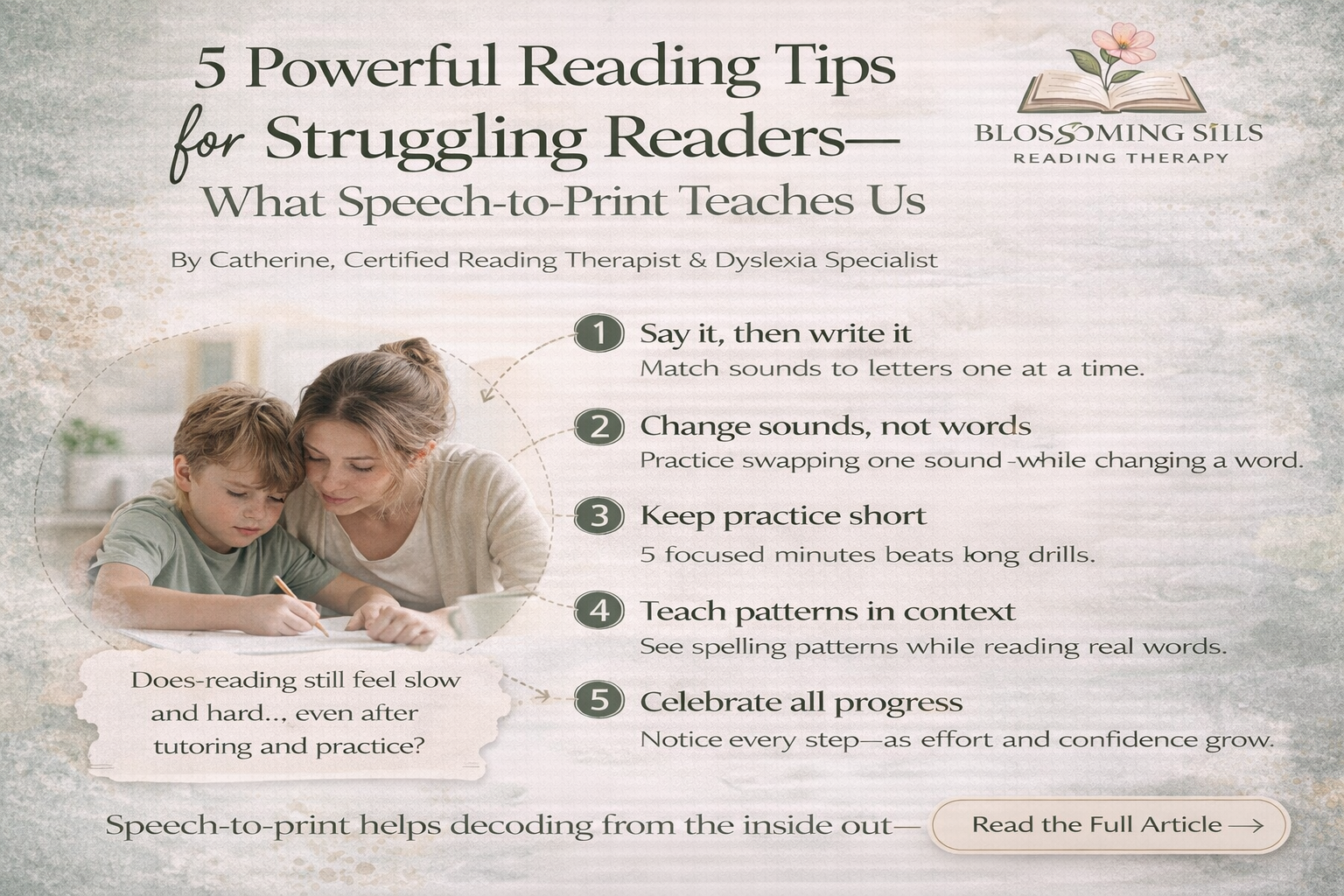
5 Powerful Reading Tips for Struggling Readers—What Speech-to-Print Teaches Us
Looking for effective reading tips for struggling readers? If your child works hard but reading still doesn’t stick, speech-to-print instruction may be the missing piece. Unlike rule-heavy phonics programs, speech-to-print builds reading from spoken language first — strengthening phonemic awareness, sound-to-letter mapping, blending, and automatic word recognition. In this article, you’ll discover 5 research-based reading strategies you can use at home to help your child build fluency, confidence, and lasting decoding skills.
By Catherine, Certified Reading Therapist & Dyslexia Specialist
[Blossoming Skills Reading Therapy]
Does your child work so hard at reading… but nothing seems to stick?
If you’re a parent searching for real, research-backed ways to help your struggling reader, you’re not alone. I’ve spent the last 20+ years working with students who’ve tried everything—tutoring, apps, school intervention—yet still feel “stuck.”
What changed everything?
Speech-to-print reading therapy (sometimes called linguistic phonics).
What Is Speech-to-Print—and Why Does It Help?
Traditional reading programs often start with letters and rules, then expect kids to “sound out” words.
But the speech-to-print approach flips the script:
We begin with spoken language—what your child already knows—and gradually connect it to print.
This method is especially powerful for struggling readers and kids with dyslexia, because it builds reading from the inside out.
Here are 5 practical speech-to-print reading tips you can use at home to help your child become a more confident, accurate reader:
1. Practice “Say It, Then Write It” (Not Just “Sound It Out”)
Most struggling readers get stuck trying to remember rules or letter patterns.
Instead, try this:
Say a simple word out loud (“map”).
Ask your child: “What sounds do you hear?” (/m/ /a/ /p/)
Then together, write each sound as a letter.
This builds the crucial skill of matching speech to print, one sound at a time.
2. Focus on Changing Sounds, Not Memorizing Words
Research shows that strong readers can change one sound at a time in a word (example: “cat” → change /k/ to /h/ = “hat”).
Try quick “swap it” games:
“Say ‘sand.’ Now change the /s/ to /h/—what’s the new word?”
This builds phonemic awareness—the foundation for all decoding, and a core part of speech-to-print and linguistic phonics.
3. Use Short, Repeated Practice Instead of Long Drills
Kids with reading challenges tire quickly.
5 minutes of focused “sound swapping” or “blend and read” each day is far more effective than 30 minutes of frustration.
Try “blending slides”: Write three letters (e.g., c-a-t), point to each, and have your child blend them together smoothly.
4. Teach Patterns in Context, Not Isolation
Speech-to-print methods teach spelling patterns as they naturally appear in real words.
Instead of memorizing a list, read short stories or sentences with target patterns (like “sh,” “ch,” or “oa”).
Underline or highlight the patterns as you read together.
This helps your child see—and hear—how sounds connect to letters in real reading.
5. Celebrate Progress—Big AND Small
Reading progress isn’t always linear.
Celebrate every new word, every smoother blend, every time your child tries, even if it’s hard.
Confidence grows when children feel safe to make mistakes—and know someone notices their effort.
When to Seek Extra Support
If you’ve tried these tips and your child is still struggling, don’t lose hope.
Speech-to-print reading therapy is specifically designed for kids who need a different, brain-based approach.
Ready for clarity?
Download my free Reading Root-Cause Checklist or book a free Reading Clarity Call to talk through your child’s needs and get a personalized plan.
You’re Not Alone
Hundreds of local families have already discovered that the right approach makes all the difference.
With the right support, your child can move from guessing and frustration to real confidence and progress.
If you have a question, feel free to email me directly at catherine@blossomingskillsreadingtherapy.net.
Why My Reading Therapy Program Works When Tutoring and Curriculums Haven’t
Your bright child has been through tutoring, new curriculums, and every phonics program you could find — yet reading is still slow, frustrating, and full of guessing.
You’re not failing… and they’re not lazy.
In this post I explain exactly why regular tutoring and school curriculums often fall short for kids with dyslexia or ADHD, and how my speech-to-print Reading Therapy program finally rebuilds confident reading skills from the ground up — with real results in as little as 12 weeks and our 12-Week Progress Promise.
Many families start seeing wins right away with my Phonics Packs, then move into full therapy for lasting change.
Download your Free Reading Assessment Checklist and book a no-pressure Breakthrough Call today. Let’s get your child blossoming. 💚
If you’re reading this, I already know your heart is heavy.
Your bright, hardworking child has been through school reading interventions, new curricula, sight-word drills, phonics workbooks, and maybe even private tutoring — sometimes all of the above. Yet every night homework still ends in tears, books are avoided, and you hear the same heartbreaking question:
“Why isn’t this working?”
You’re not failing. Your child isn’t lazy. And it’s not that they’ve had “too little” help.
The truth is they haven’t had the right kind of help for the way their brain actually learns — especially if dyslexia, ADHD, or another learning difference is part of the picture.
I’ve been exactly where you are. As a former special education teacher and a mom whose own daughter struggled for years, I watched the same cycle play out with hundreds of families… until I switched to speech-to-print structured literacy. That one change turned everything around.
In this post I’ll show you exactly why traditional tutoring and standard curriculums often fall short — and how my 1:1 Reading Therapy program finally creates the automatic, confident reading your child deserves.
Why “More of the Same” Doesn’t Work
Today’s tutors and curricula usually include phonics rules, sight-word lists, mastery checks, leveled readers, and sometimes “OG-inspired” lessons.
On paper it looks solid. Your child may even pass the weekly tests.
But if they still guess at words, read slowly and choppy, or melt down over simple books, something critical is missing.
Most tutoring and school programs are designed to support whatever is already happening in the classroom. They follow the same scope and sequence, repeat the same worksheets, and expect the same kind of practice your child has already struggled with.
That’s not support — that’s repetition of a method that doesn’t match how a dyslexic or neurodivergent brain learns.
The result? Months or years of effort with little lasting change.
Regular Tutoring vs. My Reading Therapy Program
This is the comparison parents tell me they wish they had seen years ago.
Aspect Regular Tutoring / Curriculums My Reading Therapy Program Main Focus Help with current homework & school lessons Rebuild the entire reading system from the ground up Starting Point Follows school or curriculum sequence Diagnostic — starts exactly where your child is Approach Same methods your child has already seen Speech-to-print structured literacy (spoken language first) Methods Phonics rules, sight words, worksheets Explicit, systematic, multisensory with high-repetition practiceIntensity1–2 hours/week of similar practice Therapy-level intensity designed for automaticity ADHD-Friendly Repetitive drills often cause disengagement Short, predictable, engaging routines Parent Support Minimal or none Weekly coaching calls built inGuaranteeNone12-Week Progress Promise (1 full grade level or continue free)
The difference isn’t “more time” — it’s the right approach delivered the right way.
What My Reading Therapy Program Actually Does
Here’s exactly what happens inside my program:
1. A Clear Starting Point We begin with a detailed assessment of phonemic awareness, decoding, spelling, fluency, and comprehension. No more guessing where the breakdown is happening.
2. Speech-to-Print Structured Literacy We start with spoken language (what your child already does beautifully) and carefully build the bridge to print. No overwhelming rule charts or memorization drills.
3. Therapy-Level Practice for the Dyslexic Brain Multisensory lessons with seeing, saying, hearing, and writing — plus the high-repetition practice research shows is essential for automatic word recognition.
4. Real-Life Generalization We don’t stop when your child gets 90% on a worksheet. We keep practicing until the skills show up naturally in real books, schoolwork, and everyday life.
Many families start with a simple win at home using my Phonics Packs from the Blossoming Skills Reading Shop. These instant-download card sets and activity guides use the exact speech-to-print method I teach in therapy — and parents tell me their kids actually ask to use them because they finally feel successful.
What Real Progress Looks Like in 12 Weeks
Here’s what hundreds of families experience:
Weeks 1–4: Guessing drops dramatically. Decoding becomes accurate and confident. Weeks 5–8: Fluency starts to emerge — reading sounds smoother and less exhausting. Weeks 9–12: Automatic word recognition kicks in. Your child begins reading chapter books and regains confidence.
One mom shared: “After years of tutoring with almost no progress, my daughter went from hiding books to reading aloud at bedtime. Her teacher said her focus improved across every subject!”
That’s the power of the 12-Week Progress Promise: measurable growth of at least one full grade level — or we continue working with you at no extra cost.
How This Changes Your Family
Less nightly battles. More confidence (your child finally sees themselves as “a good reader”). Long-term gains that carry into every subject and every school year.
When It’s Time to Move from Tutoring to Therapy
You may be ready if:
Your child has had help before but still avoids reading or tires quickly
They can “pass” phonics tests but the skills never show up in real books
Dyslexia, ADHD, or another learning difference has been mentioned
If this sounds like your child, they don’t need “more of the same.” They need the right kind of help.
Ready for Real Change?
You don’t have to keep watching your child struggle.
Download your Free Reading Assessment Checklist right now and book a no-pressure Breakthrough Call. In just 15 minutes we’ll map out exactly what’s holding your child back and the fastest path forward — whether that starts with the Phonics Packs or jumps straight into full Reading Therapy.
Your child’s reading story is about to change — and I’d be honored to walk beside you.
Frequently Asked Questions
What if my child has already tried Orton-Gillingham? Many families come from OG-based tutoring. My program uses structured literacy too — but delivered as true therapy with speech-to-print methods and weekly parent coaching that makes the difference.
Can I try something before committing to full therapy? Yes! Many families start with my Phonics Packs for quick at-home wins using the exact same approach.
How long until we see progress? Most families notice easier decoding and less frustration within 4–6 weeks; measurable grade-level growth by week 12.
Is this only for severe dyslexia? No — it works beautifully for any struggling reader, including mild cases, ADHD overlap, or kids who just “never clicked” with school methods.
Does Teaching Letter Names First Hurt Struggling Readers?
Why “A-B-C” Can Cause Confusion — and What to Teach Instead
If your child knows the alphabet song but still can’t read cat, you’re not alone.
A lot of bright kids memorize letter names early… and then hit a wall when decoding begins.
Parents often ask:
“Should my child learn letter names first?”
“Could that be why they keep guessing?”
“Why do they say /wuh/ for W or /yuh/ for Y?”
Let’s break it down in a way that’s simple, brain-based, and backed by research.
The Short Answer
Teaching letter names by themselves — especially before children are ready for sounds — can create real confusion for struggling readers.
The research shows:
letter names can confuse early learners because the name often contains extra sounds or doesn’t match the sound at all. NAEYC+1
letter-sound knowledge is a stronger predictor of reading growth than letter-name knowledge. JSTOR+1
the most effective instruction is teaching sounds clearly and explicitly, and pairing names only when helpful, not making names the main goal. Reading Rockets+1
So the problem isn’t that letter names exist.
It’s that kids are often taught to think in names instead of sounds.
Why Letter Names Can Cause More Harm Than Help (Especially for Struggling Readers)
1. Letter names add “extra sounds”
Take the letter H.
Its name is “aitch.”
But the sound in words is /h/.
For many kids, that mismatch creates errors like:
reading hat as “aitch-a-tuh”
spelling ship with an extra ch sound
saying “church” when they see “hrch” because they hear “ch” in the name of H
This exact confusion is documented in early literacy research. NAEYC
2. Some letter names don’t give the sound at all
Examples:
W = “double-you” → no /w/ in the name
Y = “why” → doesn’t clearly represent /y/ or /i/
H, J, Q → names don’t map cleanly to their sounds
Research shows children learn sounds less easily for letters whose names don’t contain their sounds. SpringerLink
3. Struggling readers cling to what feels “known”
When a child has been praised for alphabet mastery, they may think:
“Reading = saying letter names.”
So when decoding starts, they default to names because it feels safe and familiar — even though names don’t build words.
That’s why you hear:
“cuh-ay-tuh” instead of /k/ /a/ /t/
“bee-ay-tee” instead of blending bat
guessing at words because the names don’t lead anywhere useful
What the Research Actually Says (Simple version)
Letter sounds matter more for reading than letter names
Multiple studies show that letter-sound knowledge predicts word reading more strongly than letter-name knowledge. JSTOR+1
That means kids who know sounds well tend to become readers faster — even if letter names are shaky.
Letter names can help only when kids can isolate the sound inside the name
For example, the letter name B (“bee”) contains the /b/ sound at the beginning.
If a child has phonemic awareness, they can use the name to support the sound.
But if they can’t isolate sounds yet, the letter name becomes noise, not help. earlyliteracyci5823.pbworks.com+1
Teaching names and sounds together can be fine — if sounds stay primary
There is evidence that teaching both together can work well when instruction is explicit and sound-focused. Reading Universe+1
So again, the issue is not that names exist.
It’s the order and emphasis.
Speech-to-Print Perspective: What Kids Need First
In speech-to-print, reading starts with:
Hearing the sounds in spoken words
Mapping those sounds to letters
Blending the sounds into words
That requires sounds, not names.
Sounds-first instruction looks like:
“This is /m/.”
“These letters represent /m/.”
“Let’s build map: /m/ /a/ /p/.”
Names can come later as labels — after the sound-to-print connection is solid.
Real-Life Examples of Letter-Name Confusion
Here are common patterns I see in therapy:
Example A: The “alphabet reader”
Child sees sat and says:
“ess-ay-tee”
They aren’t being lazy.
They’re using the only strategy they’ve been trained to use.
Example B: The “extra sound speller”
Child spells jump like:
“juh-uh-em-pee”
Because they’re thinking:
J = “jay” (has an /a/ sound)
M = “em” (starts with /e/)
P = “pee” (ends with /ee/)
They’re spelling the names, not the word.
Example C: The “W problem”
Child writes double-you when asked for W
or says “double-you” instead of /w/.
That’s not a memory issue — it’s a mapping issue.
What You Should Do Instead (Simple Plan)
Step 1: Teach sounds clearly and consistently
Use one sound per letter to start.
No extra “uh” (say /m/ not “muh”).
Step 2: Blend early and often
Kids should start blending as soon as they know a handful of sounds, not after they memorize all names.
Step 3: Add names later as labels
Once blending is easy, letter names become harmless background knowledge.
FAQ Parents Always Ask
“But schools teach letter names first… won’t my child be behind?”
No.
Names are a label system.
Reading is a sound-to-print system.
If your child can read, spell, and map sounds to letters, they’re ahead where it matters.
“Should I stop teaching names altogether?”
Not necessarily.
Just don’t make names the foundation.
Think of names like shoe sizes — useful labels, but they don’t teach you how to walk.
Bottom Line
If your child is a struggling reader, sounds and blending must come first.
Letter names aren’t evil.
But teaching them early as the main goal can:
slow decoding
reinforce guessing
create spelling confusion
and make reading feel harder than it needs to be
When you flip the process to speech-to-print, reading becomes logical again.
Want the simple monthly plan for this?
That’s exactly what I teach inside the Reading Clarity Membership —
clear root-cause guidance + done-for-you toolkits + live coaching.
You don’t have to guess anymore.
www.blossomingskillsreadingtherapy.net/reading-clarity-membership

Why Spelling Is Harder Than Reading and How Speech-to-Print Makes It Stick
If your child passes the Friday spelling test only to forget every word by Monday, visual memorization isn't working. Learn how a step-by-step speech-to-print spelling block uses orthographic mapping to help struggling readers store words in long-term memory permanently
Your child may be reading words they still cannot spell.
That can be confusing for parents.
They may read a word correctly in a book, then spell the same word incorrectly five minutes later.
They may spell the same word three different ways on one page.
They may study a spelling list all week, do well on Friday, then seem to forget the words almost immediately.
This does not mean they are lazy, careless, or not trying.
Spelling is simply a more complex skill than reading.
When a child reads, the print is already there. They look at the letters and connect them to the word they know.
When a child spells, they have to do the reverse.
They must start with spoken language, identify every sound, hold those sounds in order, retrieve the correct spelling patterns, and write the word without seeing it first.
That requires much more from the brain.
For many struggling readers and students with dyslexia, spelling remains difficult even after reading begins to improve.
The answer is usually not more copying.
It is better sound-to-print mapping.
Why Spelling Can Stay Weak Even When Reading Improves
Reading and spelling develop together, but they do not always develop at the same rate.
A child may begin to recognize a word while reading long before they can produce that word accurately in writing.
For example, a child may read:
train
but spell it:
tran
trin
or
trane
They may recognize the word when they see it, but they have not yet stored the spelling strongly enough to retrieve it independently.
That is an important difference.
Reading asks:
Can you recognize this word?
Spelling asks:
Can you build this word from speech?
Spelling requires stronger recall.
It also requires the child to know that one sound can be represented by different spelling patterns.
The long /a/ sound, for example, may be spelled:
a
ai
ay
a_e
and other ways depending on the word.
The child has to hear the sound and choose the correct pattern.
That is one reason spelling often takes longer to become automatic.
Why Traditional Spelling Practice Often Does Not Stick
Many spelling routines are based on memorization.
Children may be asked to:
copy each word several times
write words in alphabetical order
use each word in a sentence
study a list visually
cover the word and try to remember what it looked like
memorize ten or twenty unrelated words for a weekly test
A child may become very good at studying a list temporarily.
That does not necessarily mean they have learned how the spelling works.
This is why parents often see the same frustrating pattern:
Study. Test. Pass. Forget.
The child may remember the appearance of a word long enough to get through the test, but that memory is not always strong enough to transfer into everyday writing.
For children with dyslexia or weak phonemic awareness, this can be especially frustrating.
The words do not stick because the child has not built a strong connection between the sounds in the word and the spelling patterns that represent them.
What Speech-to-Print Spelling Means
Speech-to-print instruction starts with spoken language.
The child already knows how to say the word.
We use that knowledge as the starting point.
Instead of showing the word first and asking the child to memorize it, we guide them through a process like this:
Say the word.
Listen to the sounds.
Break the word into phonemes.
Map each sound to a spelling pattern.
Write the word.
Read it back and check it.
The child is learning how to build the word rather than memorize the shape of it.
That process is much more useful because it can transfer to unfamiliar words.
What Is Orthographic Mapping?
Orthographic mapping is the process the brain uses to store words for automatic reading and spelling.
A child needs to connect several things together:
the sounds in the word
the letters or spelling patterns
the order of those sounds
the meaning of the word
When those connections become strong, the word becomes easier to recognize and easier to spell.
The child no longer has to reconstruct the word from scratch every time.
This is why spelling is not simply visual memory.
A strong speller is not just remembering what a word looks like.
They have built a detailed sound-to-print representation of that word.
The First Question Is Always: Can the Child Hear the Word Correctly?
Before a child can spell a word, they need to hear the sounds inside it accurately.
Take the word:
ship
A child needs to hear:
/sh/ /i/ /p/
There are three sounds.
There are four letters.
That distinction matters.
If the child cannot identify all three sounds, the spelling will often break down before we even get to letters.
The same thing can happen in words like:
jump
plant
best
float
A child may leave out a sound because they are not hearing it clearly enough.
For example:
jump → jup
plant → pant
best → bet
These errors are useful.
They tell us something about what the child is hearing.
The Speech-to-Print Spelling Block
A strong spelling lesson does not need to be long.
It needs to be targeted.
Here is what a simple speech-to-print spelling block can look like.
Step 1: Say the Word
Start with speech.
Say:
“The word is ship.”
Do not show the word yet.
The child needs to work from spoken language first.
Step 2: Stretch the Word and Hear the Sounds
Ask:
“What sounds do you hear?”
The child says:
/sh/ /i/ /p/
You can also ask:
“How many sounds?”
The answer is three.
This helps the child think in phonemes instead of letters.
Step 3: Map the Sounds to Print
Now connect the sounds to spelling patterns.
/sh/ = sh
/i/ = i
/p/ = p
At this point, the child is building the word from sound.
Step 4: Write the Word
Now the child writes:
ship
They are not copying it.
They are generating it from the sound structure.
That retrieval is important.
Step 5: Read It Back
Ask the child to read the word they wrote.
Then ask:
“Do the spelling patterns match the sounds you heard?”
This teaches the child how to check their own spelling.
Over time, that self-correction becomes an important skill.
Why Error Analysis Matters
One of the most useful things we can do is stop treating every spelling error as simply right or wrong.
Spelling errors tell us where the breakdown is happening.
If a child spells:
ship → sip
they may not yet understand that /sh/ is represented by sh.
If they spell:
boat → bot
they may hear all the sounds correctly but not know the spelling pattern for the long /o/ sound in that word.
If they spell:
jump → jup
they may be dropping the /m/ sound.
If they spell:
running → runing
the issue may involve morphology or spelling conventions rather than basic phonemic awareness.
Different errors require different teaching.
That is why assessment matters.
You need to know what the error means before you decide how to correct it.
Why Spelling Should Not Be Taught as Random Words
Random spelling lists make the child memorize each word as a separate item.
A better approach is to give the brain opportunities to notice and practice meaningful patterns.
For example:
ship
shop
fish
rush
shell
These words help reinforce the sh spelling pattern.
Later, a child may compare words such as:
rain
play
cake
Now they are learning something more complex.
The long /a/ sound can be spelled in different ways.
That is important because English spelling is not one sound equals one letter.
Children need to learn the different ways sounds can be represented.
Spelling Becomes More Complex as Children Get Older
Beginning spelling depends heavily on phonemic awareness and phoneme-grapheme mapping.
But spelling does not stop there.
As words become more complex, children also need to understand:
morphology
prefixes
suffixes
base words
spelling changes when suffixes are added
syllable structure
meaningful word parts
word origins
conventions in written English
For example:
jumped
is not just a string of sounds.
The child needs to recognize:
jump + ed
The same is true for:
helpful = help + ful
unhappy = un + happy
replaying = re + play + ing
This is one reason spelling is more complex than reading.
As children advance, spelling requires them to combine sound, pattern, structure, and meaning.
Why a Child May Spell a Word Correctly Once and Wrong the Next Time
Parents often find this especially frustrating.
A child spells a word correctly in one sentence.
Then three lines later, they spell it incorrectly.
It can look careless.
Often, it is not.
It may mean the spelling has not become automatic yet.
Writing places many demands on the brain at the same time.
The child may be thinking about:
what they want to say
sentence structure
handwriting
punctuation
capitalization
grammar
spelling
When cognitive load increases, a weak spelling representation can fall apart.
The word may be stored well enough to retrieve sometimes, but not consistently.
That inconsistency is a sign that the mapping still needs strengthening.
What Better Spelling Progress Actually Looks Like
Progress is not just getting every word correct.
You may first notice:
fewer random guesses
more complete sound representation
more logical spelling attempts
better self-correction
improved awareness of patterns
fewer omitted sounds
more consistent spelling of familiar words
better transfer into writing
less hesitation
more confidence
A child who once wrote:
jup
may begin writing:
jump
A child who guessed randomly at vowel sounds may start choosing plausible spelling patterns.
A child who used to say:
“I don’t know how to spell anything.”
may start saying:
“I know what sound I hear. I just need to figure out which spelling goes there.”
That is a major shift.
The child is no longer helpless.
They have a process.
A Simple 10-Minute Spelling Routine You Can Use at Home
You do not need a long worksheet.
You do not need to spend thirty minutes copying words.
Try this instead.
Choose one sound or spelling pattern your child is ready to practice.
Pick five to eight words.
Say each word aloud.
Have your child identify the sounds.
Map the sounds to letters or spelling patterns.
Have your child write the word.
Ask them to read it back.
Then use two or three of the words in one sentence.
That is enough.
Short, focused practice done consistently is far more useful than long sessions built around memorization.
What If Spelling Still Is Not Improving?
If spelling is still weak despite regular practice, the question should not automatically be:
“How do we practice more?”
The better question is:
“What skill is missing?”
The child may be struggling with phonemic awareness.
They may hear the sounds correctly but not know enough spelling patterns.
They may know the patterns but struggle to retrieve them.
They may have strong basic spelling but struggle once morphology becomes more complex.
They may spell well in isolation but break down during writing.
Those are different problems.
They need different instruction.
That is why guessing at the next workbook, app, or spelling list often does not solve the problem.
You first need to know where the spelling system is breaking down.
When Reading Is Improving but Spelling Is Still Far Behind
This is one of the most common things I explain to parents.
Reading usually improves before spelling.
That is expected.
Spelling is a more complex skill.
It requires stronger recall, more precise sound analysis, and more detailed knowledge of how English words are built.
So if your child is beginning to read more accurately but spelling is still lagging, that does not necessarily mean the reading instruction is failing.
It may mean the spelling system still needs more time and more direct teaching.
The important question is whether the spelling is also moving in the right direction.
Are errors becoming more logical?
Are sounds being represented more accurately?
Are familiar patterns beginning to stick?
Is the child becoming more independent?
That is the progress we want to see.
If Your Child Has Been Struggling for a Long Time
If your child is still guessing at words, reading slowly, spelling inconsistently, or making very little progress despite intervention, the answer may not be more practice.
The answer may be more precise instruction.
At Blossoming Skills Reading Therapy, we use individualized speech-to-print instruction to identify where the reading and spelling process is breaking down and teach the missing skills directly.
Our 12-Week Reading Therapy Program includes individualized instruction, assessment, parent support, progress monitoring, and targeted intervention based on your child’s specific needs.
Learn more about the 12-Week Reading Therapy Program
You can also see how we measure progress and what growth looks like beyond a single test score here:
If you are not sure where your child’s reading or spelling difficulty begins, a comprehensive literacy assessment can help identify the underlying skills that need attention.
Learn more about the Comprehensive Literacy Skills Assessment
Stop Guessing About Why Spelling Is Not Sticking
If your child can read more than they can spell, that does not mean they are careless.
It does not mean they need to copy the word twenty more times.
It usually means the spelling system is not automatic yet.
The goal is not memorization.
The goal is to help your child hear the word, understand how the sounds are represented, and build a spelling system they can actually use.
Once that starts happening, spelling stops feeling random.
Your child begins to understand what to do.
And that changes everything.
Ready to find out what is keeping your child stuck?
Or start by learning more about our individualized reading therapy:
Explore the 12-Week Reading Therapy Program

Why Does My Child Guess at Words When Reading?
Your child knows many of the sounds and has had phonics instruction, but still guesses at words when reading. Learn why this happens, what it can tell you about where reading is breaking down, and what can help.
Parents tell me this all the time:
“They know the sounds.”
“They’ve learned phonics.”
“But when they read, they still guess.”
A child may look at the first letter and say a word that would make sense. They may change the ending. They may skip a longer word. Sometimes they sound a word out correctly and then say something completely different when they blend it.
When that keeps happening, I want to know why.
Usually, the question is not whether the child has ever been taught phonics. I want to see whether they can actually use the code inside unfamiliar words — accurately, all the way through the word, without depending on context to rescue them.
That is where I get the most useful information.
What Guessing at Words Can Look Like
Guessing does not always look obvious.
Sometimes a child reads most of a sentence correctly, so it can sound like they are doing better than they actually are.
You may hear them:
replace an unfamiliar word with a word they already know
say a word that starts with the same letter
use the picture or sentence to guess what would make sense
read the beginning of the word correctly and change the ending
skip longer words
stop at unfamiliar words and wait for help
sound a word out correctly, then say a different word when they blend it
That is why I pay attention to how a child gets to the word, not just whether they eventually say the right word.
Why Guessing Starts to Take Over
If decoding is slow, uncertain, or inconsistent, guessing can become the quickest way a child knows to keep moving.
And sometimes it works.
If the sentence says, “The dog ran through the…” and the next word starts with g, a child may guess grass from the sentence even if the word is actually garden.
That can make early reading look better than it really is because simple books give children a lot of support.
The vocabulary is familiar.
The sentences are predictable.
There may be pictures.
As reading becomes more advanced, that support starts disappearing.
Science, history, chapter books, and school directions contain words a child may not already know. At that point, context is much less helpful.
They need a reliable way to work through the word itself.
Knowing Sounds Is Only One Part of Reading
A child can know many individual letter sounds and still have trouble reading unfamiliar words.
They have to be able to keep the sounds in the right order, blend them together, read through the entire word, and adjust when a spelling can represent more than one sound.
That is where I often see the breakdown.
A child may say every sound correctly and then change the word when they blend it.
They may read the first syllable and guess the rest.
They may leave off an ending.
They may recognize a familiar word one day and miss it the next.
That tells me the code is not yet automatic enough to use consistently while reading.
Want to see how fixing word-guessing leads to a full grade-level gain in 12 weeks? [See Our 12-Week Assessment Outcomes →]

Phonemic Awareness Matters
Phonemic awareness is the ability to hear and work with the individual sounds in spoken words.
Some children can identify basic sounds but struggle when they have to do more with them.
They may have difficulty removing a sound, changing one sound for another, or holding all of the sounds in order while they blend.
Those weaknesses can show up very clearly in reading.
A child may know what letters usually say but still have trouble keeping the word together from beginning to end.
That is why I look at phonemic awareness separately from phonics.
Advanced Code Is Often Where Some Readers Get Stuck
English uses more than one spelling for many sounds.
The /ē/ sound can appear in:
see, team, me, happy, key
The /ā/ sound can appear in:
make, rain, play, eight, they
A child may know some of those patterns individually but still have trouble recognizing and using them inside unfamiliar words.
This becomes much more noticeable as words get longer and the vocabulary becomes less familiar.
Spelling often shows the same weakness.
A child may hear the word correctly but not know which spelling represents the sounds they hear.
That is why reading and spelling give me different pieces of the same picture.
Why I Use Unfamiliar Words During an Assessment
One of the quickest ways to see how a child is actually reading is to give them words they cannot recognize from memory.
Sometimes I use nonsense words for this reason.
There is no picture to help.
There is no sentence to guess from.
They cannot recognize the word because they have seen it before.
They have to use the code.
That allows me to see:
whether they keep the sounds in the correct order
whether they change sounds when they blend
whether they read through the entire word
how they handle unfamiliar spelling patterns
whether longer words break down
where guessing begins to replace decoding
Those details tell me much more than whether a child has previously completed a phonics program.
More Reading Practice Is Not Always the Answer
If a child keeps guessing, simply asking them to read more does not necessarily change the way they are approaching words.
They may just practice the guessing more.
I want the child to have a way to work through unfamiliar words that they can actually use independently.
That means building stronger connections between the sounds in spoken language and the spellings they see in print.
How Speech-to-Print Approaches the Problem
Speech-to-Print starts with the sounds children already use in spoken language.
We connect a sound to the different ways that sound can be represented in print.
Then we use those spellings repeatedly in reading and spelling.
The child begins to see that different letter patterns can represent the same sound, instead of treating every spelling as a completely separate rule to memorize.
The goal is for the code to become usable.
When a child meets an unfamiliar word, I want them looking all the way through it, working with the sounds and spellings, and making adjustments when necessary.
I do not want them depending on the first letter and hoping the sentence gives them enough clues.
[Internal link: Learn How Speech-to-Print Instruction Works]
What I Want to See Change
I want to see a child:
look through the entire word
keep the sounds in order
blend without changing the word
pay attention to endings
recognize common advanced spellings
work through longer unfamiliar words
rely less and less on guessing
As those skills become more automatic, reading becomes more accurate and much less exhausting.
If Your Child Is Still Guessing, There Is More to Look At
Guessing is usually telling us something.
The next question is where the reading process is breaking down.
Is it phonemic awareness?
Blending?
Advanced code?
Word endings?
Multisyllable words?
Spelling?
Or a combination of several things?
That is what I want to figure out.
Once we know what is getting in the way, instruction can be much more targeted.
[See the 12-Week Reading Program]
[Book a Free Reading Clarity Call]
Related Reading
[My Child Knows the Phonics Rules — So Why Are They Still Guessing at Words?]
Why My Child Still Can’t Read in 4th Grade (Even Though They’re Smart)A Parent’s Guide to Understanding Late Struggling Readers
Wondering why your child isn’t making reading progress? Discover the true reasons behind reading struggles, the science of speech-to-print, and how moms can help children with dyslexia finally thrive—with a free, honest parent guide.
If your child is bright but still struggling to read in 4th grade… you’re not alone.
This is one of the most common concerns I hear from parents:
“My child is so smart… so why can’t they read yet?”
“They can talk about science, history, EVERYTHING — but reading just won’t ‘click.’”
“I feel like I’ve tried everything. What am I missing?”
If you’re asking these questions, I want you to know this first:
There is always a root cause.
And once you understand why your child is struggling, everything becomes clearer — and finally fixable.
4th Grade Is When Reading Struggles Become Impossible to Hide
In early grades, kids can “get by” with:
memorizing sight words
guessing from pictures
memorizing patterns
relying on context
charm, personality, or verbal intelligence
teachers reading aloud
But by 4th grade, everything shifts.
📌 Reading becomes the gateway to all subjects.
No more pictures.
No more short sentences.
No more predictable patterns.
Now reading requires:
decoding
fluency
automaticity
multi-syllable skills
phoneme-grapheme mapping
orthographic processing
Kids who never built these skills early on start to hit a wall — and it can feel sudden and confusing.
But here’s the truth: it’s NOT sudden, and it’s NOT your fault.
Most late reading struggles come from one or more foundational skills that were never fully developed.
These children are not “behind.”
They are not “lazy.”
They are not “not trying.”
And they are definitely not “slow.”
They simply haven’t been taught to read in the way their brain learns best.
The 5 Real Reasons Smart Kids Still Struggle to Read in 4th Grade
1. Phonemic Awareness Gaps
Phonemic awareness is the ability to hear, separate, blend, and manipulate individual sounds in words.
If this skill is weak, reading long words becomes exhausting.
2. Orthographic Processing Weakness
This is how the brain remembers written patterns.
If orthographic processing is weak, kids:
mix up sounds
confuse similar-looking patterns
struggle with spelling
can’t “map” words into long-term memory
These are very common signs in bright 4th graders.
3. Difficulty with Multi-Syllable Decoding
4th grade introduces:
science terms
content-area vocabulary
multi-syllable words everywhere
If a child never mastered syllable division and pattern recognition, reading becomes overwhelming.
4. Slow Automaticity (Fluency)
Even if a child can decode, if it’s slow and effortful, comprehension disappears.
Why?
The brain is too busy trying to read each word to think about meaning.
5. Past Tutoring Focused on Symptoms, Not Root Cause
This is the hard part — and what many parents discover:
Tutoring helps with homework…
Reading therapy fixes the why behind the struggle.
Most tutoring focuses on:
rule memorization
sight words
worksheets
guessing strategies
These don’t build the reading brain.
The Good News: Once You Pinpoint the Real Issue, Progress Happens FAST
With the right approach — one rooted in structured literacy and speech-to-print — children can make massive progress in a short amount of time.
In fact:
95% of students in my 12-week program gain one full year of reading growth.
Because once we target the right skill:
reading becomes easier
confidence returns
frustration drops
comprehension improves
the whole child begins to blossom
Parents often tell me:
“Why didn’t anyone explain this sooner?”
What You Can Do Right Now as a Mom
1. Stop blaming yourself.
Your child’s struggle is not a reflection of your effort or parenting.
2. Understand that your child is NOT behind — they just need the right method.
Speech-to-print, structured-literacy methods work because they build the reading brain from the ground up.
3. Get a Root-Cause Assessment
This is the most important step.
A proper assessment looks at:
phonemic awareness
phonological processing
orthographic processing
decoding & encoding
fluency & automaticity
multi-syllable word skills
This tells us exactly what your child needs — and what will unlock reading progress.
What You Should Avoid (These delay progress)
Memorizing word lists
Guessing strategies
“Look at the picture” cues
Worksheets
Re-reading the same books
Hoping it will “click later”
These approaches often make reading harder, not easier.
There is hope — real, measurable hope.
Your child is smart.
Your child is capable.
Your child can learn to read with clarity and confidence.
They just need a method that matches the way their brain learns.
Want help understanding your child’s root cause?
You can schedule a free Reading Clarity Call below.
Together, we’ll uncover what’s causing the struggle and what your child needs next.
Book a Free Reading Consultation
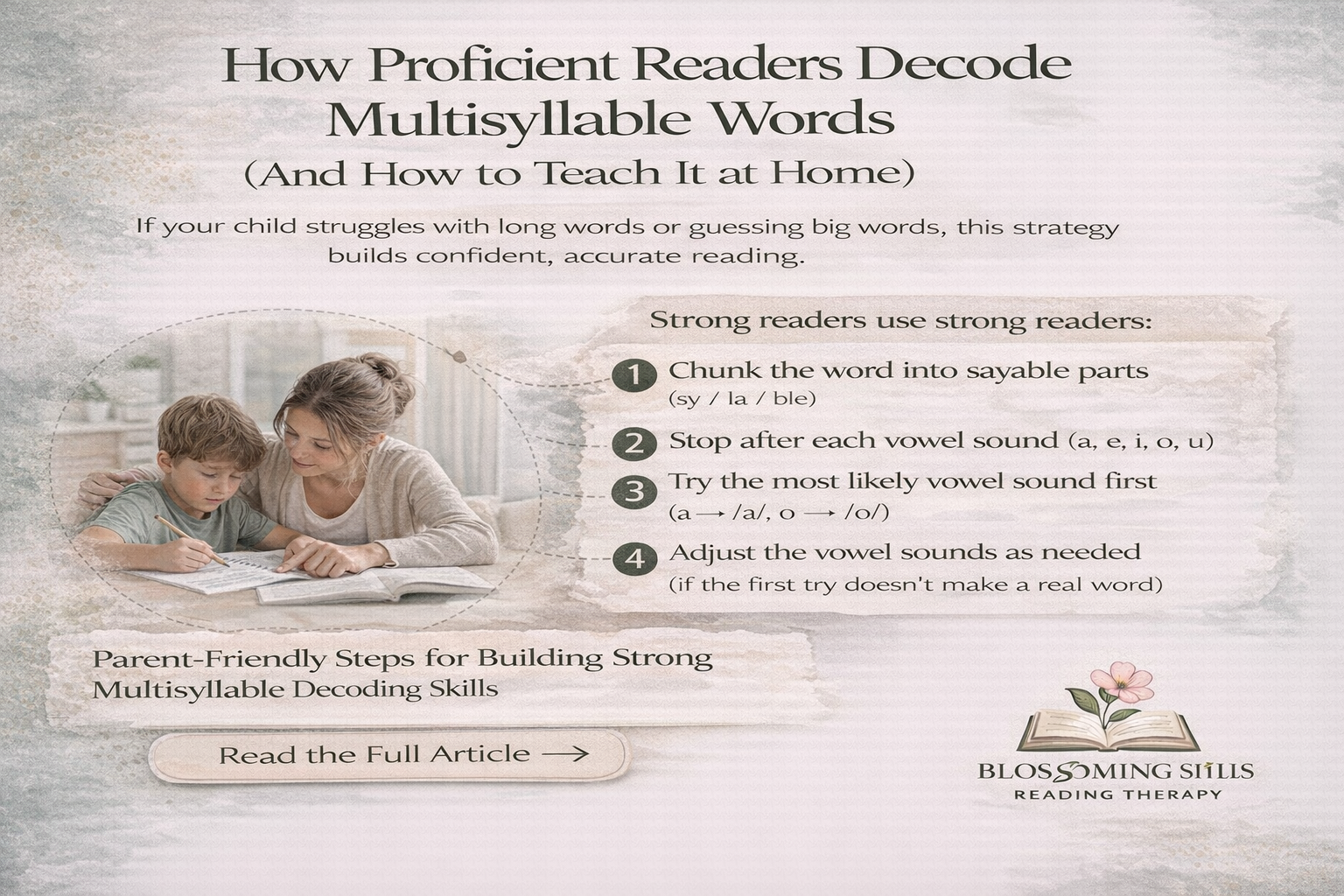
How Proficient Readers Decode Multisyllable Words (And How to Teach It at Home)
Does your child freeze on long words, guess instead of decoding, or shut down when reading multisyllable words? Many struggling readers — especially those with dyslexia — never develop a reliable system for breaking apart and decoding longer words. Proficient readers use a fast, sound-based chunking process that builds automatic word recognition without memorizing complex syllable rules. In this article, you’ll learn exactly how strong readers decode multisyllable words — and how to teach this brain-aligned strategy at home to build fluency, accuracy, and lasting reading confidence.
If your child struggles with long words, freezes on multisyllable words, or guesses instead of decoding, you’re not alone. This is one of the most common reasons parents seek reading help — especially for children with dyslexia patterns or slow reading progress.
The good news is that proficient readers use a reliable decoding process for unfamiliar words, and you can teach that same strategy at home — without relying on complicated rules or syllable labels.
Let’s walk through what strong readers naturally do and how to build that sound-to-print pathway for your struggling reader.
CHECK OUT MY NEW PHONICS PACKS HERE
How Strong Readers Approach Unfamiliar Words
Proficient readers don’t sound out long words letter-by-letter. Instead, their brains do something faster and more systematic:
Chunk the word into sayable parts
Stop after a vowel sound
Try the most likely vowel sound first
Adjust the vowel sound if the word isn’t recognized
Confirm the word by listening for meaning
This is the process the brain uses to decode new words — and it works whether the word is two syllables or five.
Why Multisyllable Words Are Hard for Struggling Readers
Many struggling readers haven’t built a stable sound-to-print system. That means when they hit a bigger word, they don’t have a dependable method to fall back on.
You might see:
slow, choppy decoding
shutting down on long words
guessing based on the first letters
relying on context instead of decoding
weak spelling that doesn’t match reading ability
This is especially common for dyslexic and neurodivergent learners, because their brains need clearer sequencing and stronger phoneme-to-grapheme mapping.
A Real-Life Decoding Example (What a Proficient Reader Does)
Imagine seeing a word you’ve never heard before:
mecrolithin
Even without knowing the meaning, proficient readers usually do this:
1) Find a chunk you can say
You instinctively avoid impossible consonant starters.
You grab a sayable unit like:
me / cro / lith / in
2) Stop after a vowel sound
Each chunk ends right after the vowel sound.
3) Try the most common vowel sound first
me (short e or long e?)
cro (could be “crow” or “crah”)
lith (usually short i)
in (short i)
4) Adjust only the vowels if needed
If it doesn’t sound like a real word, you test another vowel sound:
mee-CRO-lith-in → meh-CRO-lith-in
That’s not guessing.
That’s systematic vowel testing within chunks.
Why This Strategy Works
Reading follows a specific brain pathway:
speech → sounds → letters → words → meaning
Proficient readers start with sounds first, not visual memorization.
They decode from speech-to-print, then confirm meaning once the word is recognized.
That’s why this approach also supports spelling and writing — because it builds a clear internal map of how words are spelled.
Why Common School Methods Often Don’t Help
Many schools teach multisyllable reading using strategies that sound good but don’t match how strong readers decode unfamiliar words:
memorizing syllable types
labeling vowels before reading the word
searching for rules and exceptions
using morphology first
leaning on context to “figure it out”
The problem is simple:
A child can’t use meaning or context until they can say the word accurately.
Without a sound-based method, guessing becomes the fallback.
How to Teach Multisyllable Decoding at Home (Parent-Friendly Steps)
You don’t need a complicated program. You need a clear, repeatable routine.
Step 1: Teach “Stop After the Vowel”
Say:
“Let’s take one chunk. Stop after the vowel sound.”
This trains the brain to grab sayable units instead of panicking at a long word.
Step 2: Try the Most Likely Vowel Sound First
Not a long list of rules — just the first most common sound.
Examples:
a → /a/ then /ae/
o → /o/ then /oe/
ow → /oe/ or /ow/ (grow / how)
Step 3: If It Doesn’t Sound Right, Adjust the Vowel
Say:
“That didn’t sound like a word you know. Let’s try the next vowel sound.”
This keeps your child systematic instead of starting over or guessing.
Step 4: Blend + Check for Recognition
After a full attempt ask:
“Does that sound like a real word you’ve heard before?”
If yes, lock it in.
If not, test another vowel sound and try again.
This Strategy Improves Spelling Too
When kids decode in chunks and test vowels, they aren’t just reading — they’re building spelling automaticity.
This is why sound-to-print decoding helps spelling stick far better than memorizing lists.
If Your Child Is Guessing on Big Words, This Is the Fix
Guessing isn’t a motivation issue.
It’s a strategy gap.
Kids guess when they don’t have a reliable system.
When you teach this sound-based decoding method, guessing fades and confidence grows.
Want the Step-by-Step System for Your Child’s Pattern?
If you’re here because your child has dyslexia or is struggling to read, you’re in the right place. I share practical, research-based strategies that rebuild the reading pathway — without overwhelming rules or guesswork.
For step-by-step dyslexia reading help at home, including monthly toolkits and live coaching, start with the Reading Clarity Membership.
Inside Reading Clarity, I teach parents how to:
chunk multisyllable words without syllable labels
teach vowel sounds in the right order
rebuild the missing sound-to-print pathway
support dyslexic and neurodivergent learners effectively at home
You don’t need more random practice.
You need the right practice in the right order.
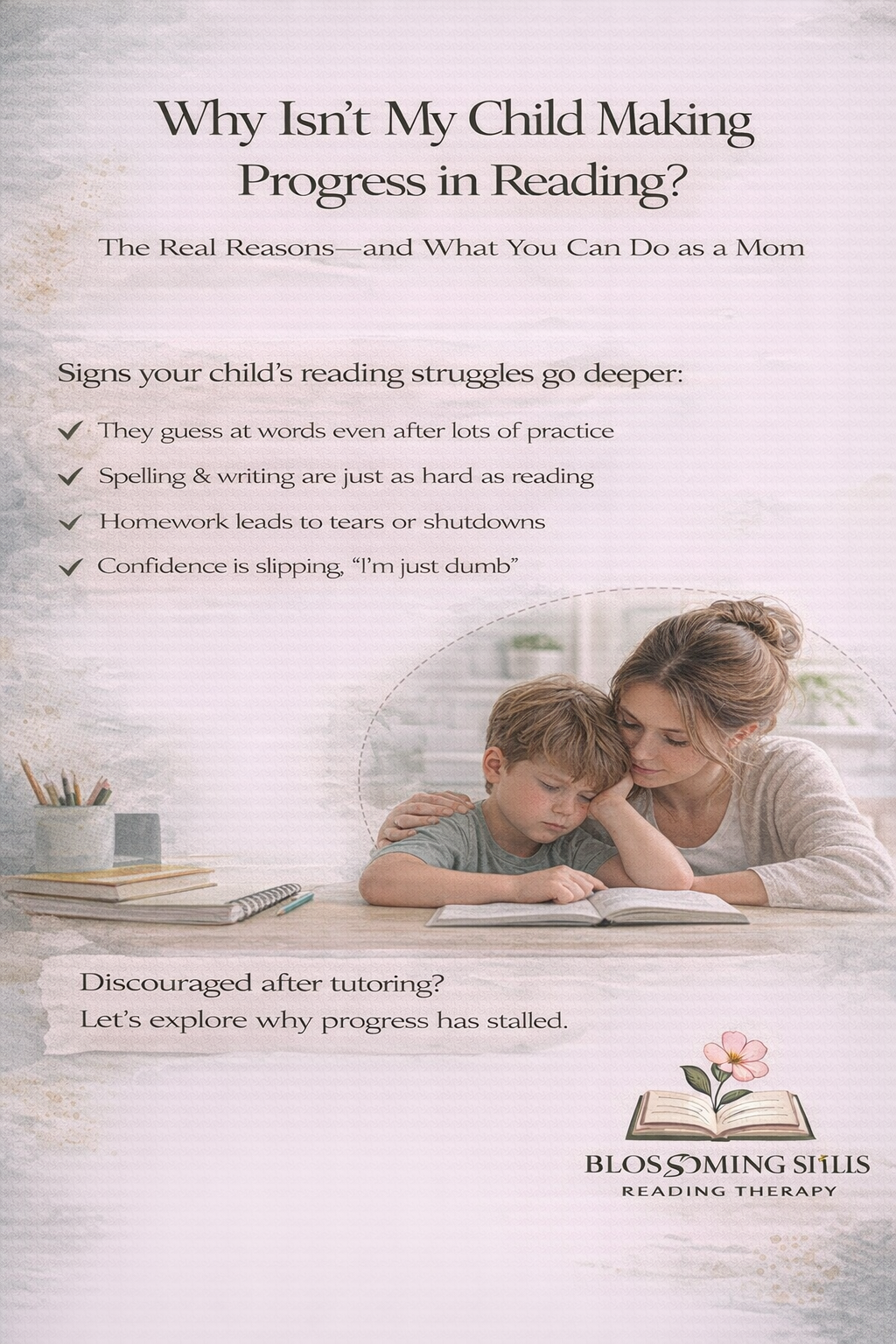
Why Isn’t My Child Making Progress in Reading?
Why isn’t my child making progress in reading—even after tutoring, phonics practice, and extra help at home? If your child is still guessing at words, struggling with spelling, or losing confidence, the issue may not be effort. Many struggling readers and children with dyslexia need sound-to-print instruction that builds real brain connections, not memorization or rule overload. In this article, you’ll discover the hidden reasons reading progress stalls—and what moms can do to help their child build fluent, confident reading skills.
The Real Reasons—and What You Can Do as a Mom
If you’re a mom whose child is still struggling to read, even after months (or years) of tutoring, you’re not alone.
Every week, I talk to parents who have tried everything—flashcards, apps, after-school help—only to watch their child’s confidence sink lower and lower.
So, what’s really going on?
The Hidden Struggles Behind Reading Failure
Dyslexia and reading difficulties aren’t caused by a lack of effort, intelligence, or love at home.
Most struggling readers have a brain that processes language differently—and surface-level tips or more “drill and kill” just don’t work.
Top signs your child’s reading struggles go deeper:
They guess at words or sound them out incorrectly, even after lots of practice
Spelling and writing are just as hard as reading
Homework is a daily battle, with tears or shutdowns
Their confidence is slipping, and they may say things like, “I’m just dumb”
Why Popular Approaches Often Miss the Mark
Many programs (even expensive, well-known ones) focus on memorization or visual tricks—asking kids to memorize sight words, rules, or word shapes.
But research shows that for children with dyslexia, the most effective path is building strong connections between spoken language and print—a method known as “speech-to-print.”
Speech-to-print instruction teaches reading the way the brain naturally learns language:
Start with what your child already knows—spoken words and sounds
Systematically connect those sounds to written letters and patterns
Practice reading and spelling in a way that feels logical, not overwhelming
Real Progress—Not Just More Practice
At Blossoming Skills Reading Therapy, we use a speech-to-print approach that’s backed by brain science and tailored for each child.
Here’s what makes our process different:
Short, focused sessions that respect your child’s mental bandwidth
No overloading of working memory—we avoid overwhelming rules or rote memorization
Personalized support and encouragement for families, not just kids
A real guarantee: Your child will make at least 1 grade level of reading progress in just 12 weeks—or your money back
What Other Moms Are Saying
“My son was significantly behind in reading until we found Catherine. We had tried tutoring before with no progress. I decided to try again and I’m so glad I did!”
—Parent of a Blossoming Skills Student
“She’s not a tutor, she’s a skilled reading therapist with the skills, knowledge, heart, and understanding to teach any child who learns differently, like my son.”
—Homeschool Parent
What Can You Do Next?
If you’re tired of seeing your child work so hard for so little progress, it’s time for a new approach—one that honors both the science and your family’s emotional journey.
Download my free Honest Parent Guide to Dyslexia Programs to see clear, research-backed comparisons of the most popular interventions, real parent stories, and the details of our unique guarantee.
[Download Your Free Guide]
or
Visit: www.blossomingskillsreadingtherapy.net
You don’t have to keep guessing. Real reading progress—and real hope—are possible.
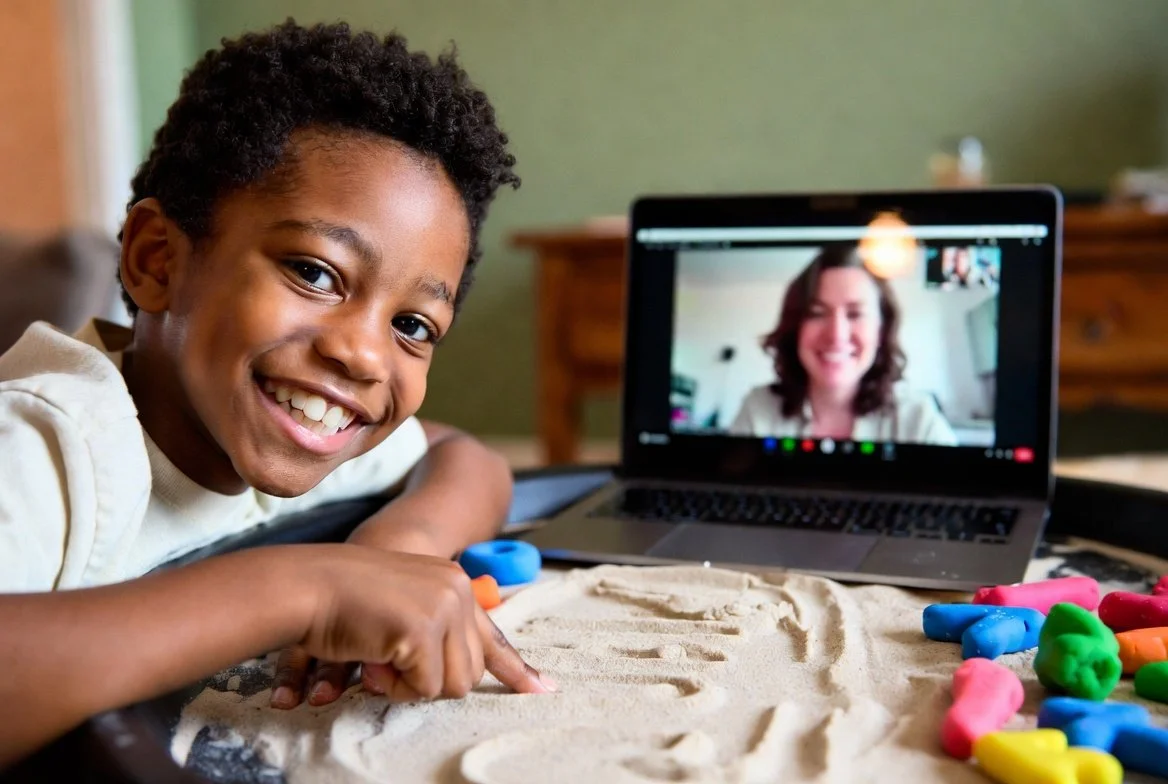
The Overlooked Key to Reading Success: Proper Letter Formation (Why It Matters More Than You Think)
Proper letter formation is often the missing piece when children struggle with reading. Learn why it matters so much and how fixing this one skill can unlock faster reading progress and greater confidence.
If your child is struggling with reading, you’ve probably tried flashcards, apps, tutoring, and extra help at school. But there’s one simple yet powerful skill that’s often completely missed — and fixing it can be the turning point that makes everything else fall into place.
That skill is proper letter formation.
Most parents and even some teachers don’t realize how critical it is. When kids form letters incorrectly, inconsistently, or backwards, it creates confusion in their brain that slows down reading, spelling, and writing for years.
I’m Catherine Mitchell, a certified reading therapist and dyslexia specialist in Fort Worth, Texas. After working with hundreds of struggling readers (including my own daughter), I’ve seen the same pattern over and over again: once we fix letter formation, reading confidence and progress improve dramatically — often within just a few weeks.
Here’s everything you need to know about why letter formation matters so much and exactly what you can do to help your child.
Why Proper Letter Formation Is a Game-Changer
When your child writes a letter, their brain is building three important connections at the same time:
Visual — What the letter looks like
Auditory — What sound it makes
Motor — How their hand moves to form it
If any of these connections are weak or mixed up (like confusing b and d, writing letters from bottom to top, or making letters different sizes), reading becomes much harder.
Research from the International Dyslexia Association and multiple studies on early literacy show that strong letter formation skills in kindergarten and first grade are one of the strongest predictors of later reading success.
Children who struggle with this often stay behind — even if they’re smart and working hard.
Common Signs Your Child Needs Help with Letter Formation
Watch for these red flags:
Frequently mixes up b/d, p/q, m/n, or other similar letters
Writes letters from the bottom up instead of top down
Letters are inconsistent in size or poorly spaced
Slow, messy, or painful handwriting
Avoids writing tasks or gets frustrated quickly
Reverses letters even after age 7
If you see any of these, addressing letter formation now can prevent years of frustration.
How I Teach Letter Formation in My 12-Week Program
In my online reading therapy program, we don’t just practice random letters. We use a structured, multisensory approach that makes the skill stick quickly and permanently:
Air writing with big arm movements (great for muscle memory)
Tracing letters in sand, on textured paper, or with playdough
Saying the sound out loud while forming each letter
Building letters with blocks or Wikki Stix
Connecting letter formation directly to real reading and spelling words
Most children show noticeable improvement in both handwriting and reading fluency within the first 4 weeks. And because we connect it to real reading, the progress carries over into everything else.
Ready to Help Your Child Finally Make Progress?
The first step is simple and free.
Download my Struggling Reader Checklist to see exactly what might be holding your child back (including letter formation red flags).
Then book a free 15-minute Reading Breakthrough Call with me. We’ll talk about your child’s specific struggles and I’ll honestly tell you if my 12-week program is the right fit.
Most parents tell me they wish they had reached out sooner.
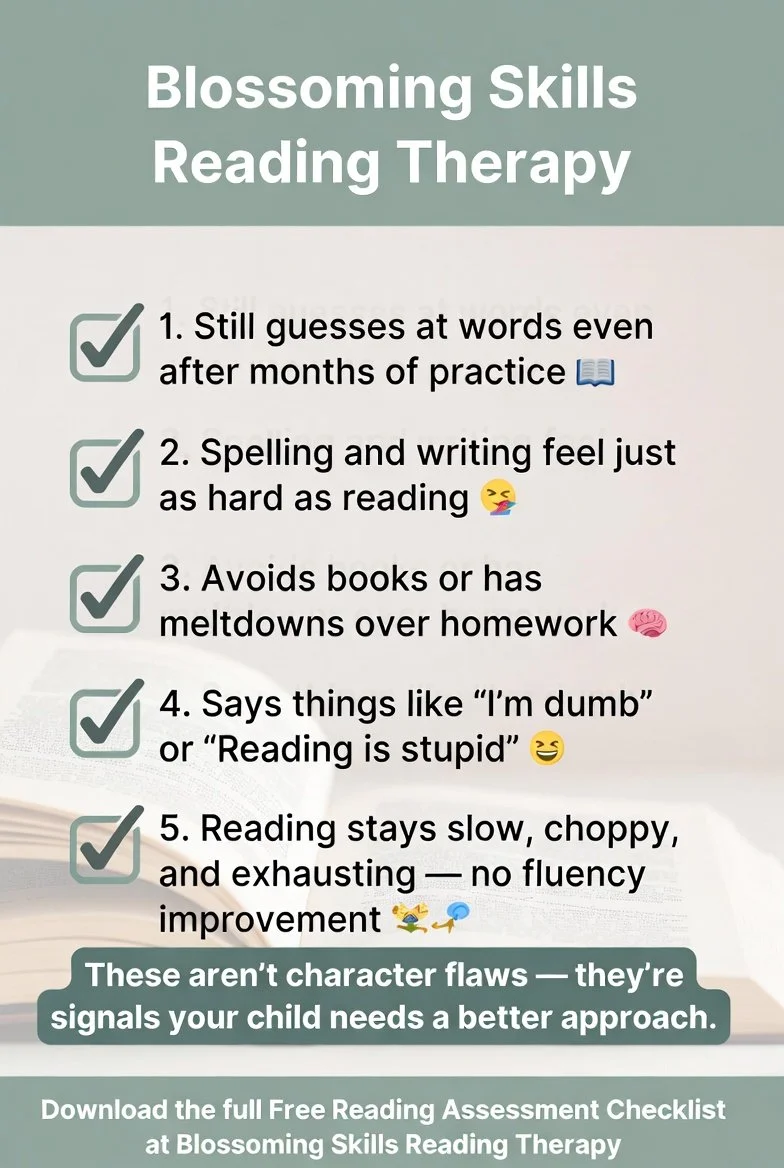
Why Your Child Still Struggles After Orton Gillingham Tutoring
Why is your child still struggling after Orton-Gillingham tutoring? If your child has dyslexia or ongoing reading difficulties despite months or years of structured phonics instruction, you’re not alone. Many struggling readers learn rules but never develop automatic word recognition or fluent decoding in real text. In this article, we explore why Orton-Gillingham doesn’t work for every child — and how speech-to-print, brain-aligned reading instruction can rebuild confidence and lasting reading progress.
If you’re here because your child has dyslexia or is struggling to read, you’re in the right place. I share practical, research-based strategies that rebuild the reading pathway — without overwhelming rules or guesswork.
For step-by-step dyslexia reading help at home, including monthly toolkits and live coaching, start with the Reading Clarity Membership.
You did everything they told you.
You found the program. You paid for the tutor. You followed every suggestion.
But here you are.
Months, maybe even years, later.
And your child still struggles to read.
If that sounds familiar, please know something important:
You’re not alone. And it’s not your fault.
The Method Isn’t Always the Miracle
Orton-Gillingham. It’s a name that comes up again and again. It’s been around for decades. People talk about it like it’s the gold standard.
But what happens when it doesn’t work?
Because for a lot of kids... it doesn’t.
Not completely. Not consistently. Sometimes, not at all.
You may have heard:
“Just give it more time.”
“Every child moves at their own pace.”
“It’s evidence-based.”
But time keeps passing. And your child is still stuck on the basics.
So now what?
Why Doesn’t It Work for Every Kid?
Let’s talk about the method for a second.
Orton-Gillingham focuses heavily on phonics, breaking down words, rules, patterns.
And sure, that works for some learners.
But not all.
Some kids don’t learn best by memorizing dozens of rules with dozens of exceptions.
They don’t need more drills. They need clarity. Something that makes actual sense.
There’s a moment where parents start to notice...
“My child can say the sounds out loud, but they still can’t read the word.”
Or...
“They practiced this all week, but today it’s like they’ve never seen it before.”
It’s not that your child isn’t trying. It’s not that they’re lazy. It’s not that you’re not doing enough at home.
It’s that the approach doesn’t match how their brain learns.
There’s Another Way
Instead of starting with letters and trying to force sounds onto them...
What if we started with spoken language?
That’s what speech-to-print methods do.
Kids already know how to talk. They understand sounds. They use them all day, every day.
So when reading instruction connects to what they already know, the confusion fades.
We stop giving them 10 different spelling rules they can’t remember.
We stop asking them to memorize sight words that don’t follow the rules.
We just teach them how the code works, in a way that’s actually usable.
Why So Many Kids Hit a Wall with Phonics Rules
Some kids can memorize 20 spelling rules and use them just fine. But others? They sit there staring at a word like “enough” or “could,” and nothing about it makes sense. That’s because phonics-heavy systems are often built around patterns and too often, English doesn’t follow those patterns. These kids try to remember the rules, then the exceptions, then the exceptions to the exceptions. And somewhere along the way, they just shut down. It's not because they’re lazy. It's because their brain doesn’t store and recall language that way. That’s why you may see your child read a word correctly one day and totally blank on it the next. They’re not forgetting. They never actually understood it in a way that stuck.
Speech-to-print helps remove that confusion by making the connection between spoken sounds and written letters much more direct. It’s not “memorize and hope”, it’s understand and apply. And that changes everything.
If You’re Feeling Tired, That Makes Sense
Parents don’t get told this stuff. Not in schools. Not in most tutoring centers.
You’re led to believe that Orton-Gillingham is the answer.
And if it’s not working, the problem must be with your child.
But the problem is the method doesn’t work for everyone.
And honestly? That’s okay.
No single program is perfect.
But you deserve to know there’s another option, one that’s simpler, quicker, and yes, often more effective.
The Warning Signs That It’s Not a Fit
If you’re not sure yet, pay attention to these things:
● Is your child making real progress, or just going through the motions?
● Do they dread reading time, even with help?
● Can they sound out words in isolation, but not in a book?
● Are they still guessing at words they’ve seen a hundred times?
If these sound familiar... trust your gut. You don’t need more time in the same system.
You might just need a better fit.
The Hidden Cost of Waiting
One of the hardest things to admit as a parent is that something’s not working. We don’t want to pull our child out of a program everyone else seems to trust. We don’t want to be the difficult one. So we wait. A few more months. Another semester. Maybe next year it will click. But all the while, your child is falling further behind and worse, they’re internalizing the struggle. They start thinking something is wrong with them. That they’re “not smart” or “just bad at reading.” That pain shows up later in school avoidance, low confidence, or even behavior changes.
And here’s the thing: the longer we wait, the harder it is to rebuild that self-trust. Yes, finding a better method takes effort. But staying in the wrong one comes at a cost too, one we don’t always see until it’s already deep. Acting now isn’t just about reading. It’s about preserving how your child sees themselves.
There’s Hope, Really
The most heartbreaking part is seeing how many parents blame themselves.
You wonder:
“Did I wait too long?”
“Should I be doing more at home?”
“Maybe my child just isn’t a reader.”
Please hear this:
You didn’t fail. And your child isn’t broken.
They just haven’t been taught in a way that clicks with their brain yet.
That can change.
Let’s Try Something That Actually Works
You’ve waited long enough.
If the rules and routines haven’t worked, if the flashcards feel endless, if your child is still stuck, you don’t have to keep going in circles.
There’s a better way.
We teach kids in a way that respects how they think, how they speak, how they understand.
And when that happens... things shift.
They stop resisting.
They start reading.
And maybe for the first time, they believe they can do it.
You don’t need years of tutoring. You need the right method.
Let’s talk. Fill out the contact form or send a message. We’re here when you’re ready.
If your budget is tapped out from paying for tutoring that didn't work, don't give up. Our [Summer Internship Program] offers our highly effective Speech-to-Print therapy at a fraction of the cost.
👉 catherine@blossomingskillsreadingtherapy.net