
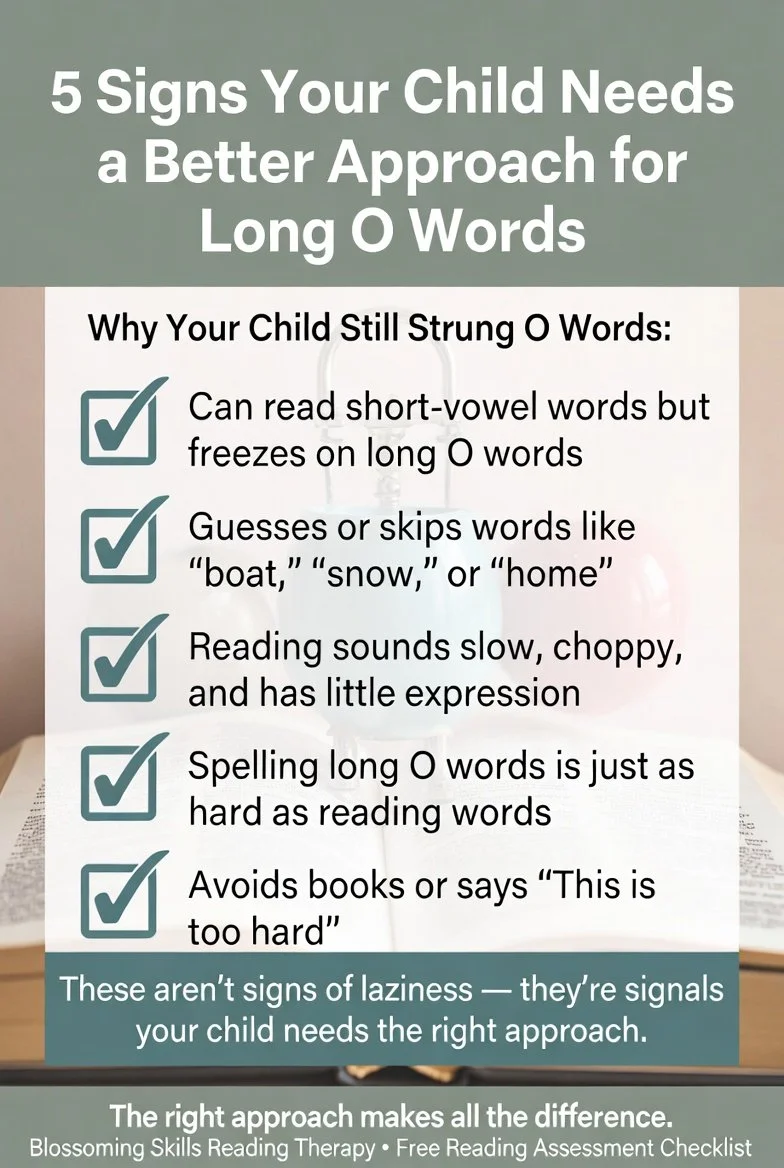
Why Your Child Still Struggles with Long O Words
Your child can sound out simple CVC words like “cat” and “dog”… but completely freezes or guesses on long O words like boat, snow, home, hope, or remote?
You’re not alone — and it’s not because they’re not trying hard enough.
In this post I explain exactly why long O spelling patterns cause so much trouble and how the speech-to-print approach finally builds strong orthographic mapping, automatic recognition, and confident fluency (with real 12-week results).
Plus simple at-home tips and how my Long O Phonics Practice Packet or full Reading Therapy program can help your child blossom fast.
Download your Free Reading Assessment Checklist and book a no-pressure Breakthrough Call today.
If your child can sound out “cat,” “dog,” and “run” pretty well… but completely freezes or guesses when they hit words like “boat,” “snow,” “home,” “toad,” or “go,” you are seeing one of the most common (and frustrating) roadblocks in early reading.
You’ve probably heard “They just need more practice” or “They’ll get it eventually.” But weeks and months go by and those long O words are still tripping them up — making reading slow, choppy, and exhausting.
I’ve been right where you are. As a former special education teacher and a mom whose own daughter struggled with these exact patterns, I watched the same cycle play out with hundreds of families… until I switched to speech-to-print instruction.
In this guide, I’ll show you exactly why long O words are so tricky, why traditional phonics often isn’t enough, and the speech-to-print approach that finally builds automaticity and smooth fluency. You’ll also get simple at-home strategies and learn how my Advanced Code: Long O Phonics Practice Packet and full Reading Therapy program can create real breakthroughs.
Why Long O Words Are Especially Difficult
Long O has more spellings than almost any other vowel sound:
oa → boat, coat, road
ow → snow, blow, grow
o_e → home, bone, rope
oe → toe, Joe, doe
ou → soul, dough (and a few more exceptions)
This is called the advanced code. Short vowels are fairly consistent, but long O forces the brain to sort through multiple possibilities every single time. For a struggling reader — especially one with dyslexia or weak orthographic mapping — that extra mental work is exhausting.
The result? Guessing, skipping words, losing expression, and growing frustration.
The Real Problem: Lack of Strong Orthographic Mapping
Most phonics programs teach kids to “look for the vowel team” or memorize rules. That works okay for some kids… but not for the ones who really struggle.
What actually creates fluent reading is orthographic mapping — the brain’s ability to permanently store a word so it can be recognized instantly without sounding it out every time.
Speech-to-print instruction is far more effective because it starts with the sound your child already knows perfectly (/ō/) and shows them exactly how that sound maps to different letter patterns. This builds the strong brain connections that traditional “print-first” methods often miss.
Traditional Phonics vs. Speech-to-Print for Long O Words
Here’s the difference that actually matters:
AspectTraditional PhonicsSpeech-to-Print ApproachStarting PointShow the letters first (oa, ow, o_e)Start with the spoken sound /ō/MethodMemorize rules and exceptionsBuild sound-to-letter mappingPractice StyleWorksheets and flashcardsMultisensory sound-first activitiesSpeed of AutomaticitySlow — lots of guessingFast — builds permanent word storageFluency OutcomeOften stays choppySmooth, confident reading
This is why your child may “know” the rule but still can’t read the word quickly in a real book.
5 Signs Your Child Needs a Better Approach for Long O Words
They can read short-vowel words but freeze on long O words
They guess or skip words like “boat,” “snow,” or “home”
Reading sounds slow and choppy with little expression
Spelling long O words is just as hard as reading them
They avoid books or say “This is too hard”
These aren’t signs of laziness — they’re signals your child needs the right kind of practice.
Simple Ways to Start Building Fluency at Home
You don’t have to wait for professional help to start making progress. Try these speech-to-print-friendly activities tonight:
Sound-First Word Building — Say the word out loud (“This word is /ō/ /k/ = oak”), then build it with letter tiles.
Vowel Team Sorting — Sort words by sound first, then by spelling.
Word Chains — Change one sound at a time (boat → coat → goat → goal).
Echo Reading — You read a sentence with expression, your child echoes it.
For even faster results, many families start with my Advanced Code: Long O Phonics Practice Packet. It includes everything you need — sound-first word lists, games, sentence practice, and activities designed specifically for the tricky long O patterns. Parents tell me their kids actually ask to use these packs because they finally feel successful.
👉 Shop the Long O Phonics Practice Packet here
What Real Progress Looks Like in 12 Weeks
With consistent speech-to-print practice (either through the Phonics Packs or full therapy), here’s what most families see:
Weeks 1–4: Much less guessing on long O words. Decoding becomes more accurate. Weeks 5–8: Fluency starts improving — reading sounds smoother and more natural. Weeks 9–12: Automatic recognition kicks in. Your child reads long O words in context with confidence and expression.
This is exactly why I offer the 12-Week Progress Promise in my full 1:1 Reading Therapy program: measurable growth of at least one full grade level — or we continue working with you at no extra cost.
Ready for Your Child to Finally Blossom?
If long O words (or other vowel teams) are still holding your child back, they don’t need more of the same. They need the right approach.
Download your Free Reading Assessment Checklist right now and book a no-pressure Breakthrough Call. In just 15 minutes we’ll map out exactly where the breakdown is happening and the fastest path forward — whether that starts with the Long O Phonics Pack or moves into full therapy.
Your child’s reading story is about to change — and I’d be honored to help them blossom.
Frequently Asked Questions
Why are long O words so much harder than short vowels? Long O has multiple spellings (oa, ow, o_e, etc.), so the brain has to sort through more possibilities.
Will my child eventually “get it” with more practice? Not if the method doesn’t match how their brain learns. Speech-to-print builds permanent mapping much faster.
Can I use the Phonics Pack without full therapy? Absolutely! Many families start with the Long O packet for quick wins and add therapy later if needed.
How long until we see real fluency? Most families notice easier decoding within 4–6 weeks and smooth, confident reading by week 12.
Is this only for dyslexia? No — it works beautifully for any struggling reader, including kids with ADHD or those who just never clicked with school phonics.
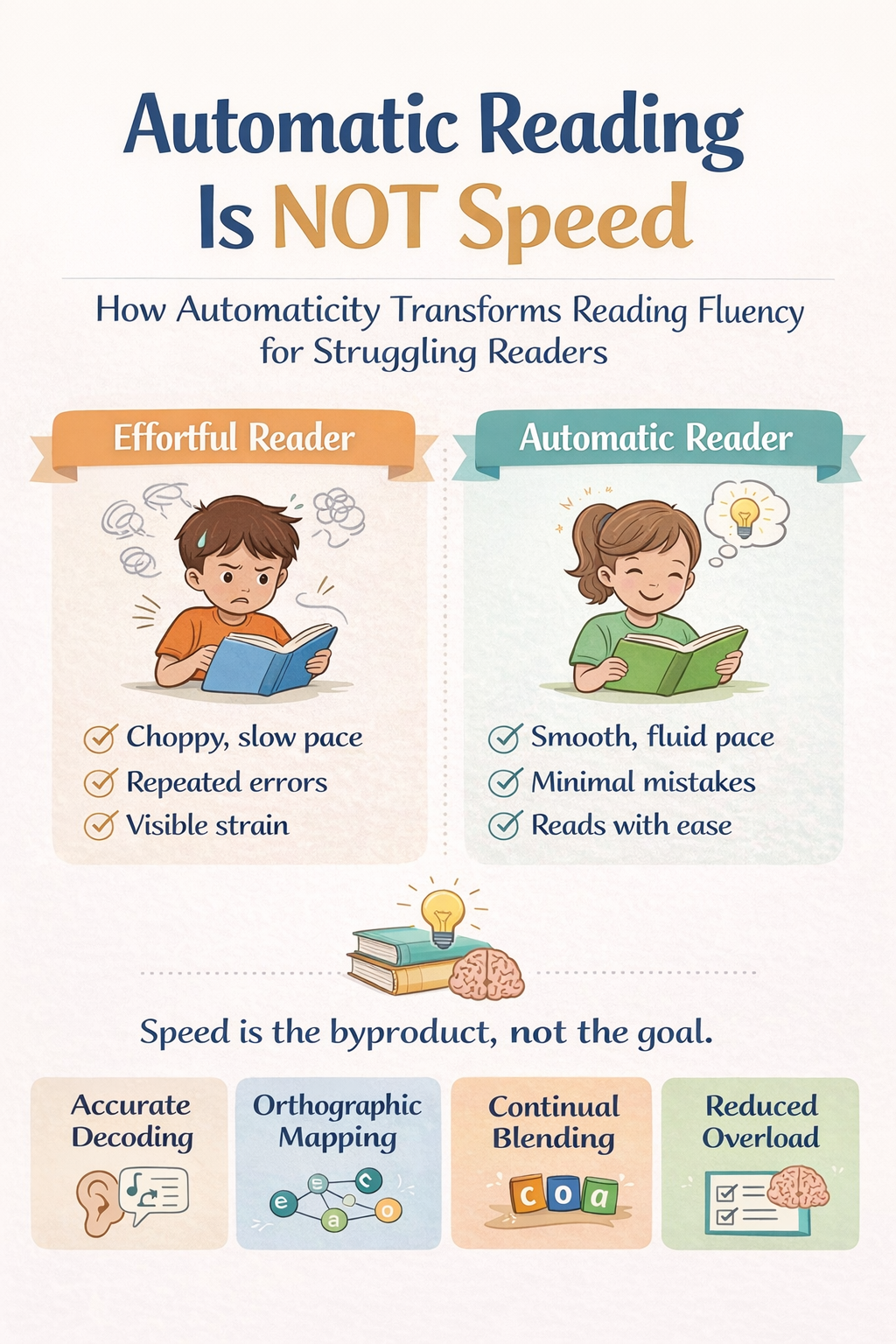
Automatic Reading Is Not Speed(And Why That Distinction Changes Everything)
If your child reads slowly, speed may not be the real issue. Automatic reading depends on orthographic mapping, accurate decoding, and reduced cognitive strain. In this article, you’ll learn why fluency stalls for struggling readers and how building automaticity — not pushing speed — transforms comprehension and confidence.
Many parents tell me:
“She reads so slowly.”
“He needs to read faster.”
“The school says her words per minute are low.”
Speed feels like the problem.
But here’s the truth:
Automatic reading is not speed.
Speed is a byproduct of something deeper.
If we focus only on speed, we miss the real work the brain must do to become a fluent reader.
What Automatic Reading Actually Means
Automatic reading means the brain recognizes words with very little conscious effort.
It includes:
Accurate decoding
Smooth blending
Words stored securely in memory
Minimal mental strain
Stronger comprehension
When reading is automatic, the child is not thinking through every step.
They are not pausing to apply a rule.
They are not guessing.
They are not working through letters one by one with visible effort.
The word simply connects.
And when that happens consistently, speed naturally improves.
Why Speed Alone Is Misleading
Two children can read at the same words-per-minute rate and be having completely different experiences.
One child:
Reads smoothly
Understands what they read
Feels confident
The other:
Strains through every word
Barely remembers the sentence
Feels exhausted afterward
Speed does not tell you how much cognitive energy was required.
And for struggling readers, that energy cost matters.
What’s Really Happening in the Brain
Reading requires the brain to:
Hear and isolate the sounds in a word
Connect those sounds to letters
Blend them smoothly
Store the word in long-term memory
Recognize it automatically next time
If any of those steps are fragile, reading stays effortful.
And when reading is effortful, automaticity doesn’t develop.
Instead, you may see:
Slow, choppy reading
Repeated errors on familiar words
Guessing based on first letters
Avoidance
Fatigue
This is not laziness.
It is load.
The Role of Orthographic Mapping
Automatic reading depends heavily on orthographic mapping.
This is how words become permanently stored in memory.
When orthographic mapping is strong:
The child doesn’t re-decode the same word repeatedly
Words feel familiar instantly
Blending becomes smoother
Reading pace increases naturally
When mapping is incomplete:
Words feel new every time
Reading stays slow
Fluency stalls
Speed drills won’t fix weak mapping.
Foundational skill work will.
Why Fluency Improves When Automaticity Improves
When decoding becomes automatic:
Working memory is freed
Attention can shift to meaning
Comprehension strengthens
Endurance increases
Confidence grows
That’s when reading starts to look fluent.
Not because we forced speed —
but because we reduced strain.
What Actually Builds Automatic Reading
If your child is stuck reading slowly despite knowing phonics, the solution is not “read faster.”
It’s strengthening the system that creates automaticity:
Phonemic awareness
Sound-to-print connections
Continuous blending
Strategic spelling integration
Structured repeated reading
Reduced cognitive overload
When these are in place, automatic reading develops.
And once automatic reading develops, speed follows.
If You’re Watching Your Child Struggle
If reading still feels hard even though your child “knows the rules,” the question isn’t:
“How do we make them faster?”
The better question is:
“Is their reading automatic yet?”
If not, the work is still foundational — not motivational.
And that is fixable.
Next Steps
If you’re unsure whether your child’s reading is automatic or still effortful, you can:
• Download the free Reading Root-Cause Checklist
• Book a free Reading Clarity Call
• Learn more about the 12-Week 1:1 Reading Therapy Program
When reading becomes automatic, everything changes.
Speed.
Confidence.
Comprehension.
Peace at the kitchen table.
Automatic reading is not speed.
It is ease.
And ease can be built.
www.blossomingskillsreadingtherapy.net
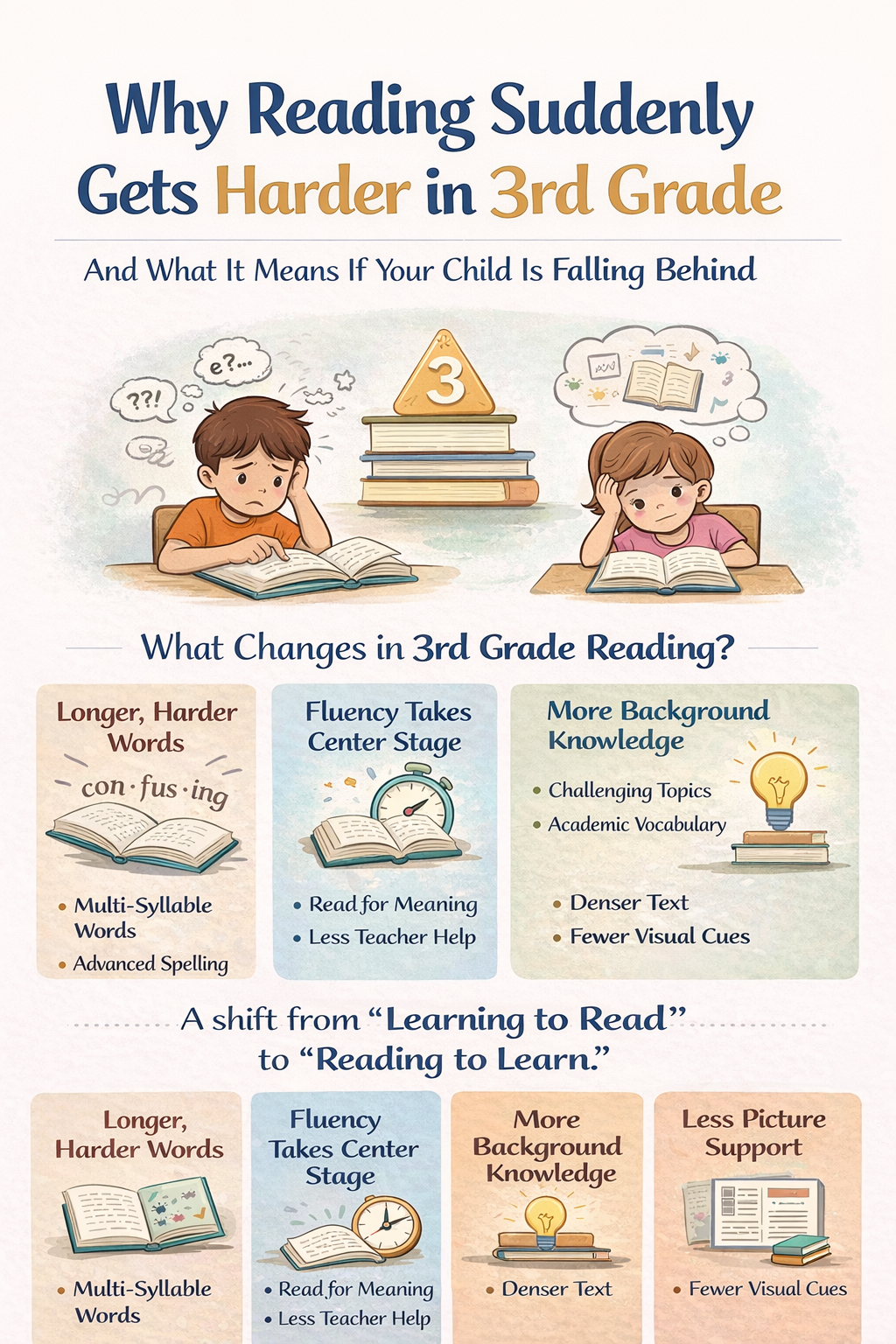
Why Reading Suddenly Gets Harder in 3rd Grade (And What to Do If Your Child Is Falling Behind)
Reading often feels harder in 3rd grade because the demands change. Text becomes longer, vocabulary grows more complex, and fluency becomes essential for comprehension. If your child suddenly seems to be falling behind, the issue may not be motivation — it may be foundational decoding and automaticity gaps that are now being exposed.
Many parents tell me the exact same story:
“My child did okay in 1st and 2nd grade… but 3rd grade hit and everything fell apart.”
Homework that used to take 15 minutes now drags on for an hour. Reading time turns into tears and meltdowns. Your once-confident child starts saying, “I’m just not smart” or “I hate reading.”
If this is your child right now, please know — you are not failing, and your child is not broken. This is incredibly common, and there’s a real reason it happens.
The Big Shift in 3rd Grade
In early grades, kids are “learning to read.” Books are short, pictures help, and teachers give lots of support.
Starting in 3rd grade, everything changes. Kids are now expected to “read to learn.” They have to pull information from longer chapter books, science texts, and social studies with almost no help.
This new stage requires:
Fast, automatic word reading
Strong fluency
The ability to understand and remember what they just read
When those skills have small gaps, reading suddenly feels exhausting and overwhelming.
Why Most Phonics Programs Make It Worse
Here’s something most parents don’t realize:
A lot of traditional reading programs teach kids to memorize phonics rules and all their exceptions, then try to apply them while reading.
This puts a huge load on working memory — and that’s simply not how brains are wired to learn.
When a child has to stop and think about rules on almost every word, there’s almost no brainpower left for actually understanding the story. That’s why so many kids can “know their phonics” but still guess, slow down, or melt down.
The Better Way: Speech-to-Print
My brand new packets use a completely different approach called speech-to-print.
Instead of memorizing confusing rules and exceptions, kids learn to map sounds to letters the natural way the brain actually processes language. This reduces cognitive overload and makes reading start to feel automatic and easy.
You’re Not Too Late
The great news? Most kids who hit this wall catch up quickly once they get the right kind of support.
Ready to Help Your Child Move Forward?
Here are the easiest next steps you can take today:
1. Download my Free Struggling Reader Checklist. Find out exactly what’s holding your child back (takes just 2 minutes)
2. Grab my brand new Long E Packet The perfect starting point for building strong speech-to-print skills (currently on special launch pricing)
3. Book a Free Reading Clarity Call. Let’s talk about your child’s specific situation and make a clear plan
You’ve got this, mama. Your child’s reading story isn’t over — it’s just entering a new chapter, and the right support can make all the difference.
Catherine Mitchell Blossoming Skills Reading Therapy www.blossomingskillsreadingtherapy.net
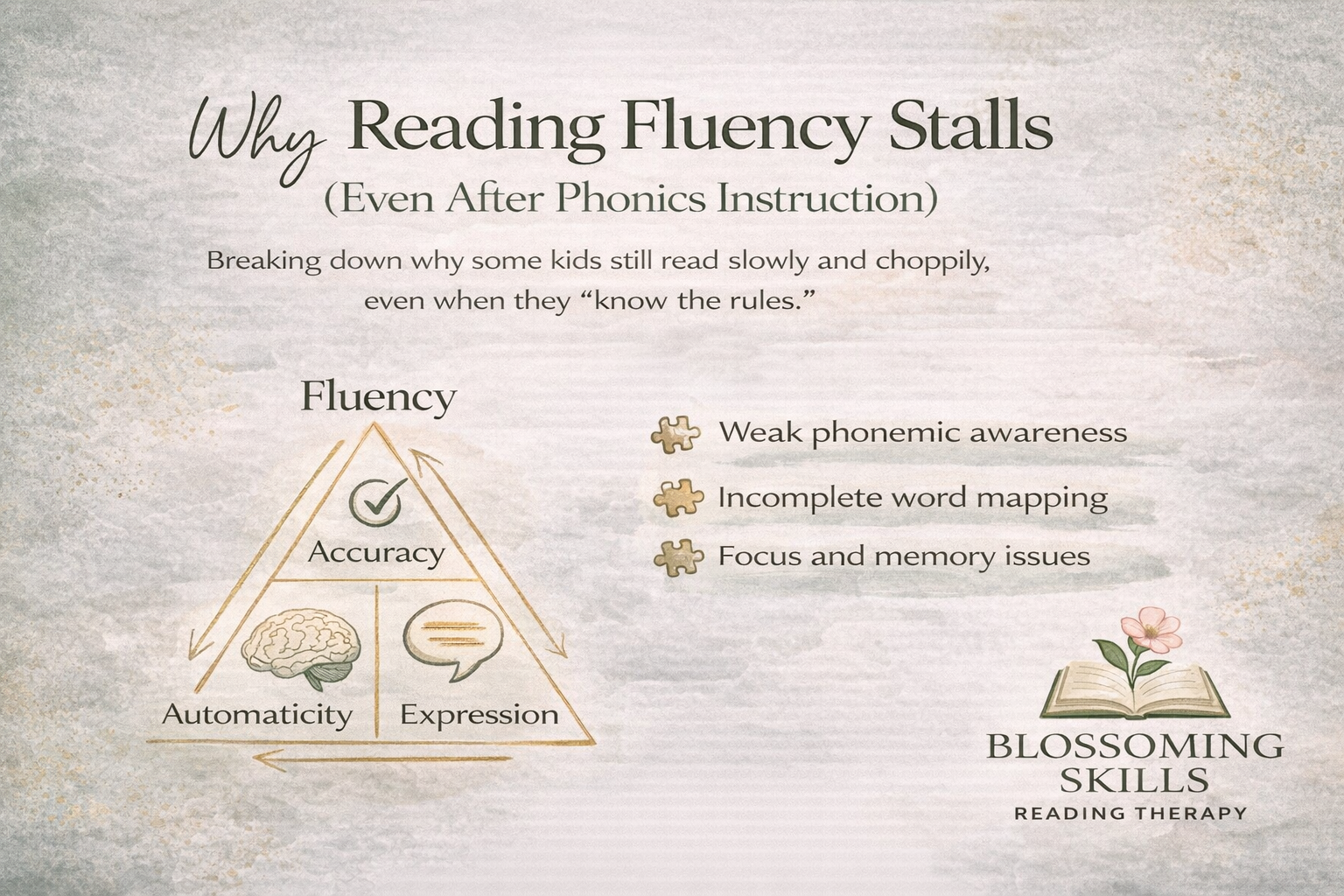
Why Reading Fluency Stalls (Even After Phonics Instruction)
Why is your child still reading slowly even after phonics instruction? If decoding is accurate but fluency hasn’t developed, the problem is rarely “they just need to read more.” Reading fluency stalls when automaticity, phonemic awareness, orthographic mapping, or working memory are fragile. In this article, you’ll learn the real reasons fluency plateaus — and what actually helps struggling readers move from effortful decoding to confident, automatic reading.
If your child can sound out words…
but still reads slowly, choppily, or with little expression…
You’re not imagining it.
Fluency can stall — even after phonics instruction.
And the reason is rarely “they just need to read more.”
Let’s break down what’s really happening.
What Is Reading Fluency — Really?
Fluency is not just speed.
True fluency includes:
Accuracy (reading words correctly)
Automaticity (reading without effortful decoding)
Prosody (natural phrasing and expression)
Cognitive endurance (sustaining attention across text)
Speed is a symptom of automaticity.
When automaticity is fragile, speed never fully develops.
1. Weak Phonemic Awareness (Even If Phonics Was Taught)
A child can be taught phonics patterns and still have shaky phonemic awareness underneath.
If they:
Struggle to quickly segment sounds
Blend slowly
Need extra time to hold sounds in memory
Have difficulty manipulating sounds in words
Then decoding remains effortful.
Effortful decoding means the brain is working too hard at the word level.
When that happens, there’s not enough cognitive space left for smooth reading.
Fluency stalls.
2. Incomplete Orthographic Mapping
Orthographic mapping is how words become permanently stored in long-term memory.
If this process isn’t solid:
Words don’t “stick”
The same word feels new each time
The child decodes it over and over again
This is where spelling matters more than most people realize.
Spelling strengthens the brain’s sound-to-print connections.
When spelling is weak, word recognition stays slow.
Fluency cannot outgrow unstable word storage.
3. Overloaded, Rule-Heavy Instruction
Some reading instruction focuses heavily on:
Memorizing rules
Remembering exceptions
Managing multi-step decoding strategies
Large sight word lists
For children with working memory weaknesses, ADHD, or processing differences, this creates cognitive overload.
Fluency requires freed working memory.
If reading feels procedural — “step one, step two, apply the rule” — it won’t feel automatic.
And automaticity is what drives fluency.
4. Fluency Is Measured… But Not Taught
Many schools measure words per minute.
But measuring is not the same as teaching.
Effective fluency instruction includes:
Guided repeated reading
Modeling prosody
Phrase marking
Accuracy-first rereading
Short passages practiced intensively
Immediate corrective feedback
Without structured practice, fluency rarely improves on its own.
5. ADHD and Working Memory Weakness
This is often overlooked.
If your child:
Loses their place while reading
Stares off during longer passages
Forgets what they just read
Struggles to copy information accurately
This may reflect cognitive load — not effort.
Fluency is fragile when attention and working memory are fragile.
Standardized tests amplify this because they require sustained, single-pass performance with no scaffolding.
That doesn’t mean progress isn’t happening.
It means endurance hasn’t caught up yet.
6. Text That Is Too Difficult
If a child is constantly reading grade-level text independently before automaticity is stable, they will look permanently disfluent.
They need:
Controlled text
Supported ramping
Repeated success
Gradual release
You build fluency by reducing strain — not by increasing pressure.
7. Processing Speed Differences
Some children process language more slowly.
This does not reflect intelligence.
It means automaticity takes longer to consolidate.
When speed is pushed too early, anxiety increases and comprehension drops — which actually slows progress further.
So What Actually Moves Fluency Forward?
Instead of “read more,” effective intervention includes:
Strengthening phonemic awareness
Integrating spelling with reading
Reducing cognitive overload
Structured repeated reading
Modeling expression
Short, focused practice bursts
Accuracy before speed
Fluency improves when decoding becomes effortless.
Effortless reading doesn’t happen through exposure alone.
It happens through intentional, brain-aligned instruction.
If Your Child Can Decode but Isn’t Fluent…
Fluency hasn’t failed.
The system is still integrating.
When the right supports are in place, automaticity builds — and once it does, fluency begins to shift in a noticeable way.
If you’re wondering whether your child’s fluency has stalled — or if something deeper is happening — you don’t have to figure it out alone.
You can learn more about my structured, root-cause reading intervention here:
Or schedule a consultation to discuss your child’s specific profile:
Homepage
Catherine Mitchell
www.blossomingskillsreadingtherapy.net
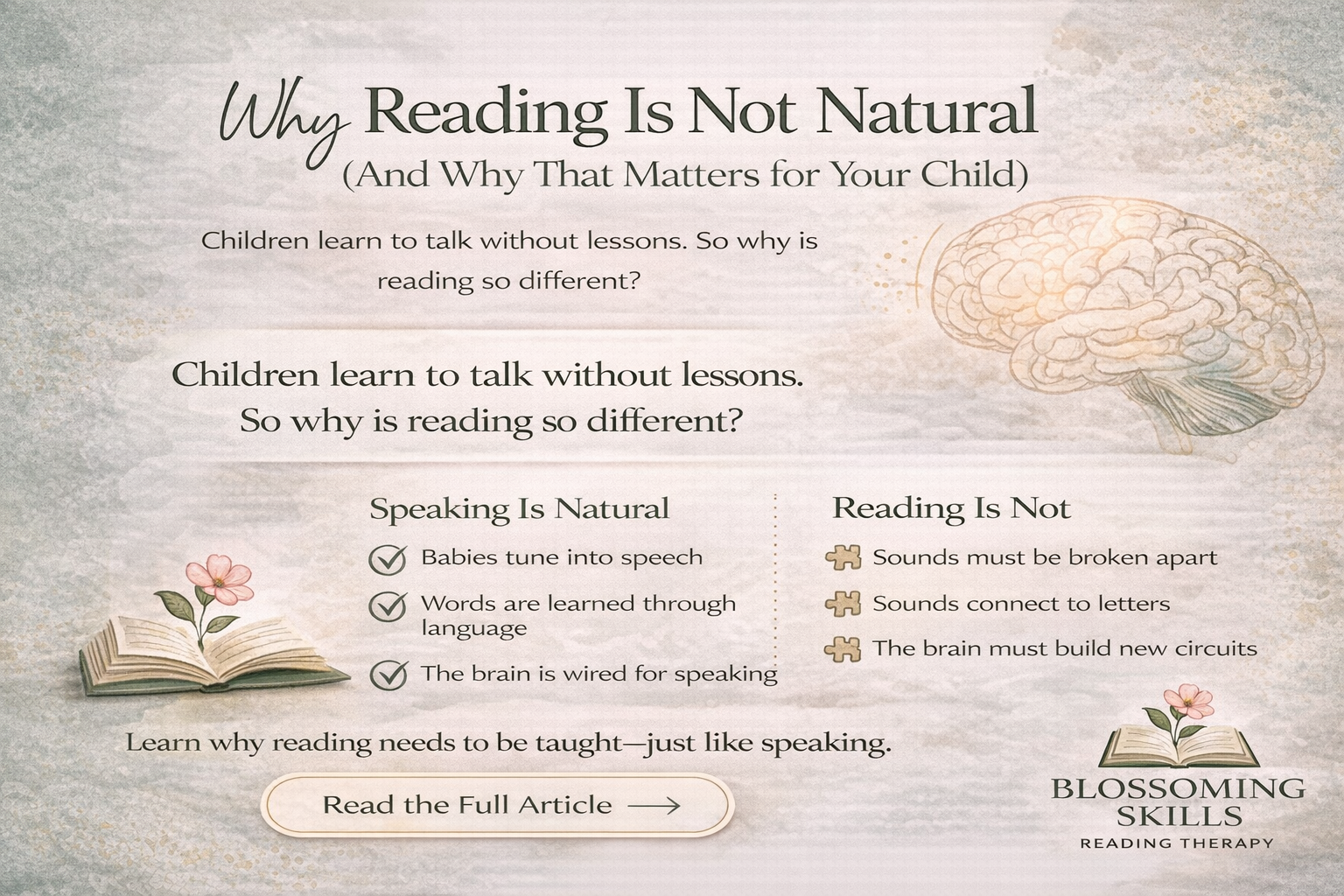
Why Reading Is Not Natural (And Why That Matters for Your Child)
Why isn’t reading natural for many children — especially struggling readers? While speaking develops automatically, reading requires explicit, structured instruction that aligns with how the brain maps sounds to letters. When children are taught through memorization, guessing strategies, or rule-heavy phonics, progress often stalls. Learn why reading must be taught differently — and what brain-aligned instruction actually looks like for dyslexia and reading difficulties.
Many parents assume reading develops the way speaking does.
Children learn to talk without formal instruction. So when reading doesn’t develop easily, it feels confusing.
But here’s the truth:
Reading is not natural.
It must be taught — and taught in a way that aligns with how the brain actually learns language.
Understanding this changes everything.
Speaking Is Natural. Reading Is Not.
Humans are biologically wired for spoken language.
Babies are born with brains prepared to:
hear speech sounds
detect patterns in language
imitate and produce words
build vocabulary naturally through conversation
Reading is different.
Reading requires the brain to:
break spoken words into individual sounds
connect those sounds to letters
blend those sounds back into words
store those words for automatic recognition
The brain must build a new system that does not exist automatically.
What Happens When Reading Is Taught Out of Order
When reading instruction does not match how the brain processes language, students often:
memorize words instead of decoding
guess based on the first letter
rely on picture clues
struggle to remember phonics rules
read slowly and choppily
feel overloaded during reading
This is not a motivation issue.
It is an instructional alignment issue.
Why Phonics Rules Alone Don’t Solve the Problem
Many children are taught reading through phonics rules.
The challenge?
English contains many spelling patterns with multiple exceptions.
When students try to hold:
the rule
the exceptions
and the word
…all at the same time, working memory becomes overloaded.
Overload leads to hesitation.
Hesitation leads to guessing.
Guessing becomes a habit.
Why Memorizing Words Creates Bigger Problems
Some instruction relies heavily on memorizing sight words.
Memorization is not the same as automatic reading.
When students memorize many words:
they begin memorizing unfamiliar words
they skip decoding
they avoid sounding out
they struggle when text becomes more complex
This often shows up later as:
stalled progress
slow fluency
weak spelling
difficulty transferring skills to real books
The Brain Learns Through Speech First
The brain processes spoken language before written language.
Effective reading instruction builds from that foundation.
Instead of starting with memorization, instruction should:
Strengthen awareness of individual sounds in words
Connect those sounds to spellings
Build smooth, continuous blending
Develop automatic word recognition
Train fluency directly
This approach aligns reading with how the brain naturally stores language.
Why Some Children Struggle More Than Others
Some children:
process sounds less clearly
have weaker phonemic awareness
struggle with working memory
become overwhelmed by complex rule systems
need more direct fluency coaching
When instruction does not match their learning profile, progress slows.
When instruction aligns with the brain, progress accelerates.
What Automatic Reading Actually Looks Like
Automatic reading is not speed.
It is:
accurate decoding
smooth blending
effortless word recognition
strong spelling connections
comprehension that improves because decoding is easier
When the brain no longer has to work so hard to read each word, meaning becomes accessible again.
What Parents Should Watch For
If your child:
guesses at words
reads slowly despite knowing phonics
forgets patterns they have been taught
struggles to transfer skills into real books
understands language well but struggles when reading independently
…it may not be about effort.
It may be about alignment.
The Bottom Line
Reading is not natural.
It requires:
structured instruction
sound-to-spelling connections
fluency coaching
and a method that matches how the brain processes language
When instruction aligns with the brain, reading becomes less effortful, more automatic, and more confident.
If your child is not progressing, the question is not “How much more practice?”
The better question is:
Is the method aligned with how the brain actually learns to read?
Schedule a free Reading Breakthrough Call: https://calendar.app.google/SFCcnF8k5WytCiFeA
www.blossomingskillsreadingtherapy.net
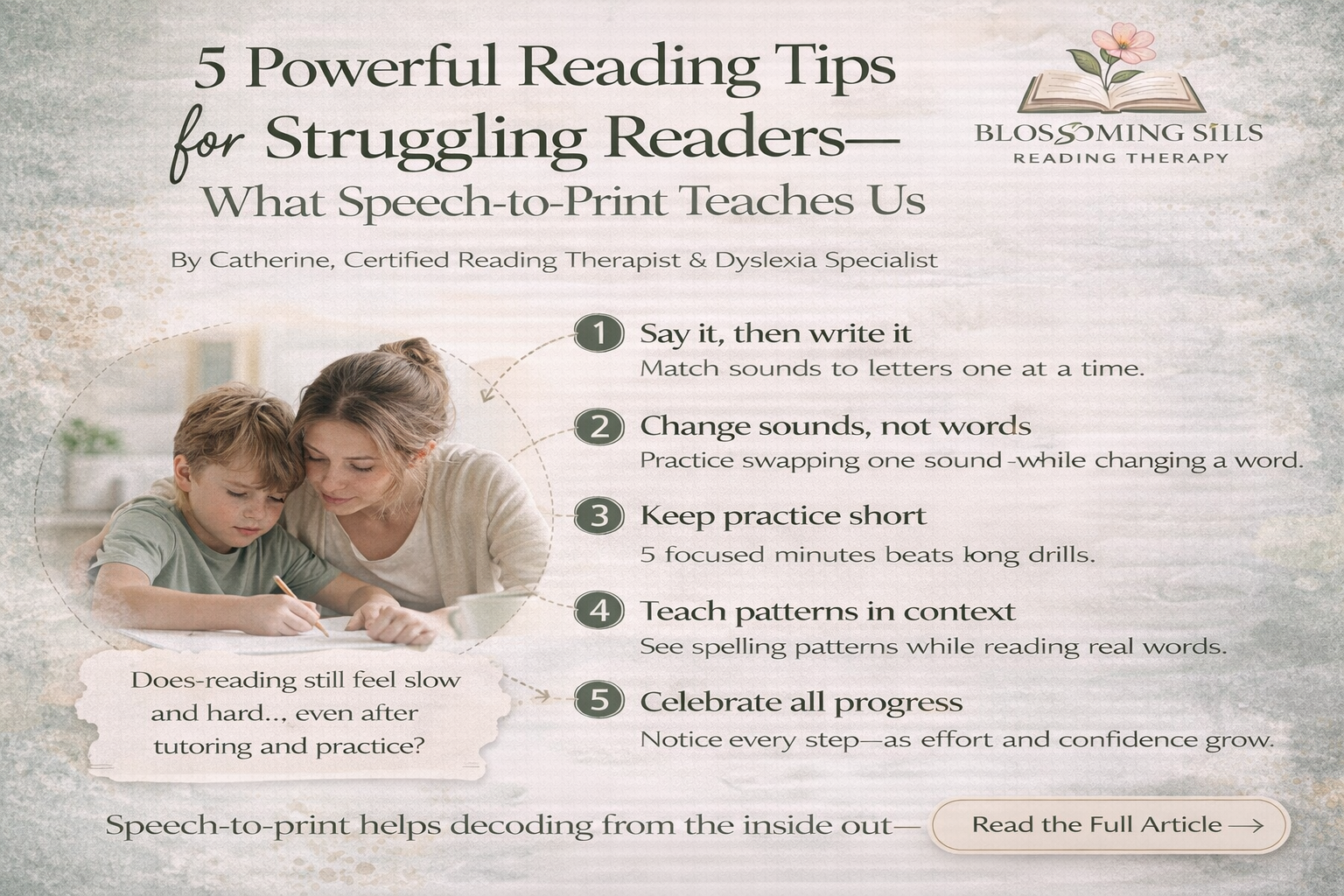
5 Powerful Reading Tips for Struggling Readers—What Speech-to-Print Teaches Us
Looking for effective reading tips for struggling readers? If your child works hard but reading still doesn’t stick, speech-to-print instruction may be the missing piece. Unlike rule-heavy phonics programs, speech-to-print builds reading from spoken language first — strengthening phonemic awareness, sound-to-letter mapping, blending, and automatic word recognition. In this article, you’ll discover 5 research-based reading strategies you can use at home to help your child build fluency, confidence, and lasting decoding skills.
By Catherine, Certified Reading Therapist & Dyslexia Specialist
[Blossoming Skills Reading Therapy]
Does your child work so hard at reading… but nothing seems to stick?
If you’re a parent searching for real, research-backed ways to help your struggling reader, you’re not alone. I’ve spent the last 20+ years working with students who’ve tried everything—tutoring, apps, school intervention—yet still feel “stuck.”
What changed everything?
Speech-to-print reading therapy (sometimes called linguistic phonics).
What Is Speech-to-Print—and Why Does It Help?
Traditional reading programs often start with letters and rules, then expect kids to “sound out” words.
But the speech-to-print approach flips the script:
We begin with spoken language—what your child already knows—and gradually connect it to print.
This method is especially powerful for struggling readers and kids with dyslexia, because it builds reading from the inside out.
Here are 5 practical speech-to-print reading tips you can use at home to help your child become a more confident, accurate reader:
1. Practice “Say It, Then Write It” (Not Just “Sound It Out”)
Most struggling readers get stuck trying to remember rules or letter patterns.
Instead, try this:
Say a simple word out loud (“map”).
Ask your child: “What sounds do you hear?” (/m/ /a/ /p/)
Then together, write each sound as a letter.
This builds the crucial skill of matching speech to print, one sound at a time.
2. Focus on Changing Sounds, Not Memorizing Words
Research shows that strong readers can change one sound at a time in a word (example: “cat” → change /k/ to /h/ = “hat”).
Try quick “swap it” games:
“Say ‘sand.’ Now change the /s/ to /h/—what’s the new word?”
This builds phonemic awareness—the foundation for all decoding, and a core part of speech-to-print and linguistic phonics.
3. Use Short, Repeated Practice Instead of Long Drills
Kids with reading challenges tire quickly.
5 minutes of focused “sound swapping” or “blend and read” each day is far more effective than 30 minutes of frustration.
Try “blending slides”: Write three letters (e.g., c-a-t), point to each, and have your child blend them together smoothly.
4. Teach Patterns in Context, Not Isolation
Speech-to-print methods teach spelling patterns as they naturally appear in real words.
Instead of memorizing a list, read short stories or sentences with target patterns (like “sh,” “ch,” or “oa”).
Underline or highlight the patterns as you read together.
This helps your child see—and hear—how sounds connect to letters in real reading.
5. Celebrate Progress—Big AND Small
Reading progress isn’t always linear.
Celebrate every new word, every smoother blend, every time your child tries, even if it’s hard.
Confidence grows when children feel safe to make mistakes—and know someone notices their effort.
When to Seek Extra Support
If you’ve tried these tips and your child is still struggling, don’t lose hope.
Speech-to-print reading therapy is specifically designed for kids who need a different, brain-based approach.
Ready for clarity?
Download my free Reading Root-Cause Checklist or book a free Reading Clarity Call to talk through your child’s needs and get a personalized plan.
You’re Not Alone
Hundreds of local families have already discovered that the right approach makes all the difference.
With the right support, your child can move from guessing and frustration to real confidence and progress.
If you have a question, feel free to email me directly at catherine@blossomingskillsreadingtherapy.net.
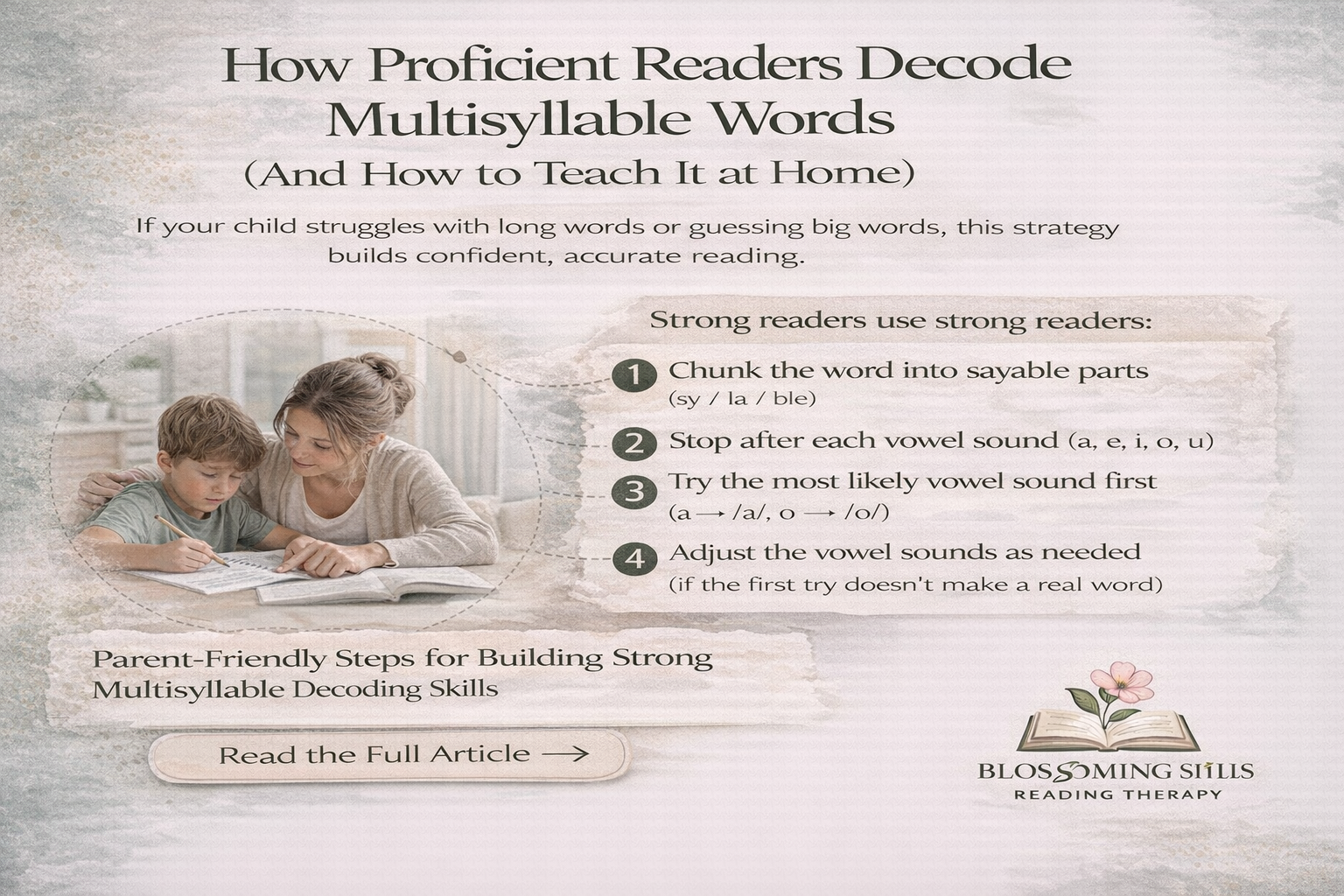
How Proficient Readers Decode Multisyllable Words (And How to Teach It at Home)
Does your child freeze on long words, guess instead of decoding, or shut down when reading multisyllable words? Many struggling readers — especially those with dyslexia — never develop a reliable system for breaking apart and decoding longer words. Proficient readers use a fast, sound-based chunking process that builds automatic word recognition without memorizing complex syllable rules. In this article, you’ll learn exactly how strong readers decode multisyllable words — and how to teach this brain-aligned strategy at home to build fluency, accuracy, and lasting reading confidence.
If your child struggles with long words, freezes on multisyllable words, or guesses instead of decoding, you’re not alone. This is one of the most common reasons parents seek reading help — especially for children with dyslexia patterns or slow reading progress.
The good news is that proficient readers use a reliable decoding process for unfamiliar words, and you can teach that same strategy at home — without relying on complicated rules or syllable labels.
Let’s walk through what strong readers naturally do and how to build that sound-to-print pathway for your struggling reader.
CHECK OUT MY NEW PHONICS PACKS HERE
How Strong Readers Approach Unfamiliar Words
Proficient readers don’t sound out long words letter-by-letter. Instead, their brains do something faster and more systematic:
Chunk the word into sayable parts
Stop after a vowel sound
Try the most likely vowel sound first
Adjust the vowel sound if the word isn’t recognized
Confirm the word by listening for meaning
This is the process the brain uses to decode new words — and it works whether the word is two syllables or five.
Why Multisyllable Words Are Hard for Struggling Readers
Many struggling readers haven’t built a stable sound-to-print system. That means when they hit a bigger word, they don’t have a dependable method to fall back on.
You might see:
slow, choppy decoding
shutting down on long words
guessing based on the first letters
relying on context instead of decoding
weak spelling that doesn’t match reading ability
This is especially common for dyslexic and neurodivergent learners, because their brains need clearer sequencing and stronger phoneme-to-grapheme mapping.
A Real-Life Decoding Example (What a Proficient Reader Does)
Imagine seeing a word you’ve never heard before:
mecrolithin
Even without knowing the meaning, proficient readers usually do this:
1) Find a chunk you can say
You instinctively avoid impossible consonant starters.
You grab a sayable unit like:
me / cro / lith / in
2) Stop after a vowel sound
Each chunk ends right after the vowel sound.
3) Try the most common vowel sound first
me (short e or long e?)
cro (could be “crow” or “crah”)
lith (usually short i)
in (short i)
4) Adjust only the vowels if needed
If it doesn’t sound like a real word, you test another vowel sound:
mee-CRO-lith-in → meh-CRO-lith-in
That’s not guessing.
That’s systematic vowel testing within chunks.
Why This Strategy Works
Reading follows a specific brain pathway:
speech → sounds → letters → words → meaning
Proficient readers start with sounds first, not visual memorization.
They decode from speech-to-print, then confirm meaning once the word is recognized.
That’s why this approach also supports spelling and writing — because it builds a clear internal map of how words are spelled.
Why Common School Methods Often Don’t Help
Many schools teach multisyllable reading using strategies that sound good but don’t match how strong readers decode unfamiliar words:
memorizing syllable types
labeling vowels before reading the word
searching for rules and exceptions
using morphology first
leaning on context to “figure it out”
The problem is simple:
A child can’t use meaning or context until they can say the word accurately.
Without a sound-based method, guessing becomes the fallback.
How to Teach Multisyllable Decoding at Home (Parent-Friendly Steps)
You don’t need a complicated program. You need a clear, repeatable routine.
Step 1: Teach “Stop After the Vowel”
Say:
“Let’s take one chunk. Stop after the vowel sound.”
This trains the brain to grab sayable units instead of panicking at a long word.
Step 2: Try the Most Likely Vowel Sound First
Not a long list of rules — just the first most common sound.
Examples:
a → /a/ then /ae/
o → /o/ then /oe/
ow → /oe/ or /ow/ (grow / how)
Step 3: If It Doesn’t Sound Right, Adjust the Vowel
Say:
“That didn’t sound like a word you know. Let’s try the next vowel sound.”
This keeps your child systematic instead of starting over or guessing.
Step 4: Blend + Check for Recognition
After a full attempt ask:
“Does that sound like a real word you’ve heard before?”
If yes, lock it in.
If not, test another vowel sound and try again.
This Strategy Improves Spelling Too
When kids decode in chunks and test vowels, they aren’t just reading — they’re building spelling automaticity.
This is why sound-to-print decoding helps spelling stick far better than memorizing lists.
If Your Child Is Guessing on Big Words, This Is the Fix
Guessing isn’t a motivation issue.
It’s a strategy gap.
Kids guess when they don’t have a reliable system.
When you teach this sound-based decoding method, guessing fades and confidence grows.
Want the Step-by-Step System for Your Child’s Pattern?
If you’re here because your child has dyslexia or is struggling to read, you’re in the right place. I share practical, research-based strategies that rebuild the reading pathway — without overwhelming rules or guesswork.
For step-by-step dyslexia reading help at home, including monthly toolkits and live coaching, start with the Reading Clarity Membership.
Inside Reading Clarity, I teach parents how to:
chunk multisyllable words without syllable labels
teach vowel sounds in the right order
rebuild the missing sound-to-print pathway
support dyslexic and neurodivergent learners effectively at home
You don’t need more random practice.
You need the right practice in the right order.