
My Child Knows the Letter Sounds. Why Can’t They Put the Sounds Together to Form a Word?
Your child can work through the sounds in a longer word and still end up saying something completely different. Learn why blending, working memory, sound patterns, and other hidden reading challenges can cause words to fall apart, and what targeted instruction can do to help.
Your child comes to a longer word.
They work through the sounds.
Then they say something completely different from the word on the page.
Sometimes they try again.
Sometimes they guess.
Sometimes they quickly skip over the word and keep reading, hoping you did not notice.
Maybe they cover part of the word with their finger.
Maybe they mumble through it.
Maybe the frustration shows immediately.
And you are left wondering:
How can they work through the sounds and still end up with the wrong word?
There can be several reasons.
And figuring out which one is happening matters.
Longer Words Put More Pressure on the Reading System
This problem often becomes much more obvious as words get longer.
Now your child may be dealing with:
consonant blends
vowel teams
endings
prefixes or suffixes
multiple syllables
less familiar spelling patterns
They have more to hold onto.
More patterns to recognize.
More pieces to keep in the right order.
And more opportunities for the word to fall apart before they reach the end.
Sometimes Blending Is the Problem
The child may work through the sounds, but those sounds do not come together smoothly enough to form the word.
They may get through the whole thing and still say something that sounds completely different.
That can be especially noticeable with words that contain several sounds close together, blends, or more than one syllable.
Sometimes Sounds Get Lost or Changed
A longer word puts more demand on working memory.
Your child has to hold onto the beginning while still processing what comes next.
A sound may disappear.
Another may change.
The beginning may get lost by the time they reach the ending.
By the time they say the whole word, the result may barely resemble what is printed.
Sometimes the Spelling Pattern Is Getting in the Way
Older struggling readers are dealing with increasingly complex words.
They may be trying to figure out a vowel pattern, a blend, an ending, or a syllable while also holding the rest of the word together.
That extra load can make the whole word break down.
Sometimes Extra Sounds Make Blending Harder
Some struggling readers add a small vowel sound after consonants.
Instead of producing the consonant cleanly, a little “uh” sneaks in.
That extra vowel sound is called a schwa.
One extra sound may not seem like much.
But add several of them into a longer word and the child is suddenly trying to blend sounds that were never actually there.
That can make the word much harder to put together.
It is also one of those habits that is easier to correct when it is noticed and addressed early.
Sometimes Speech Differences Add Another Layer
For some children, articulation or speech differences can make reading even more complicated.
If certain sounds are difficult to produce clearly, that can interfere with how accurately the child holds and blends the sound sequence.
That does not mean every child with this reading pattern has a speech issue.
It simply means there can be more than one reason the same reading mistake shows up.
What Parents Usually Notice First Is the Frustration
Your child probably does not explain any of this.
You see:
skipped words
guesses
mumbling
covering part of the word
rushing through the sentence
getting irritated when asked to go back
trying to keep reading before anyone notices the mistake
And over time, the frustration can become bigger than the word itself.
Some children become very good at hiding what they cannot read.
This Is Why the Cause Matters
Two students can make the same mistake for completely different reasons.
One may be struggling with blending.
Another may be losing sounds.
Another may be overwhelmed by the length of the sound sequence.
Another may be getting stuck on advanced spelling patterns.
Another may have developed habits that make blending harder.
If we only correct the final word, we miss the important part.
What caused the word to break down in the first place?
That is what instruction needs to address.
The Fix Should Match the Problem
Good reading intervention should not simply give a child more words to practice.
It should identify what is actually causing the reading difficulty.
That may mean strengthening:
phonemic blending
sound sequencing
working memory for longer sound strings
advanced sound-spelling patterns
consonant blends
word endings
syllable work
automatic word recognition
The goal is to build the foundation the child actually needs, not skip important skills.
But that foundation does not have to look identical for every child.
Why Some Dyslexia Programs Take Years
Many traditional dyslexia programs are built as long, sequential systems.
Students move through a prescribed series of levels or steps, often beginning at the start of the program and progressing through the sequence.
That can be effective for some students.
It can also take a long time.
Barton states that a student with moderate dyslexia receiving one-on-one instruction twice a week may take about 2 to 3 years to complete all ten levels.
Wilson says completing all 12 steps of its program may take 2 to 3 years or more, depending on the frequency and intensity of instruction.
Wilson also incorporates fluency instruction throughout its program and offers an additional fluency resource for students who need extra practice developing automatic, fluent reading.
There is nothing wrong with systematic instruction.
The question is whether every child needs the same sequence, at the same pace, for the same length of time.
A More Individualized Approach
At Blossoming Skills, I start with assessment.
I identify the specific skills contributing to the reading struggle.
Then instruction is built around those needs.
That may include blending, advanced code, endings, multisyllable words, automatic word recognition, fluency, or another area.
The goal is to build the strong foundation the child needs while focusing instruction on the skills that are actually holding them back.
The program is designed around a defined 12-week period, with measurable pre- and post-assessment data.
100% of students with complete 12-week outcome data met the Progress Promise by gaining at least one full grade level in a key area of reading.
What Progress Can Look Like
Your child comes to a word they would normally skip.
This time, they stay with it.
They work through it.
The sounds stay in the right order.
The word comes together.
And the word they say actually matches what is on the page.
Then it starts happening more often.
You may notice:
fewer wild guesses
fewer skipped words
more accurate decoding
less frustration
smoother reading
more willingness to tackle unfamiliar words
less dependence on an adult
greater reading independence
That is the change we want.
Not just getting through one difficult word.
Building a reading system that works more reliably.
If This Sounds Like Your Child
If your child can work through the sounds in longer words but still regularly ends up saying the wrong word, there is usually a reason.
The next step is identifying where the process is breaking down.
At Blossoming Skills Reading Therapy, that is where we start.
We identify the specific skills keeping your child stuck, target them directly, and measure whether the instruction is working.
Ready to Find Out What Is Keeping Your Child Stuck?
Book Your Free Reading Clarity Call
Prefer to call or text? 682-209-0952

My Child Knows the Phonics Rules So Why Are They Still Guessing at Words?
Your child knows the sounds and has had phonics instruction, but still guesses, changes words, or gets stuck on unfamiliar words. Learn why that happens, what it can reveal about the reading process, and how targeted Speech-to-Print instruction can help build more accurate, independent reading.
Parents tell me this all the time:
“They know the sounds.”
“They’ve learned the phonics rules.”
“They’ve practiced this.”
“But when they read, they still guess.”
That is usually the part that does not make sense to a parent. If your child has spent years learning phonics, you expect those skills to show up when they actually read.
But a child can know a sound or remember a rule and still have trouble using that information quickly and accurately inside an unfamiliar word.
They may read the first part of the word correctly and change the ending.
They may look at the first letter and guess.
They may sound out the word, then say something completely different when they blend it together.
Or they may read a familiar word correctly one day and miss it the next.
That tells me I need to look beyond whether they have been taught phonics.
I want to see what happens when they actually have to use it while reading.
Guessing does not always look obvious.
Sometimes a child reads most of a sentence correctly, so it sounds like they are doing better than they actually are.
But if you listen closely, you may hear them:
read the first part of a word and change the ending
substitute a word that starts with the same letter
say a word that makes sense in the sentence but is not actually on the page
stop at unfamiliar words and wait for help
sound out a word correctly, then say a different word when they blend it
read a familiar word correctly in one place and miss it somewhere else
That is why I pay attention to how a child gets to the word, not just whether they eventually say the right word.
If a child is depending on context, memory, or the first few letters, that can work for a while. It gets much harder as the reading becomes more advanced and the words become less predictable.
Still Guessing After Years of Phonics?
If your child knows many of the sounds and rules but still guesses, changes words, or struggles with unfamiliar words, I look at where the reading process is breaking down and target those skills directly.
[See the 12-Week Reading Program]
Why This Becomes More Noticeable as Reading Gets Harder
Early books give children a lot of support.
The sentences are short. The vocabulary is familiar. There may be pictures that help them figure out what a word could be.
As children get older, that changes.
They begin reading science, history, longer chapter books, and directions with vocabulary they may have never seen before.
A child cannot reliably guess words like photosynthesis, government, migration, or investigation from the picture or the first letter.
They need to be able to work through the print.
This is often when parents start noticing that a child who seemed to be getting by is suddenly struggling much more.
This Is Why I Look at Unfamiliar Words
When I assess a student, I want to know what happens when they cannot rely on memory.
Can they keep the sounds in the correct order?
Can they blend without changing the word?
Do they read all the way through the ending?
What happens when they see a spelling they do not recognize immediately?
Can they work through a longer word?
That gives me much more useful information than simply knowing whether they have had phonics instruction before.
Why 2-Year Dyslexia Programs Like Barton and Take Flight Stall (And What Works Faster)
Is your child a year or two into Barton or Take Flight with little progress to show for it? Learn why heavy rule memorization stalls bright readers and how a speech-to-print approach helps kids make real reading gains in months instead of years.
When a child receives a dyslexia diagnosis in Texas, parents almost always hear about programs like Take Flight or Barton Reading and Spelling. These traditional Orton Gillingham style programs are considered the standard option, and school districts frequently rely on them for dyslexia intervention.
However, many parents find themselves a year or two into these programs with very little progress to show for it. Their child is still guessing at words, avoiding reading out loud, and struggling through nightly homework battles.
If your child is stuck in a multi year reading program without making real gains, the issue is not your child's intelligence or effort. It comes down to how these traditional programs teach reading.
The Heavy Weight of Rule Memorization
Programs like Barton and Take Flight rely on a traditional print to speech model. They ask children to look at letters on paper and memorize dozens of abstract rules to figure out what those letters say.
Your child ends up having to memorize over ninety different phonics rules, syllable division formulas, and spelling exceptions. For a bright child with dyslexia, working memory challenges, or ADHD, this creates massive mental fatigue.
Instead of reading smoothly, your child spends all their energy trying to recall which rule applies to which letter combination. When that process gets overwhelming, the brain naturally looks for a shortcut. That is when you see your child guessing words based on the first letter, skipping small words, or guessing based on the context of the story.
How Speech to Print Accelerates Growth
A speech to print approach turns this traditional model around. Instead of starting with abstract markings on paper, it begins with the spoken sounds your child already uses every single day.
Your child already knows how to speak fluently. By starting with spoken words and mapping those sounds directly to written letters, the brain forms fast, permanent pathways for reading.
This process is called orthographic mapping. It allows children to store words permanently in their long term memory. They no longer have to recall complex syllable rules or flip through mental flashcards while trying to read a single sentence.

Key Differences Between the Two Approaches
Targeting reading this way changes the entire timeline for progress:
Traditional programs average two to three years of slow, incremental lessons. Targeted intervention through our12-Week Reading Breakthrough Program focuses on rapid, measurable growth in a fraction of that time.
Traditional tutoring relies on memorizing rules about letters on paper. Speech to print connects written letters directly to the spoken sounds already hardwired in your child's brain.
Traditional methods break reading and spelling into separate drills. Speech to print teaches decoding and writing together so skills transfer immediately into classroom work.
Knowing When It Is Time for a Change
If your child has spent six months or more in Take Flight, Barton, or a school reading group with minimal improvement, you do not have to wait three years for a breakthrough.
Switching to a direct speech to print method helps bright children stop guessing at words and start reading accurately, building real reading confidence in months instead of years.
Ready for a Faster Path to Confident Reading?
You do not have to watch your child struggle through years of rule memorization. Book a free 15-minute Clarity Call to talk through your child's specific reading history and see if our specialized 1:1 virtual intervention is right for your family.
Related Reading for Parents
Understanding Orthographic Mapping: Why Bright Children Guess at Words (and How to Stop It)
How to Teach Spelling: What Finally Makes Spelling Stick
Serving Fort Worth, Texas, and Nationwide: Specialized 1-on-1 reading intervention, parent coaching, and diagnostic reading assessments available virtually across Texas, with local specialist support for families in Fort Worth, across Texas and nationwide.
This video explains how Scottish Rite's Take Flight curriculum is structured and implemented, providing helpful context on why its multi-year timeline prompts many Texas parents to seek faster, 1:1 clinical alternatives: Take Flight: A Comprehensive Intervention for Students with Dyslexia
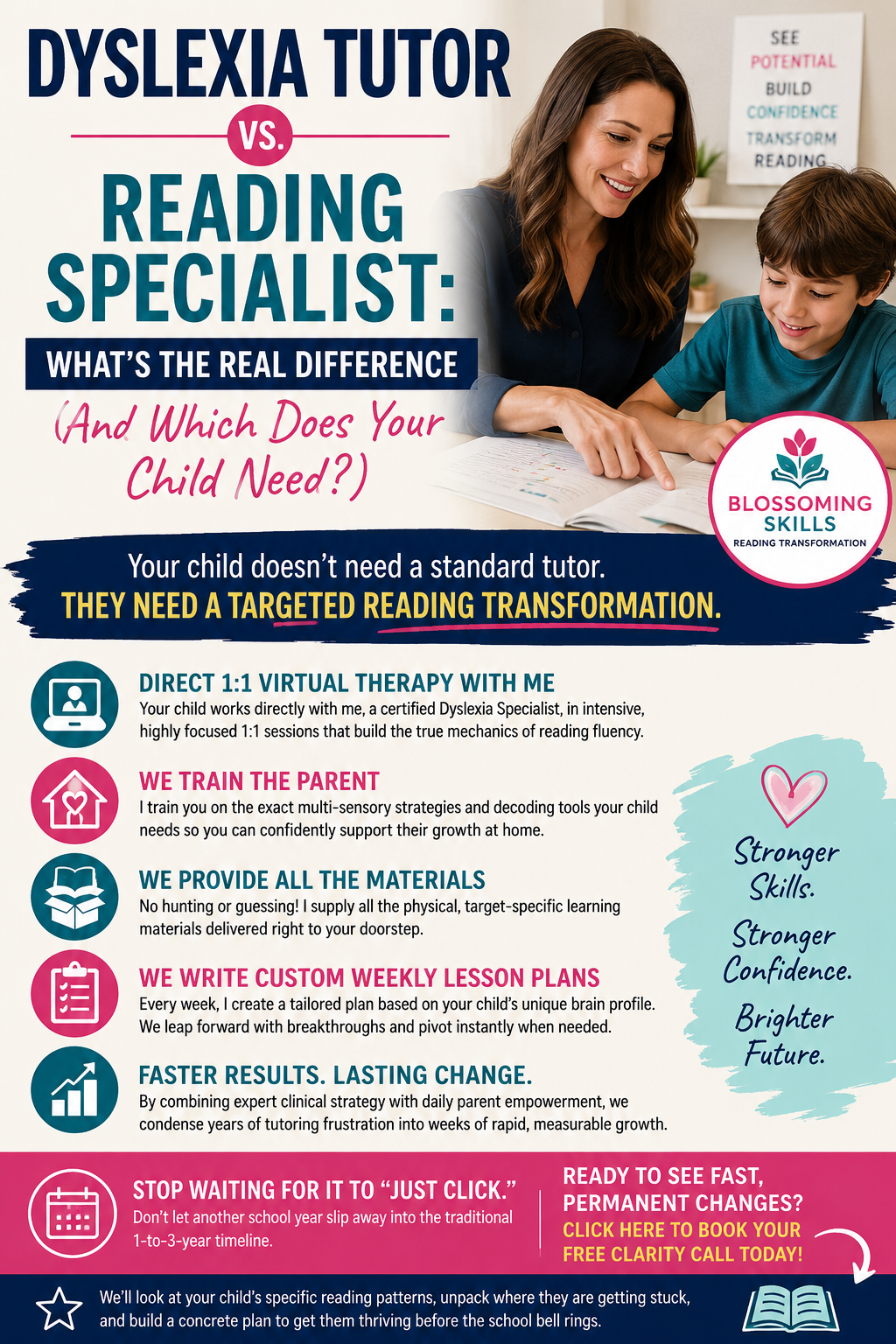
Dyslexia Tutor vs. Reading Specialist: What’s the Real Difference (And Which Does Your Child Need)?
If your child is struggling with reading, your first instinct is to search for a "dyslexia tutor." But did you know standard tutoring can take 1-3 years and often fails to produce true reading fluency? When your child is falling behind, they need help NOW. Before school starts, understand why a specialized Reading Specialist is the critical difference your child needs to catch up, thrive, and start reading fluently this semester.
Your child doesn’t need a standard tutor to walk them through a generic workbook. They need a targeted Reading Transformation.
At Blossoming Skills, we broke away from the traditional 1-to-3-year tutoring model because we know urgency matters. We attack the reading gap from two powerful angles: intensive 1:1 specialist intervention and active home support.
Here is exactly how our specialized program fast-tracks your child's reading pathway and builds true fluency:
Direct 1:1 Virtual Therapy With Me: Your child works directly with me, a certified Dyslexia Specialist. These are intensive, highly focused sessions where the deep clinical work happens. Because I am working 1:1 with your child, I can catch microscopic tracking errors, correct guessing behaviors in real-time, and explicitly teach the mechanics of reading fluency.
We Train the Parent: A child needs more than just a couple of hours of therapy a week to make massive leaps. To keep the momentum going at home, I explicitly train you on the exact multi-sensory strategies, sound-mapping cues, and decoding tools your child needs. You become the confident ally who knows exactly how to support them without frustration.
We Provide All the Materials: No hunting down specialized decodable books or expensive tools. I supply all the physical, target-specific learning materials directly to your doorstep, so you have everything you need to succeed from day one.
We Write Custom Weekly Lesson Plans: A generic curriculum cannot adapt to your child's specific breakthroughs or roadblocks. Every single week, I write a tailored, targeted lesson plan designed around your child's unique brain profile. If they master a concept, we leap forward. If they hit a snag, we pivot instantly to protect their confidence.
By combining expert clinical strategy with daily parent empowerment, we condense years of traditional tutoring frustration into weeks of rapid, measurable growth.
Stop Waiting for It to "Just Click"
If traditional school intervention or standard tutoring methods haven't closed the gap for your child, it isn’t because they aren't trying hard enough. It simply means their brain needs a different, faster path to building an automatic, fluent reading pathway.
Don't let another school year slip away into the traditional 1-to-3-year timeline.
Ready to see fast, permanent changes in your child's reading fluency? [Click here to book a free Clarity Call with me today.] We will look at your child's specific reading patterns, unpack where they are getting stuck, and build a concrete plan to get them thriving before the school bell rings.
Finding the Best Online Reading Programs for Struggling Readers: Why Time is the Hidden Variable
Tired of being told dyslexia intervention has to take three years? Discover why traditional multi-year timelines put your child at academic risk, and how a brain-aligned speech-to-print approach closes the reading gap in months, not years.
If your child is struggling to keep up with reading, you have likely spent hours online trying to find an intervention that actually works. It is incredibly hard to watch them fall behind their classmates while their confidence drops a little more every day.
When you start looking for specialized intervention programs designed for dyslexia and struggling readers, you generally run into two choices.
First, there are the apps and websites that promise fast, easy results. Most of these rely on bright graphics and reward points to keep kids clicking, but they don't actually teach reading. They usually teach kids to guess words based on pictures, which only builds bad habits and leads to more frustration.
The second option is traditional, long-term dyslexia tutoring based on Orton-Gillingham methods, such as Barton, Wilson, or Take Flight. These programs are often called the gold standard, but the actual peer-reviewed research on their long-term success is surprisingly mixed. Many parents are shocked to find that even after two or three years of intensive, multi-week tutoring in these programs, their children still cannot read fluently.
The Real Risk of a Multi-Year Timeline
Traditional programs are an enormous commitment, often taking years to complete. While a slow, multi-year timeline is frequently presented as the only thorough way to teach a child with dyslexia, struggling readers simply do not have that kind of time.
Every month a child spends slowly working through an overly complicated system of abstract rules is a month they fall further behind their peers in the classroom.
When a child cannot read fluently, they miss out on grade-level vocabulary, science, social studies, and the general knowledge that their classmates are absorbing every day. By the time a child finally finishes a three-year program, they might be better at decoding individual words, but the academic gap between them and the rest of the class has grown even wider.
Intervention needs to be intense, focused, and short-term. The goal has to be getting your child reading fluently as quickly as possible so they don't miss out on the education they are supposed to be getting right now.
(If you want to look closely at what the data actually says about these long timelines, you can read our full breakdown here: What is the Best Reading Intervention for Dyslexia?).
Reading is Built on Speech, Not Print
The reason traditional interventions take years isn't because dyslexia is impossible to fix quickly. It takes that long because traditional methods fight against how the brain naturally operates. They start with letters on a page and try to force a child to translate those visual shapes into spoken words. For a child who already struggles with visual language, memorizing dozens of complex spelling rules feels like trying to decode a secret language.
The alternative isn't a new digital trend or a flashy app. Cognitive science research from the last 50 years proves that human brains are biologically wired for spoken language, not printed text.
A speech-to-print approach simply lines up with the brain's natural architecture.
Instead of starting with abstract shapes on a page, speech-to-print starts with what your child already masterfully knows: the sounds of spoken language. It teaches them to take the words they say every day, break them into sounds, and map those sounds directly to the letters on the screen. Because this method connects to the language pathways your child already uses, it is faster, more logical, and significantly easier for a struggling reader to understand.
Equipping You for the Daily Reality
An effective online reading intervention cannot just be about the time your child spends on a screen with a therapist. It has to recognize what happens after the session ends.
Raising a child who struggles with reading is stressful, and there is no app or program that makes that stress magically disappear. Because you are the one there every single day, you shouldn't be left guessing how to help your child at home, nor should you be expected to turn into an untrained reading teacher.
A real intervention program must equip you. You need to know exactly how to handle daily reading habits at home without turning homework time into a battle. Just as importantly, you need to understand the science well enough to confidently advocate for your child’s accommodations during school meetings and IEP reviews. You are your child's ultimate advocate, and you deserve to be treated as a partner in the process, not just a spectator.
This is why an effective online environment requires a live, specialized therapist who interacts with your child in real time using interactive, multisensory digital tools—adjusting the lesson second-by-second based on how your child is processing the sounds.
Accountability and Progress
Because traditional interventions take years, parents are often forced to write check after check with no clear endpoint or performance accountability. We don't believe in trapping families in endless loops.
When we partner with a family, we stand by the efficiency of the speech-to-print model. That is why our 12-week program includes a specific progress guarantee. We track measurable baseline data on day one, and if your child does not hit their targeted growth milestones by the end of the 12 weeks despite consistent attendance, we continue working with them at no additional cost until they do. You deserve to see tangible, rapid growth from your investment in your child’s education.
Closing the Reading Gap Now
Your child does not have three years to wait to become a fluent reader. They need to be able to read their schoolbooks and feel confident in class today.
At Blossoming Skills Reading Therapy, Catherine Mitchell provides specialized online reading therapy that focuses on efficient, targeted results. Our 12-week reading therapy program uses the biological logic of the speech-to-print method and structured, multisensory instruction to help children with dyslexia and struggling readers catch up to their peers from home.
Let's stop managing the reading gap over a period of years, and start closing it now.
[Click here to schedule your free Reading Clarity Call today.]
What is the Best Reading Intervention for Dyslexia?
"He can read a word at the top of the page, and by the bottom of the page, it’s like he’s never seen it before."
If you are utterly exhausted from watching your child guess words based on the first letter, or sick of being told it will take years of expensive tutoring just to get them caught up, you are not alone. The multi-year timeline is a myth, and your child isn't running out of memory—they're just running out of visual brain space to memorize word shapes.
Here is why traditional tutoring takes so long, why flashcards stop working by the 3rd grade, and how the actual science of reading can close the gap in months, not years.
If you are searching for dyslexia tutoring near me, you have likely been handed a bleak timeline. The standard narrative from schools and corporate tutoring centers is that closing a significant reading gap takes two, three, or even four years of intensive remediation.
That timeline is false.
When a reading intervention drags on for years, it is rarely a reflection of your child's capability. Instead, it is a flaw in the design of the program itself. Many legacy dyslexia programs require children to memorize over a hundred abstract spelling rules, syllable types, and exceptions. This approach overloads a child's working memory and slows progress to a crawl.
Whether you are looking for hands-on support right here in the Fort Worth and Tarrant County area, or seeking an expert online reading specialist across the Dallas-Fort Worth metroplex, the core issue isn't your child—it's the program.
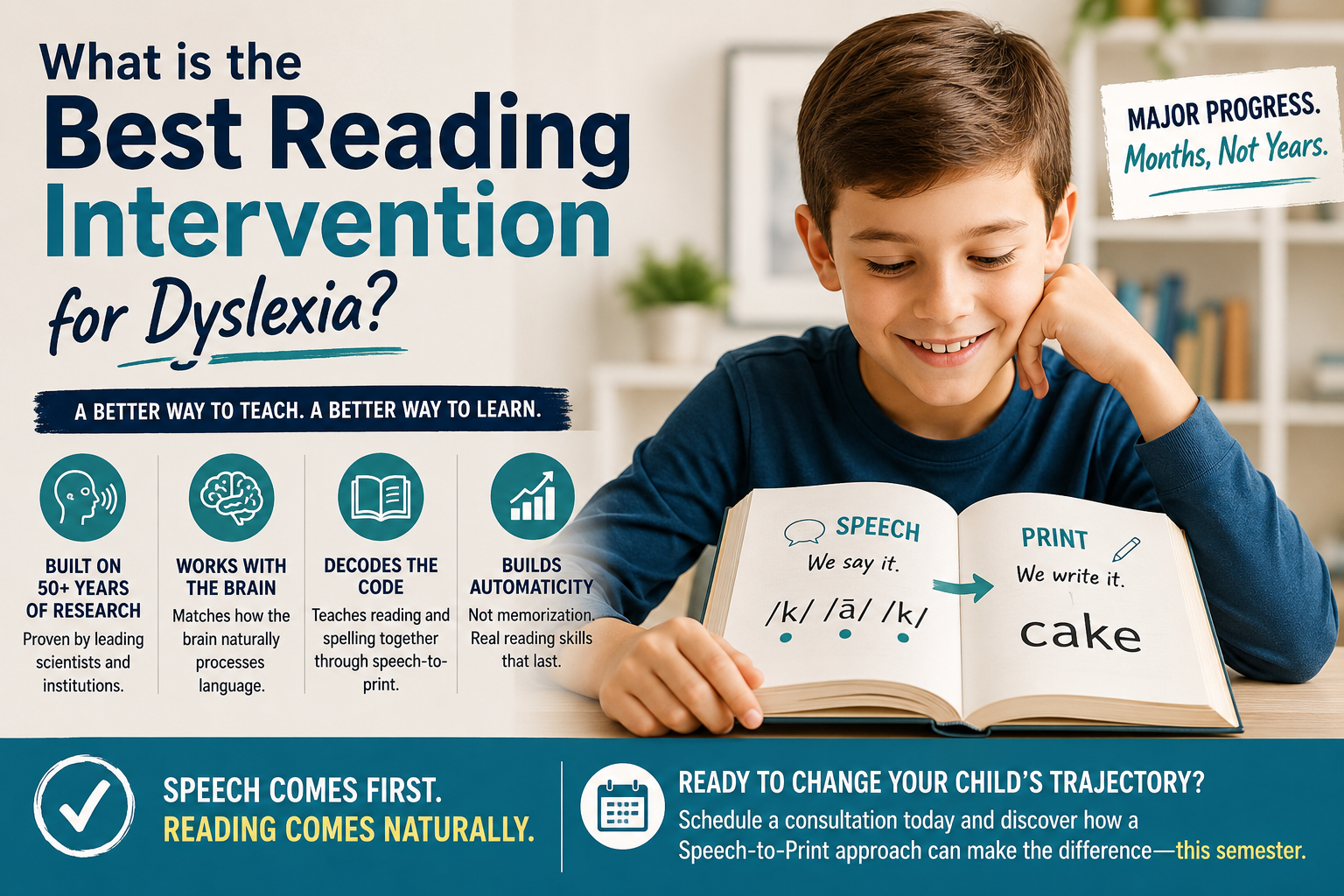
The most efficient, effective reading intervention for dyslexia is Linguistic Phonics (commonly called a Speech-to-Print approach). It does not take years to see dramatic grade-level gains. When a program matches how the human brain is biologically wired to process language, major progress happens in months, not years.
This Is Not New Science: The 50-Year History of Speech-to-Print
Marketing teams often brand Speech-to-Print or Linguistic Phonics as a "shiny new trend." It isn't. The foundational data supporting this approach has been proven for over half a century.
The 1960s (Elkonin Boxes): In the 1960s, psychologist D.B. Elkonin demonstrated that the absolute foundation of reading is the ability to segment spoken words into individual sounds. He designed "sound boxes" to map spoken language before children ever struggled with complex text.
The 1970s (Haskins Laboratories): Extensive research by the National Institutes of Health (NIH) and Haskins Laboratories in the 1970s explicitly proved that early reading failure is tied directly to phonological processing—the brain's handling of spoken speech sounds, not a visual deficit.
The 1970s–1980s (Dr. Linnea Ehri): Dr. Linnea Ehri’s foundational research proved how the brain permanently stores words. It isn't through visual memorization. It happens through orthographic mapping—the process where the brain naturally glues the individual sounds we say to the letters we see.
The 1990s (Dr. Diane McGuinness): Cognitive scientist Dr. Diane McGuinness conducted an exhaustive meta-analysis spanning a century of applied reading research. Her work proved that alphabetic writing systems are designed as a code for spoken sounds. Programs that teach reading backward (starting with the letter names on a page rather than the sounds in a child's mouth) create artificial barriers for dyslexic brains.
Why Legacy Programs Take Too Long
Many traditional, highly marketized dyslexia programs rely on a Print-to-Speech model. They show a child a sequence of letters, expect them to recite a rigid rule, analyze the syllable type, and then guess the sound.
This model forces a child to treat reading as a visual memorization task. Because dyslexic brains struggle with rapid visual-to-auditory retrieval, this method forces them to work against their natural cognitive architecture. These are the exact programs that claim "favorable research" but require years of agonizingly slow compliance to move a child up a single grade level.
Linguistic phonics reverses this entirely. It starts with what a child already knows: their own spoken language.
How Linguistic Phonics Streamlines the Code
Instead of teaching hundreds of isolated rules, a speech-to-print approach organizes the entire English language into four straightforward concepts:
Letters are pictures of sounds: The spoken sound comes first; the written symbol is just its visual representation.
Sounds can be represented by multiple letters: The sound /sh/ uses two letters (ship); the sound /igh/ uses three (night).
The same sound can be written in different ways: The spoken sound /ā/ can look like ai (rain), ay (play), or a_e (cake).
The same spelling can represent different sounds: The letters ea represent different sounds in bread vs. beach.
By anchoring written text to oral speech, reading and spelling are taught in tandem. When a child writes a word, they are encoding (pulling speech apart into symbols); when they read, they are decoding (putting symbols back into speech).
Automaticity vs. Memorization
There is a massive difference between memorizing a word and making a word automatic.
When children are forced to memorize words using flashcards or sight-word lists, they are treating words like pictures. A child’s visual memory bank caps out at around 2,000 words. This is why many dyslexic kids hit a wall in the 3rd grade—they simply run out of brain space to memorize any more word shapes.
Linguistic phonics does not ask children to memorize anything. Instead, it teaches them to crack the code. Once the brain maps the connection between the spoken sound and the written letter, that word becomes permanently automatic. The child doesn't have to guess, visualize, or recall a rule. They just read it.
When you strip away the unnecessary rules and teach reading as a logical code based on human speech, children build this automaticity rapidly. They aren't memorizing more words; they are learning how to process all words.
If you are looking for local support that prioritizes efficient, evidence-based results over multi-year contracts, we can help.
Looking for the Best Dyslexia Tutoring in Fort Worth or Online across DFW?
Your child does not have a bad memory, and they do not need to be sentenced to years of exhausting, repetitive tutoring. They just need an intervention that aligns with how the human brain actually learns to read.
We provide specialized, evidence-based speech-to-print instruction locally in Tarrant County and virtually to families throughout the entire Dallas-Fort Worth metroplex.
[Click here to explore our specialized dyslexia tutoring services and schedule a free reading consultation to change your child's trajectory this semester!]
Can Reading Struggles Be Prevented? What Every Parent of a Young Learner Needs to Know
Most reading struggles aren't inevitable — they're the result of a few specific instructional decisions made in kindergarten and first grade. A certified dyslexia specialist explains exactly what gets taught wrong, what the research says should happen instead, and how to know if your child's foundation is being built correctly before a gap has a chance to form.
By Catherine Mitchell, Certified Dyslexia Specialist | Blossoming Skills Reading Therapy | Fort Worth, TX | dyslexiaspecialisttx.com
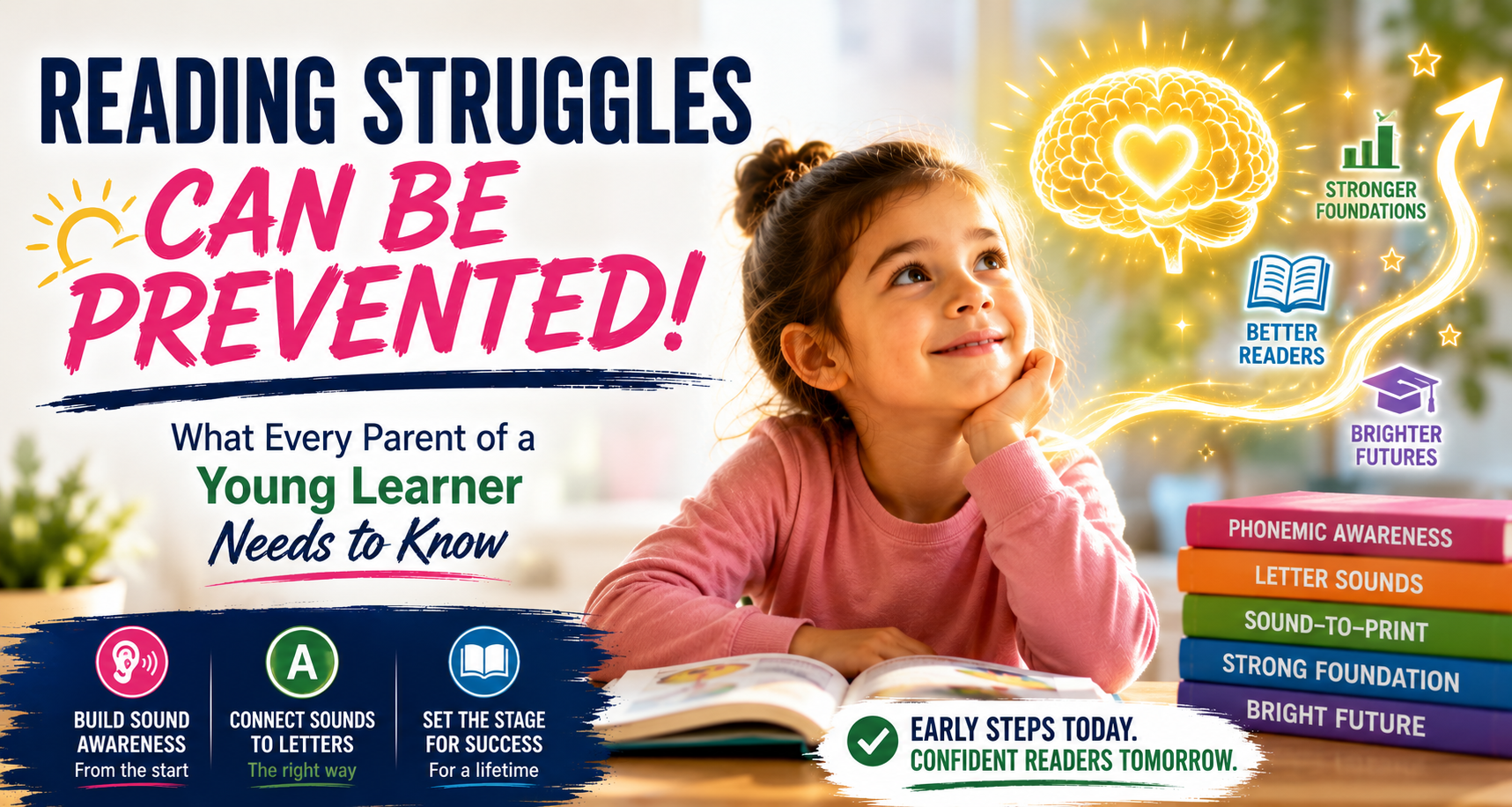
Yes, for most children, reading struggles are entirely preventable.
I am Catherine Mitchell, a certified dyslexia specialist and the owner of Blossoming Skills Reading Therapy here in Fort Worth, Texas. After spending more than a decade teaching special education in public schools, I can tell you with absolute confidence that the reading difficulties I watched children develop were rarely inevitable.
In most cases, those struggles were the direct product of a few specific instructional decisions made in kindergarten and first grade. It usually comes down to how phonemic awareness was introduced, how letter names and sounds were connected, and how high-frequency words were taught.
If we get those three elements right from the very beginning by using a speech-to-print approach grounded in the Science of Reading, we can dramatically reduce the odds that a child will ever struggle to read.
Reading difficulties are not a foregone conclusion
Research consistently shows that with the correct early instruction, the vast majority of children who would otherwise struggle can be spared that experience entirely.
To look at the full picture honestly, roughly 15 to 20 percent of children have neurological dyslexia. These children will need specialized, structured literacy support regardless of how well they are initially taught in a mainstream classroom. But even for them, receiving the correct instruction early means earlier identification and a much smaller gap to close later on.
As for the other 80 to 85 percent of struggling readers? They are simply receiving instruction that does not align with how the human brain actually learns to decode language. For these children, prevention is absolutely possible.
The Critical Window: Kindergarten and First Grade
This is the exact window when the brain actively builds the phonological-orthographic pathway, which is the vital connection between the spoken sounds of language and the written symbols that represent them. What happens in these early years shapes everything that follows, far beyond third-grade standardized reading scores.
The foundation either gets laid correctly right out of the gate, or it develops quiet gaps that compound over time. Parents often do not see the cracks until a child hits second or third grade and suddenly falls behind, even though the root problem started years earlier.
A Personal and Professional Perspective
The difference in these two trajectories is something I have watched up close, including within my own family. My son is 19 years younger than my daughter, who has severe dyslexia. Knowing what I know now, I started building his phonemic foundation when he was just two years old. We did not use flashcards or formal lessons; we just played simple games.
We would play I Spy in the car, identifying the individual sounds inside words. He learned early on that the word "truck" starts with the sound /tr/, not /chr/, which is a distinction many children miss entirely because no one has trained their ear to notice it. By age three, we were mapping those oral sounds to physical letter tiles. Because his sound-to-print mapping was incredibly strong before formal schooling even began, he never struggled to learn to read. He already had the engine built.
I saw this same momentum with a three-year-old boy in my private practice. His family had a strong genetic history of dyslexia on both sides, and his mother wanted to build a resilient foundation before he entered a mainstream classroom. By the end of our 12 weeks together, he was mapping words, understanding how spoken sounds correspond to written symbols, and identifying individual sounds in his everyday speech. That specific skill, hearing the tiny sounds inside your own spoken words, is exactly what dyslexic children struggle with for years in school. We built that skill at age three through play.
The Problem with Teaching Letter Names First
Most children arrive at kindergarten knowing at least some letter names, which is a wonderful head start. The issue is what happens next in typical classrooms: letter names are often emphasized without being immediately and explicitly connected to the actual sounds those letters represent.
Think about what it means for a child to know that a letter is called "Bee," but not know that it says /b/. They have learned a name for a symbol, but they have not learned a functional reading tool. That child cannot use the letter name to decode a word because decoding requires the sound, and the name does not provide it.
In fact, letter names can actively mislead a young reader:
The name "aitch" for the letter H contains no /h/ sound at all.
The name "doubleyoo" for the letter W does not obviously produce the /w/ sound.
When children try to use letter names to decode text, they end up frustrated, confused, and forced to guess.
The educational research of Timothy Shanahan, building on work by Piasta and others, suggests that for typically developing children, teaching letter names and sounds simultaneously with an explicit bridge between them produces the strongest outcomes. The name provides visual stability, while the sound provides the actual reading function. For many children, this blended approach works well.
However, in my clinical experience working with children who have speech delays, apraxia, language processing differences, or significant phonological weaknesses, this simultaneous combination causes immediate cognitive overload. When a child is still working hard to solidify their foundational sound system, adding letter names splits their limited attention between two distinct concepts before either has become automatic. For these children, I always prioritize the sounds first. We build a stable phonological foundation until they can identify, segment, and manipulate sounds with confidence. Letter names come later, once the reading foundation is secure. The sounds are the engine; the names are just the label.
(For a deeper look at this approach, you can read my full comparison guide: Speech-to-Print vs. Orton-Gillingham: What's the Difference?
The Trap of Treating High-Frequency Words as Visual Memorization
Sight word flashcards are everywhere. They are sent home in kindergarten folders, packed into homework packets, and stacked on kitchen counters. The traditional assumption behind them is that high-frequency words like "the," "said," and "was" are completely irregular and impossible to sound out, meaning children have no choice but to memorize them as visual shapes.
This completely contradicts how the human brain stores words.
Dr. Linnea Ehri’s foundational research on orthographic mapping proves that words enter our long-term memory through a specific process: the brain bonds the word's spelling to its pronunciation at the phoneme level. The human brain is fundamentally a sound-processing organ, not a visual shape-memorizer. When it encounters a written word, it processes the letters by connecting each one to the spoken sound it represents. It is through these sound-symbol bonds that the word gets permanently stored for instant retrieval. Rote visual repetition completely bypasses this mechanism. This is exactly why a child can successfully identify a sight word on a flashcard on Tuesday, yet completely fail to read that same word inside a sentence two weeks later.
Furthermore, many words on these lists are not nearly as irregular as they look. The word "said" appears odd, but once a child is taught that the letter team AI can represent the short /e/ sound, "said" maps perfectly as /s/ /e/ /d/.
A landmark study released by NWEA confirms that teaching words as visual wholes is far less effective than teaching letter-sound correspondences. Children who are taught to look closely at the individual parts of a word, noticing which letters correspond to which sounds, read and spell those words with much greater permanence and reliability.
A Better Approach: Mapping the Sounds
Instead of flashcards, we need to map the sounds. Say the word aloud, point to the letters, and connect them explicitly. If a word truly has an irregular part, point to that specific piece and teach it as the "heart" part of the word, the small piece they need to learn by heart, while still phonemically mapping the rest of the word. This is what structured literacy actually looks like in practice.
Sound walls are another excellent tool for this. A sound wall organizes words by the actual speech sounds they represent, which mirrors the brain's natural phonological reference system. On the other hand, a traditional word wall organized alphabetically by letter name reinforces name knowledge but fails to build the phonological pathway required for reading text. Literacy research strongly supports shifting to sound walls in early childhood classrooms as one of the most practical upgrades a school can make.
What True Phonemic Awareness Looks Like
Phonemic awareness is the ability to hear and manipulate the individual sounds, called phonemes, in spoken words. This process takes place entirely in the oral domain, completely out loud, before any print or letters are involved. Researchers have identified it as the single strongest predictor of later reading success, carrying far more weight than letter recognition, vocabulary, or simple reading exposure.
In everyday practice, oral phonemic awareness looks like:
Blending: Hearing someone say the separated sounds /d/ /o/ /g/ and knowing they come together to make the word "dog."
Segmenting: Listening to the word "ship" and identifying /sh/, /i/, and /p/ as the three distinct sounds inside it.
Manipulating: Asking a child, "Say 'cat.' Now change the /k/ to a /b/. What word do you get?" A child with strong phonemic awareness will answer "bat" instantly.
None of this requires a pencil, a paper, or a screen. It is entirely about training the ear to process language at the level of individual sounds.
Phonemic vs. Phonological Awareness
It is common to confuse phonemic awareness with phonological awareness, but they are not the same. Phonological awareness is a broad umbrella category that covers larger chunks of language, like rhyming and counting syllables. Phonemic awareness is the narrowest, most critical part of that umbrella, focusing strictly on individual phonemes.
Research from the International Dyslexia Association makes it clear that programs focusing immediately on phoneme-level work, coordinated directly with letter knowledge, are what successfully build the alphabetic principle. Spending weeks or months mastering rhyming before ever touching individual phonemes is an outdated and unnecessary developmental sequence. Rhyming is a fun language game, but it does not build the core reading engine.
With young children, this work should be entirely oral, fast-paced, and playful. We should be listening, saying, clapping, and tapping sounds in real words rather than staring at worksheets. By the time we eventually introduce printed letters, the child's internal sound system is already doing its job seamlessly.
Red Flags to Watch for in Kindergarten and First Grade
These indicators are not definitive proof of dyslexia, but they are strong warning signs that your child's classroom instruction may not be building the right foundation. Watch closely if your child exhibits any of the following:
Struggling to Blend Sounds Out Loud: Being unable to push oral sounds together into a cohesive word, such as hearing /k/ /a/ /t/ but being unable to say "cat," even after explicit instruction.
Knowing Names but Not Sounds: Demonstrating fluent letter-name knowledge but having zero awareness of what actual sounds those letters make when reading.
The Picture-Guessing Habit: Confidently guessing words based on illustrations or the context of the page rather than attempting to physically decode the printed letters.
Rote Flashcard Overload: Bringing home long sight word lists to memorize as flat visual shapes with no emphasis on phonics or sound-mapping.
The Three-Cueing Strategy: Being explicitly prompted by a teacher or a school worksheet to look at an unfamiliar word and ask, "Does it look right? Does it sound right? Does it make sense?" This cueing strategy actively trains children to use the habits of struggling readers and signals that the classroom is not using structured literacy.
Questions to Ask at Your Next Teacher Conference
If you are noticing these red flags at home, bring these direct questions to your next parent-teacher meeting:
What phonics curriculum do you use, and is it fully systematic and explicit?
How are high-frequency words taught in this classroom? Do the children map the sounds to the letters, or are they expected to memorize them as whole visual shapes?
What specific phonemic awareness work are the children doing out loud, separate from reading connected text?
The answers to these questions will give you a very clear picture of what your child is receiving and exactly what gaps might be forming.
The Elements of Correct Early Instruction
When early reading instruction aligns perfectly with the Science of Reading, it utilizes a speech-to-print approach that follows a logical, natural sequence:
Begin with Sound: Daily, playful, and systematic oral phonemic awareness work right from the start.
Connect to Symbol: Introducing letter names and sounds together with an explicit bridge so children understand from day one that letters are simply symbols that hold sounds, and sounds are how we decode words.
Map Every Word: High-frequency words are mapped phonemically by looking at their parts, never memorized as flat visual outlines.
Practice with Decodable Text: Providing reading practice using meaningful, phonically controlled decodable books rather than leveled readers that rely on context clues or picture guessing. This ensures every reading session actively strengthens the brain's phonological pathway.
Regular diagnostic assessment belongs in this picture, too. We need to identify exactly where a child's foundation is solid and where gaps are forming before those gaps compound, rather than taking a "wait and see" approach until a child falls visibly behind.
What to Do If You Are Concerned About Your Young Learner
If you have read this far, you are already the kind of parent who is paying close attention. You are watching your child carefully, asking the right questions, and taking early warning signs seriously. That attentiveness is incredibly powerful.
My best advice to you right now is simple: ask direct questions of your child's teacher, watch closely for the red flags listed above, and do not wait for the school to officially tell you there is a problem. Public schools operate under real, bureaucratic limitations regarding what they can flag and when they can intervene.
"Wait and see" is the most expensive approach a family can take when it comes to reading development. Too often, waiting simply leads to the illusion of school dyslexia graduation, where children are pushed through standard accommodations without ever truly fixing their underlying sound processing skills. You can read a deeper breakdown of how this systemic issue impacts our local community in my previous article: DFW Schools Shifted Their Reading Instruction Years Ago. So Why Are Our Kids Still Stuck?
Prevention is always faster, lighter, and more effective than remediation. But if prevention is no longer an option for your child, early intervention is the next best path.
How We Support Families at Blossoming Skills Reading Therapy
At Blossoming Skills Reading Therapy, I work with children starting at age six. As a virtual dyslexia specialist, I serve families across Texas and beyond through a research-backed, 12-week reading intervention program that comes with a full grade-level guarantee. My evaluation process identifies exactly where the foundational gaps live, showing us not just what a child can or cannot read, but precisely why, and what specific skills need to be targeted to change their academic trajectory.
For Local DFW Families: For children under the age of six, direct virtual instruction is rarely the right fit. Young children simply are not developmentally built to sit and benefit from Zoom-based therapy sessions. For local families in the Fort Worth area, I make special arrangements for in-person sessions tailored to this younger age bracket.
For Families Across Texas and Nationwide: If you live outside the immediate DFW area with a child under six, I offer virtual parent training. This program equips you with the exact tools, games, and knowledge you need to build that vital phonemic foundation at home through everyday play. You become the confident deliverer of the instruction, and I provide the professional roadmap to ensure you do it flawlessly.
No matter how old your child is right now, the human brain retains an incredible ability to rewire itself and build the reading pathways it needs. Earlier is always easier, but right now is always the right time to start.
If you are ready to find out exactly where your child’s foundational skills stand, let's talk. You can book a free Clarity Call directly at dyslexiaspecialisttx.com so we can figure out the right next step for your family together.
Sources and References:
Ehri, L.C. — Orthographic mapping: How words are stored in long-term memory through phoneme-level spelling-to-sound bonding.
Shanahan, T. — Research and analysis on the effectiveness of simultaneous letter name and sound instruction.
International Dyslexia Association (IDA) — Clinical guidance on phoneme awareness, the alphabetic principle, and early literacy intervention.
NWEA — Comparative studies on whole-word visual instruction versus letter-sound correspondence in early childhood.
Reading Rockets — Field research regarding the implementation of sound walls versus traditional alphabetic word walls in early classrooms.
Speech-to-Print vs. Orton-Gillingham for Dyslexia | TX
YIf your child has spent months in famous dyslexia programs but is still reading far below grade level, the problem is not your child. It is the method. Learn why I chose speech to print for my virtual intervention, backed by a written grade-level guarantee.
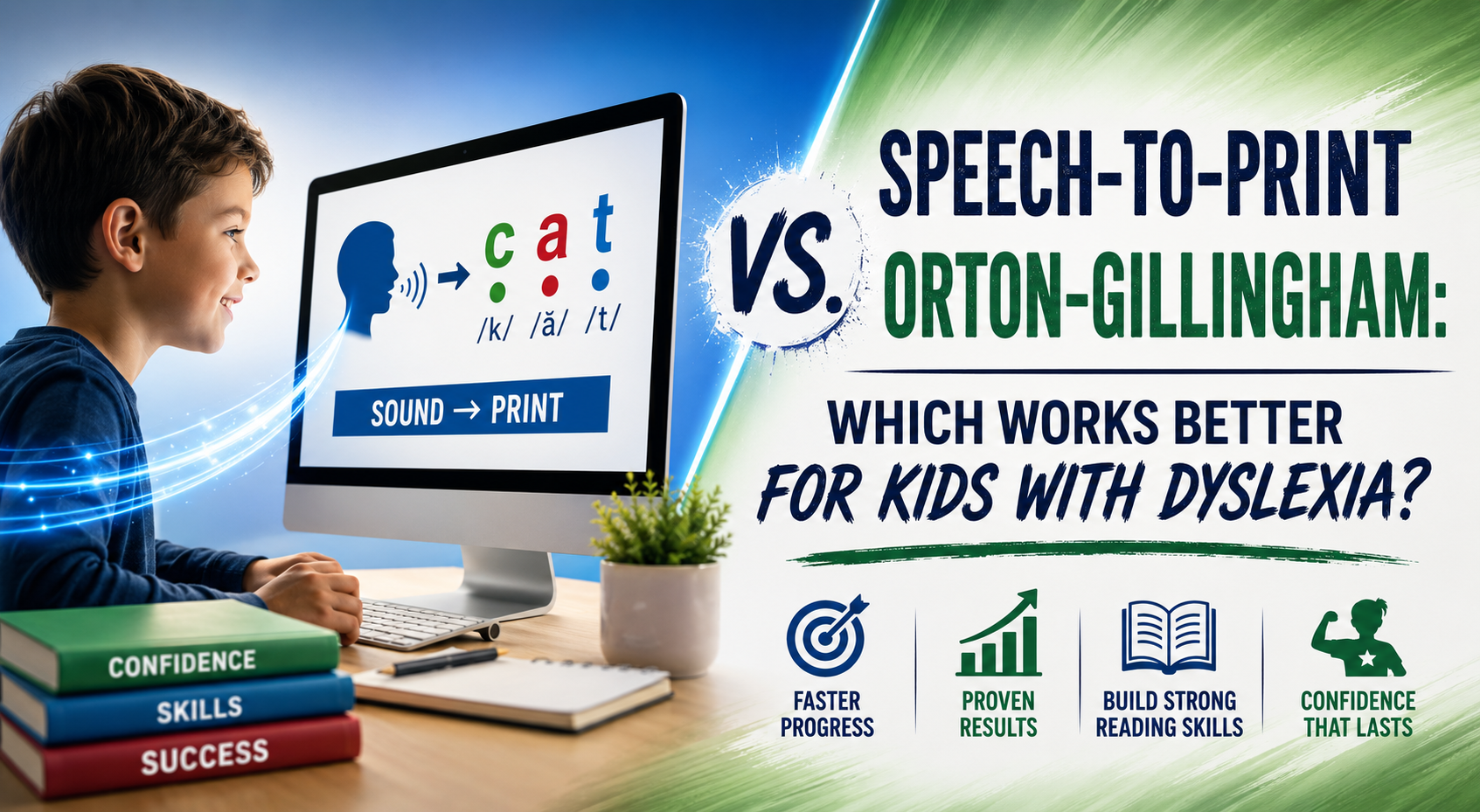
Both speech-to-print and Orton-Gillingham are structured, systematic reading approaches, and both are far better than anything a typical general tutor will offer. But they are built on entirely different starting points. That difference matters immensely, especially for a child who is already behind and needs to catch up fast.
I'm Catherine Mitchell, a certified dyslexia specialist based in Fort Worth, Texas, working virtually with families across the state and beyond. In my practice, I use a speech-to-print methodology because I regularly see children who haven't made adequate progress with traditional methods make fast, measurable gains once we shift our strategy.
I see it so consistently that I back my virtual 12-week intervention program with a written grade-level guarantee. If your child completes the 12 weeks as designed and does not gain a full grade level in reading, we keep working together until they do. No exceptions, no fine print.
What Is Orton-Gillingham?
If you have spent any time researching dyslexia, you have probably heard of Orton-Gillingham (OG). It is often described as the gold standard for dyslexia intervention, and many parents trust it for that exact reason.
For a long time, it was one of the only structured approaches widely known by teachers and parents. It became the default option for families who wanted something more effective than whole-language or balanced literacy instruction, which was clearly failing a lot of children.
When you look at the actual data, however, the picture is much messier than the gold standard marketing suggests. If you visit the website for almost any big-name OG curriculum, you will find pages dedicated to evidence-based research and official-looking data. But when independent scientific bodies look under the hood, those claims quickly fall apart.
Take the U.S. Department of Education’s What Works Clearinghouse, the federal agency that reviews educational data. When they analyzed the research on these exact programs, they found that virtually zero of the studies conducted on programs like Barton or Wilson met high scientific standards for students with learning disabilities. The proof these companies use in their marketing usually relies on incredibly weak study designs. They often highlight simple before-and-after test scores on a tiny group of kids without using a control group, meaning there is no way to prove the program actually caused the progress. Or, they compare their results to completely broken classroom methods like balanced literacy. Surviving a comparison to a method that fails almost every kid does not make a program elite.
This is exactly why a landmark 2021 meta-analysis in the journal Exceptional Children found that OG interventions did not statistically outperform other structured reading instruction on foundational skills. It is not that OG never helps. It just means the independent science does not show it to be clearly superior to other well-designed, structured approaches.
The Misconception About Certification and Programs
I see a common misconception among parents, especially in mom groups on Facebook, where a fully OG-certified provider is assumed to be automatically more effective than someone who uses the tools without formal certification. In the students I work with, I have not seen that difference. Many of my clients have worked for months or years with highly trained, fully certified OG practitioners, while others worked with tutors using the programs without full certification. Both groups of children still arrived at my practice reading far below grade level.
This is not a criticism of those practitioners. Most of them chose OG because they were told it was the ultimate solution, invested significant time and money in their training, and genuinely care about helping students. The problem is less about the person and more about the design, pacing, and mechanics of these tracks, which parents often lump together just because they share the OG label.
In reality, these programs are completely different tools built for completely different jobs:
Barton and Wilson are heavy-duty, multi-year clinical interventions.
Lexia is an adaptive, digital classroom supplement that schools run on computers as a daily general routine.
All About Reading is a standard developmental homeschool curriculum.
If you look at homeschooling groups online, you will see All About Reading praised to high heaven. Parents rave about it because it is gentle and easy to teach, which stops the daily reading meltdowns. But if you look closer at those same comment threads, you see a heartbreaking pattern. The very parents doing the praising will casually mention that their fourth or fifth grader is still working through the early primary levels. The program feels like a win because it is low-stress, but the child is still years behind where they need to be. It is a slow-drip method that was never designed to be an intensive, rapid intervention tool for a child who needs to close a massive gap.
Whether it is a software app, a homeschool phonics track, or a clinical intervention, they all share the exact same flaw. They rely on a slow, rule-heavy progression that takes two to three years, and sometimes longer, to complete. For a child who is already one, two, or three grade levels behind, that timeline simply does not close the gap quickly enough.
I regularly meet students who have worked through large portions of these programs, and sometimes finished them, yet still read slowly and with great effort. They can tell you rules, name syllable types, and explain exception patterns, but their reading does not feel automatic. Their fluency is weak, they avoid reading when they can, and they still do not experience themselves as capable readers. That tells me the core issue has not been resolved.
What Is Speech-to-Print?
The research on how the brain learns to read points us in a completely different direction. We need instruction that builds fast, efficient connections between spoken language and print, rather than a long-term dependence on memorizing rules. This is where the speech-to-print approach comes in.
The most frustrating part is that none of this is new information. If you look back fifty years, a fascinating thing happened in the scientific community. Neuroscientists, linguists, and cognitive psychologists working completely independently at different universities all began studying the reading brain. Without ever collaborating, they all arrived at the exact same conclusion: human brains are naturally wired for spoken language, and the only way to build an efficient reading brain is to anchor print directly to speech.
Yet, for decades, this incredible consensus was largely ignored by schools, popular curriculum publishers, and university teacher prep programs. The education system spent half a century ignoring this mountain of data in favor of broken approaches like whole language and balanced literacy.
But even within the specific world of dyslexia intervention, the clinical proof for this speech-first philosophy has been hiding in plain sight. In 1996, a landmark study published in the Annals of Dyslexia (the official research journal of the International Dyslexia Association) examined a foundational speech-to-print framework called Phono-Graphix. The data demonstrated that putting those fifty years of brain science into practice produced significant standard score gains in word identification and word attack up to seven times faster than traditional, rule-based programs.
Today, modern speech-to-print frameworks continue to outperform old-school paths in rigorous settings. For instance, the core methods behind the Reading Simplified model are backed by high-quality randomized controlled trials out of the University of North Carolina at Chapel Hill, showing massive acceleration in decoding. Over in the UK, a speech-to-print framework called Sounds-Write is widely utilized because independent evaluations show substantial, rapid growth in fluency and spelling for older, struggling elementary and middle school students.
However, there is a catch that parents need to understand. While these speech-to-print tools are incredibly powerful, they are not magic wands you can just buy off a shelf and hand to a child. Every struggling reader has a completely unique set of skill gaps. A boxed curriculum cannot look a student in the eye, analyze their specific cognitive blocks, and instantly know how to tweak a lesson when that child gets stuck.
True intervention requires an experienced specialist who understands the deep mechanics of how the brain processes language. Because I have advanced training across multiple linguistic phonics frameworks, including direct coaching from the creators of these methods, I do not rely on a rigid, one-size-fits-all script. Instead, I use diagnostic assessments to see exactly where a child's reading foundation is cracking. From there, I dynamically blend and customize materials from different programs to fit that specific student's immediate needs.
How They Differ
Parents often want a simple answer about which approach is better. The honest reality is that while both frameworks are structured and systematic, they are built on fundamentally different philosophies, and they yield very different results for a child who is already behind.
The Orton-Gillingham Approach
The Starting Point: Starts with the printed letters on the page and moves backward toward the sound.
The Mechanics: Highly rule-heavy. It requires children to look at printed letters, recognize vowel pairs, categorize them into one of six formal syllable types, and recall a sound rule to decode the word.
Reading and Spelling: Treated as parallel but separate tracks. A child often practices reading a list of words, and then shifts to a separate drill to practice spelling them.
The Timeline: Moves at a very slow, methodical pace, frequently taking two to three years to complete.
The Focus: Heavily reliant on visual charts, rule sheets, and tactile multisensory routines to help kids memorize definitions.
The Speech-to-Print Approach
The Starting Point: Starts with the spoken sounds the child already knows and moves forward toward the print.
The Mechanics: Intuitively simple. The child says a word, isolates the individual sounds they hear, and learns the matching visual codes for those exact sounds, building the word from the inside out.
Reading and Spelling: Integrated as two sides of the exact same coin. Reading is decoding print into sound, and spelling is encoding sound into print. They are taught simultaneously as a single, reversible skill.
The Timeline: Designed for rapid gap-closing, producing measurable progress in weeks and months rather than years.
The Focus: Built entirely around orthographic mapping, which rapidly bonds pronunciations directly to spellings in the permanent memory.
The defining difference comes down to cognitive load. Orton-Gillingham splits a child's attention by forcing them to manage a massive internal catalog of rules while trying to read. Speech-to-print unifies the process. By treating reading and spelling as the exact same skill, it frees up the brain's working memory, allowing a struggling reader to finally achieve true automaticity and actually understand what they are reading.
What the Research Suggests
When you look at the wider body of modern cognitive science, the data clearly supports explicit, systematic instruction that aligns with the brain’s natural architecture. Speech-to-print is the purest application of this science because it targets phonological awareness and letter-sound alignment right from day one, without any of the unnecessary rule-based detours.
Decades of literacy research show that treating reading and writing as separate subjects is a massive mistake. When you integrate spelling directly into reading instruction, reading outcomes improve dramatically. This is exactly why the speech-to-print model is my tool of choice for children who need to make rapid, undeniable progress. Spelling forces the brain to pay attention to every single sound and letter in a word, which is the exact mechanism that drives orthographic mapping.
I see the proof of this every single week in my practice. Most of the families who come to me have already tried the traditional routes. Their children have sat through months or years of intensive, rule-based tutoring and still are not making meaningful gains. They do not need more regulations to memorize, and they certainly do not need to move any slower. They just need a completely different entry point. For these kids, starting with the spoken sounds they already know is the exact key that finally unlocks the print on the page.
Which One Fits Your Child?
For a very young child just starting out, the absolute priority is early, effective instruction. When reading vulnerabilities are identified and addressed right away, they rarely morph into long-term academic struggles.
But if you have an older child who is already stuck behind grade level, the pacing of their intervention becomes the most critical factor. If your child has been going to tutoring sessions week after week, month after month, and the gap between them and their peers isn't visibly closing, it is time to change the strategy.
To figure out if a pivot is necessary, ask yourself a few honest questions:
How far behind is your child right now? If they are multiple grade levels behind, a slow-paced program will keep them behind for years.
Have they already spent significant time in an OG-based program? If a method hasn't worked after a year, doubling down on it rarely produces a different result.
Is their spelling drastically weaker than their reading? A massive disconnect here means they are missing the deep phonetic foundation that speech-to-print naturally targets.
Does your child desperately need a win? If their self-esteem is plummeting, they cannot afford to wait two years for visible progress. They need to experience success now.
A Different Way Forward at Blossoming Skills
This exact sense of urgency is why I founded Blossoming Skills. I do not believe in signing families up for multi-year tutoring contracts that leave children trapped in a cycle of endless remediation.
Instead, I offer a virtual 12-week reading intervention program specifically designed to target and close these exact reading gaps rapidly. This approach combines intensive, structured lessons with direct parent coaching and customized materials for home practice.
The philosophy here is simple: the ultimate goal of good tutoring is to get the child to a place where they no longer need it. We focus on building a bulletproof reading foundation and giving you the exact tools required to sustain that momentum at home, allowing your child to exit the intervention cycle as quickly as possible.
When a child finally learns to read with true automaticity, the entire trajectory of their education changes. The daily homework battles disappear, their natural confidence returns, and reading stops being a source of family anxiety.
Final Thoughts
At the end of the day, both Orton-Gillingham and speech-to-print are explicit, structured approaches to reading. Neither one relies on guessing. But the critical difference lies in where they begin, how tightly they lock reading and spelling together, and how quickly a struggling child can catch up to their peers.
For the child who is already falling behind and needs to close a massive gap sooner rather than later, the slow drip of memorized rules is rarely the answer. Speech-to-print offers a direct, efficient path that works with the brain's natural wiring rather than overloading it.
If you are ready to step off the multi-year tutoring treadmill and want to see what fast, automatic reading looks like for your child, let's connect. You can book a free Clarity Call at dyslexiaspecialisttx.com to talk through your child’s specific needs and see if my 12-week program is the right match to finally unlock their potential.

DFW Schools "Fixed" Reading Instruction Years Ago. So Why Are Our Kids Still Stuck?
Texas forced every elementary teacher into "Science of Reading" training years ago, yet DFW reading scores are still cratering and state takeovers are happening in our own backyard. If your child is crying over sight-word flashcards, freezing up over clunky phonics rules, or parked in front of a school iPad, the problem isn’t their brain—it’s a system that traded one broken method for another. Here is the raw truth about what is actually happening in local classrooms, and the exact strategy your child needs to finally close the gap.
DFW Schools Shifted Their Reading Instruction Years Ago. So Why Are Our Kids Still Stuck?
The state pushed the "Science of Reading" changes hard, and Texas schools spent years putting them in place. It's been over six years since House Bill 3 required elementary teachers to complete the Texas Reading Academies. Districts all over the DFW area put in serious time and money to move away from the old balanced literacy methods. Parents were told the problem was finally fixed.
But the numbers tell a different story. A lot of kids are still struggling.
The issues run deep. Just look at Fort Worth ISD. The state had to take over the whole district, and one of the main reasons was the reading data. Only 34% of their students were at or above grade level.
The pandemic made things worse, but Texas schools already had a big literacy problem long before 2020. All the closures did was force parents to see up close what was really happening every day at the kitchen table.
This isn't only an urban problem. The latest Texas Academic Performance Reports show the same struggles across our suburbs. Arlington ISD is at 43%, Dallas ISD at 47%, Denton ISD at 49%, Mansfield at 57%, HEB at 58%, and Northwest ISD around 64%. Even the higher-performing districts have hidden struggles. Frisco ISD sits at 74% and Southlake Carroll at 91%. Those averages hide plenty of kids who are falling behind. In those areas, parents can usually afford outside help right away. A lot of bright kids also get by early on by memorizing words visually. That trick works until fourth or fifth grade when the reading gets harder and it suddenly falls apart.
Fortunately, these late-elementary academic crashes are entirely avoidable if we catch the warning signs early enough. If you have a preschooler, kindergartener, or first grader, see my strategic guide on Can Reading Struggles Be Prevented? What Every Parent of a Young Learner Needs to Know.
So after all these years and new mandates, why are so many kids still slipping through?
Many schools simply replaced one rigid approach with another. They went from the old guessing games to heavy rule-based phonics programs rooted in traditional Orton-Gillingham. Kids went from too little structure to drowning in abstract rules, syllable types, and sayings like "when two vowels go walking, the first one does the talking."
Structured phonics is important. But loading kids up with too many complicated rules can overwhelm their working memory. They use up all their brain power trying to remember the rules instead of actually reading the word and understanding what it says.
On top of that, districts rely heavily on apps like Lexia Core5, i-Ready, Amira, or Imagine Learning to manage big classes. The truth is, an app cannot teach a struggling reader. It might reinforce skills for kids who catch on easily, but it can't give the moment-by-moment human guidance a child with real reading challenges needs. And these days kids do so much work on iPads that parents barely see any handwriting anymore.
Brain research is clear on this. The physical act of writing letters by hand strengthens the reading networks in the brain in ways that typing or touching a screen never will.
Many classrooms also still send home sight word lists for kids to memorize by shape — a leftover from the old whole-language days that goes against how the brain actually learns to read.
The Illusion of School Dyslexia Graduation
I spent over a decade in public school classrooms and watched too many smart, creative kids lose confidence because reading was so hard for them. One of them was my own daughter. That experience is exactly why I left the system and started Blossoming Skills.
The gaps become obvious during the full assessments I do with new clients. Just last week I started with a 6th grader who had graduated from her school's dyslexia program. Her mom thought the reading was probably okay and the school said she was fine, but her spelling and writing were way behind.
My testing showed the truth: word recognition at 9th grade level, but phonological awareness at 1st grade, spelling at 1st grade, and phonemic awareness at 2nd grade. She had been masking the problem with strong visual memory and memorizing whole words.
I see this all the time. Kids finish the school's dyslexia program and everyone thinks they're caught up. In reality, many still have major holes in their basic sound skills. Bright kids are especially good at hiding it, so school tests miss the real issue.
But real progress is possible. I just finished the 12-week program with a 5th grade boy who started with speech delay and apraxia. He came in reading at a 2nd grade level. By the end he was reading 3rd grade material on his own and handling 4th grade with support. His foundation is finally strong. His mom told me that now she knows how to help him, their practice time actually works and she's seeing real progress almost every day.
A Better Way Forward
This is why I use a speech-to-print approach at Blossoming Skills. We start with the spoken language your child already knows and map it directly onto print. No heavy rule memorization. No overwhelming abstract lists. Just a natural process that fits how the brain actually works.
If your child can talk in detail about science, explain every part of Minecraft, or have smart conversations but shuts down when trying to read a paragraph, it's not about intelligence. It's the teaching method.
If you want a deeper breakdown of exactly how speech-to-print differs from traditional Orton-Gillingham, you can read my full comparison here: Speech-to-Print vs Orton-Gillingham – Which Works Better for Kids with Dyslexia.
I work with both the child and the parents because the real goal is independence. I don't want families stuck in years of tutoring. Once the brain properly maps the code, the need for extra help goes away.
My 12-week virtual program is built around clear results. If your child finishes the program as planned and doesn't gain at least a full grade level in reading, we continue working together at no extra charge until they do.
My goal is simple: help DFW kids become strong, confident, independent readers — one student at a time. The schools often miss the mark, but your child doesn't have to stay stuck.
If you're watching your child struggle with iPad work, get upset over sight word lists, or freeze up on phonics rules that don't make sense, let's talk. Book a free Clarity Call at dyslexiaspecialisttx.com. We'll look at what's really happening at home and figure out a practical path forward.
Written by Catherine Mitchell, Certified Dyslexia Specialist Blossoming Skills Reading Therapy | Fort Worth, TX dyslexiaspecialisttx.com
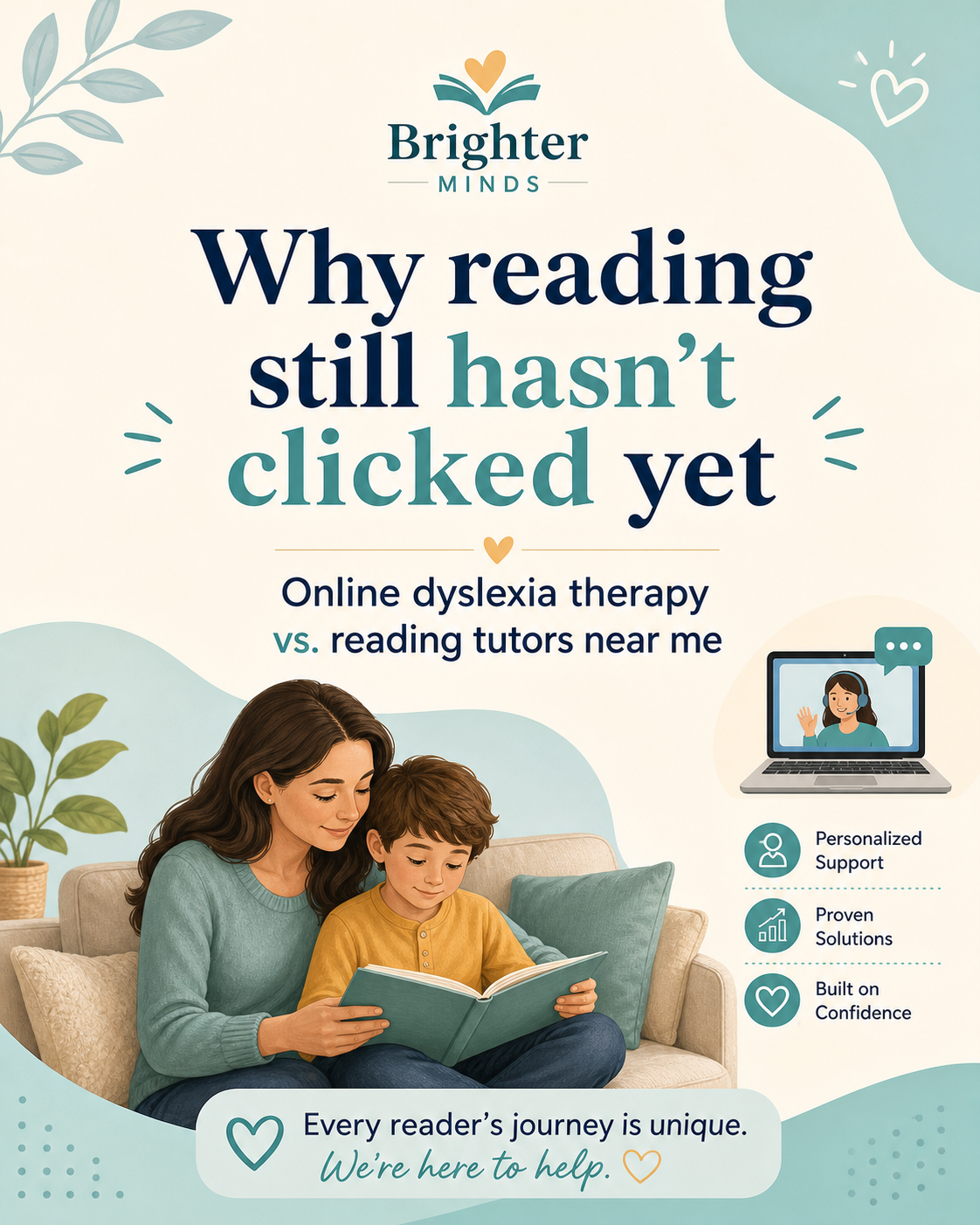
Online Dyslexia Therapy vs. “Reading Tutors Near Me”: What Parents in Fort Worth, Coppell, Irving, and Across Texas Should Know
Parents often search for “reading tutor near me” or “online dyslexia therapy” and see the same kinds of results—but these options work very differently. This post explains how a dyslexia specialist’s online therapy compares with traditional reading tutoring, so you can choose the support that actually matches your child’s needs and history.
Whether you’re in Fort Worth, Coppell, Irving, Southlake, or another Texas community, you’ve probably searched for “dyslexia tutor near me” or “online dyslexia therapy” and seen the same kinds of results…
You are listening to your child read, and they come to the word house.
They say home.
It makes sense in the sentence. It means almost the same thing. They may not even realize they read the wrong word.
Or maybe the word is horse, and they say house.
The word is little, and they say like.
The word is jumped, and they say jumping.
Sometimes the guess starts with the same letter. Sometimes it fits the meaning of the sentence. Sometimes it is a similar word they already know.
But it is not the word on the page.
This is often the point when parents feel completely stuck.
“My child is so smart. We’ve tried tutors. We’ve done school interventions. We’ve practiced at home. Why are they still guessing at words instead of reading them?”
It can be especially confusing when a child understands stories, has great ideas, and seems capable in so many other areas — but continues to substitute words, struggle through unfamiliar words, or read in a way that feels inconsistent from one day to the next.
Often, the problem is not that a child has not had enough practice or support. It is that they have not yet been taught to approach printed words in a way that helps them read accurately and independently.
When reading feels unreliable, children naturally begin using what does work for them: meaning, memory, pictures, sentence context, or the first sound in a word. Those strategies may help them get close to the word, but they do not consistently help them read the word that is actually on the page.
When a Child Reads for Meaning but Misses the Actual Word
A child who reads home instead of house is not making a random mistake. They are paying attention to the meaning of the sentence.
For example, the sentence may say:
We walked back to the house after playing outside.
Your child reads:
We walked back to the home after playing outside.
The sentence still makes sense. In fact, if you were only listening for comprehension, the mistake might be easy to overlook.
But the print says house, not home.
Reading is not only understanding the general meaning of a sentence. A child also needs to accurately read the specific words the author wrote.
When children regularly substitute similar words, it can be a sign that they are relying more heavily on context than on the letters and sounds within the word itself.
What Word Guessing Can Look Like
Guessing does not always look like a child blurting out a completely unrelated word. Often, their substitutions are close enough that adults initially assume they are simply rushing.
You may notice your child:
Reads home instead of house.
Reads pony instead of horse.
Reads small instead of little.
Reads running instead of ran.
Reads a word correctly once, then misses it later on the same page.
Uses the picture or the storyline to predict a word.
Looks only at the first letter and guesses the rest.
Skips unfamiliar words or replaces them with easier words.
Struggles much more with unfamiliar words or made-up words.
Understands stories well when listening, but struggles when reading independently.
These substitutions can be especially confusing because the child may appear to understand the story perfectly well. They may answer comprehension questions, discuss the plot, and sound fluent at times.
But underneath that, they may not be accurately decoding the words.
Why Does This Happen?
Children begin guessing at words because guessing sometimes works.
In very early books, there may be repeated sentence patterns and strong picture clues. A child can look at the illustration, remember part of the sentence, notice the first letter, and come up with a word that seems right.
For a while, that can look like reading progress.
But as books become more complex, children are expected to read longer words, new vocabulary, and sentences that cannot be predicted from pictures or context. At that point, a child who has relied on guessing may begin to struggle much more noticeably.
Parents may see:
Reading becoming slower and more frustrating.
More substitutions and skipped words.
Difficulty with chapter books or grade-level passages.
Weak spelling, even when the child recognizes some words in reading.
A child who begins to avoid reading or says it is boring.
This is often the point when a parent realizes that the extra practice and support their child has received have not addressed the reason accurate reading is still so difficult. Their child may be using context and memory to work around words they do not yet know how to read reliably.
Is Guessing at Words a Sign of Dyslexia?
It can be.
Not every child who substitutes words has dyslexia, but consistent guessing is something worth paying attention to, especially when it happens alongside difficulty with sounding out unfamiliar words, spelling, reading fluency, or remembering words from one page to the next.
Children with dyslexia are often very good at understanding language and meaning. They may have strong vocabulary, excellent listening comprehension, and thoughtful ideas. Their difficulty is often in the process of connecting the sounds in spoken words to the printed patterns on the page.
Because they understand meaning so well, some children become very skilled at using context to compensate.
A child may appear to be doing fairly well in early reading because they can make intelligent guesses. The difficulty becomes more noticeable when the reading demands increase and accuracy matters more.
Why “Look at the Picture” Can Make the Problem Worse
When a child gets stuck on a word, adults naturally want to help.
It can be tempting to say:
“Look at the picture.”
“What word would make sense?”
“Think about the sentence.”
“What do you think it says?”
Those prompts may help a child guess the word in that moment. But they do not teach the child how to read the word.
If the word is house, a picture might help the child say home. The sentence might help them predict a place someone lives. But neither one teaches them to look through the letters in house and connect them to the word they are reading.
Context is helpful for understanding a story. It should not be the primary strategy a child uses to identify words.
Strong readers use the print first and then confirm that what they read makes sense.
What Should a Child Do Instead of Guessing?
The goal is to help children understand that the word itself contains the information they need.
Instead of relying on a picture or thinking of a word that would make sense, a child needs to learn to attend to the sounds represented by the letters in the word.
For example, when reading house, they need to notice the sounds in the word and the letter pattern that represents those sounds. When reading home, they need to recognize that although the meaning is related, the printed word is different.
This shift is important.
The question changes from:
“What word would make sense?”
to:
“What word do these letters say?”
In targeted reading intervention, children work on skills such as:
Hearing and identifying the individual sounds in words.
Mapping those sounds to letters and letter patterns.
Reading all the way through a word instead of using only the beginning.
Blending sounds smoothly into accurate words.
Reading unfamiliar words without relying on pictures or context.
Spelling words by listening for sounds and representing them in print.
Applying those skills in sentences, passages, and real reading.
When a child learns how to work through printed words accurately, reading becomes far less dependent on guessing.
What Parents Can Say During Reading Practice
When your child substitutes a word, keep the correction simple and neutral.
If your child reads home instead of house, you might say:
“That word means something similar, but check the word on the page.”
“Look through the whole word.”
“You said home. This word is house. Let’s read it again.”
“Make sure the word you say matches the letters you see.”
Try not to turn every mistake into a long lesson in the middle of reading. The goal is to help your child notice that meaning alone is not enough; the word must also match the print.
If this happens often, however, correcting mistakes during homework or bedtime reading will probably not be enough to change the pattern. A child who regularly guesses needs instruction that directly teaches the missing reading skills.
Why More Reading Practice Is Not Always the Answer
Parents are often encouraged to have their child read more.
Reading together is valuable. Books matter. Practice matters.
But if a child is reading by guessing, more independent reading may simply give them more opportunities to practice guessing.
A child who reads home every time they see house is not going to fix that pattern simply by reading more pages. They need support that helps them connect the sounds and letters in the word accurately.
This is why some children read every night and still seem stuck. They are putting in the work, but the underlying reading difficulty has not been addressed.
When It May Be Time to Seek Specialized Help
Occasional word substitutions can happen with any child, especially when they are tired or rushing.
But it may be time to look more closely if your child frequently:
Substitutes similar-meaning words.
Guesses from the first letter or picture.
Struggles to sound out new words.
Reads inaccurately despite strong comprehension.
Spells far below expectations.
Avoids reading or becomes frustrated quickly.
Has received extra help but continues to rely on guessing.
A reading assessment can help identify whether your child is struggling with sound awareness, decoding, spelling, fluency, or a combination of skills.
More importantly, it can help determine what kind of instruction will actually move them forward.
Reading Should Not Feel Like a Guessing Game
A child who substitutes home for house may clearly understand the story.
But they still need to learn how to read the exact word on the page.
Accurate reading matters because each year, school reading becomes more dependent on new vocabulary, longer words, and text that cannot be predicted from context. The earlier a child learns to approach words accurately, the more confidently they can handle the reading demands ahead.
At Blossoming Skills Reading Therapy, I work one-on-one with children who are relying on guessing, memorizing, or context to get through reading. My 12-Week Reading Breakthrough Program begins by identifying exactly where a child’s reading process is breaking down and then providing targeted instruction in sound-to-print mapping, decoding, spelling, and accurate reading.
The goal is not for a child to become better at guessing what a sentence might say.
The goal is for them to look at the word on the page and know how to read it.
Concerned That Your Child Is Guessing Instead of Reading?
A Reading Clarity Call can help you understand what you are seeing, whether your child may benefit from specialized support, and what the next step could look like.
Book a free Reading Clarity Call today to learn how targeted reading intervention can help your child become a more accurate, confident reader.
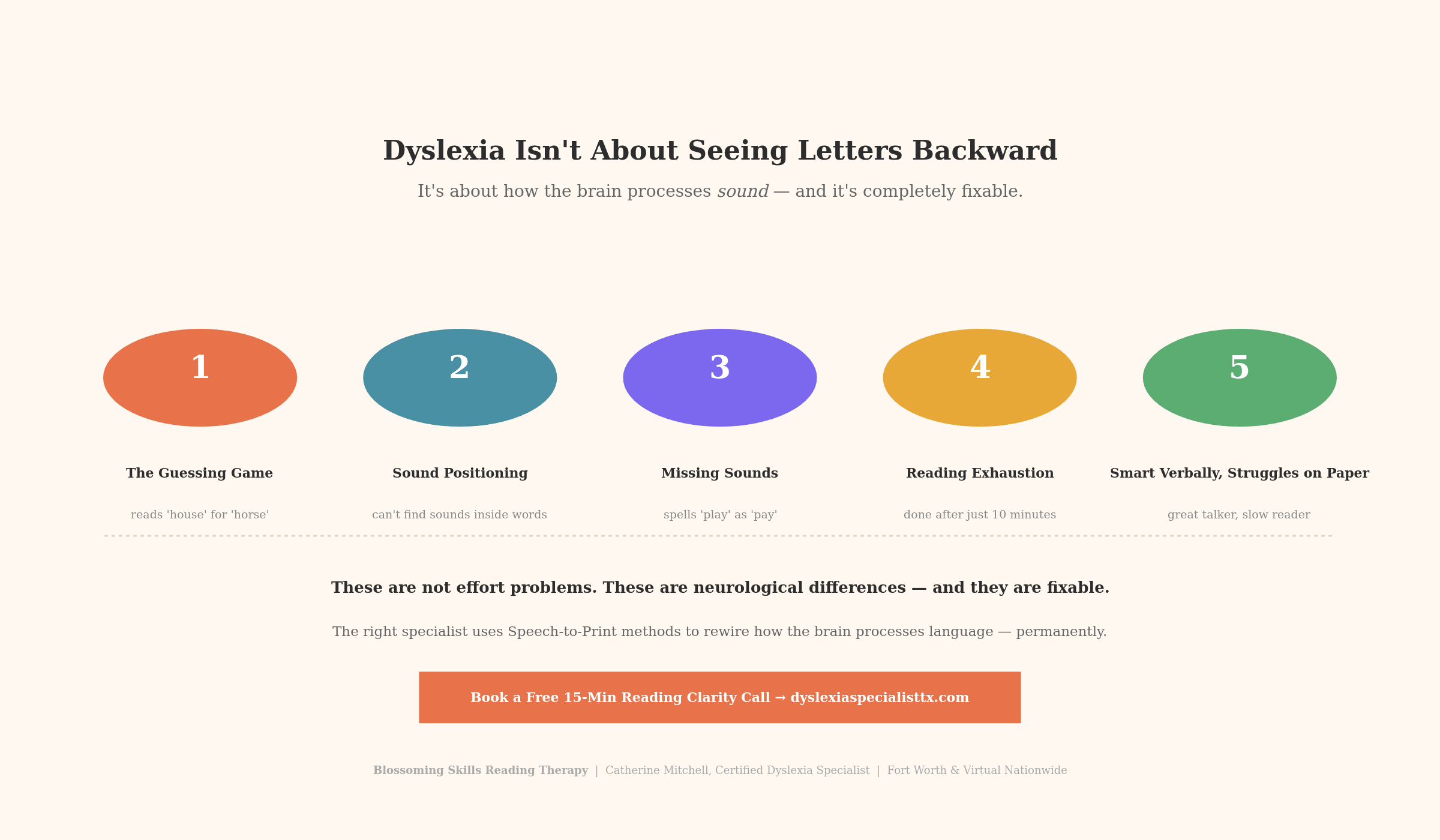
Dyslexia in Fort Worth: What It Really Looks Like.
Is your child smart in everything but reading? Learn 5 real signs of dyslexia in children — and why more practice isn't the answer. Fort Worth & virtual nationwide.
You know your child is bright. You see the quick wit, the curiosity, the ability to hold a surprisingly deep conversation about topics they love.
But the moment it's time to read? The light in their eyes dims.
In homes across Fort Worth — from Keller to Mansfield — the reading homework battle is a nightly reality. Parents ask me all the time: "Is my child just not trying?"
The answer is almost always no.
What looks like guessing, laziness, or not paying attention is almost always a biological difference in how the brain processes the sounds of language. It has a name. It has a cause. And it is completely fixable with the right intervention.
Here is what Dyslexia actually looks like in real children — and what to do about it.
What Dyslexia Actually Is (It's Not About Seeing Letters Backward)
Most people think Dyslexia means a child sees letters reversed. That's a myth. Dyslexia is a phonological processing difference — a glitch in how the brain "grabs" and maps individual sounds onto written letters.
For a child with Dyslexia, the individual sounds inside words — called phonemes — are slippery. They can't hear where sounds live inside a word, which makes decoding print feel like solving a puzzle with missing pieces.
5 Signs Your Child May Have Dyslexia
1. The Guessing Game
Your child looks at the first letter of a word and takes a wild stab at the rest. They might read "house" for "horse" or "want" for "went." This isn't carelessness — it's their brain compensating for an unreliable sound map.
2. Sound Positioning Struggles
Ask your child to say "blast" without the /l/ sound. A child with Dyslexia often cannot identify where a specific sound lives inside a word — which makes spelling and decoding feel impossible.
3. Missing Sounds in Spelling
They spell "play" as "pay" or "train" as "tran." Their brain hasn't fully captured the architecture of the word, so sounds quietly drop out.
4. Reading Exhaustion After 10 Minutes
Because every single syllable requires conscious, effortful decoding, children with Dyslexia are often mentally depleted after a very short reading session. This is not attitude. This is a brain working three times as hard as it should have to.
5. Strong Verbal Skills, Weak Reading Skills
This is the hallmark contrast. Your child can tell you an elaborate, detailed story — but reading or writing that same story on paper is a completely different struggle. Their intelligence is intact. The input/output system is misfiring.
Why Traditional Tutoring Doesn't Work
More practice does not fix a processing difference. You cannot drill your way out of a phonological glitch.
What works is Speech-to-Print intervention — a method that starts with the spoken sounds your child already knows and builds a systematic bridge to the written page. This is the foundation of our 12-Week Reading Breakthrough Program, and it is why our students gain an average of one full grade level in 12 weeks.
Virtual Specialist Support for DFW Families
I work with families virtually across the entire DFW Metroplex — including Fort Worth, Keller, Southlake, Colleyville, Highland Village, Mansfield, Grapevine, and Flower Mound — with no commute, no waiting room, and no traffic on I-35.
Your child learns best at home. That's exactly where we meet them.
Don't Wait for the Next Parent-Teacher Conference
Texas schools provide accommodations. They rarely provide the high-intensity, 1:1 intervention needed to actually close the reading gap.
Book your free 15-Minute Reading Clarity Call — we'll talk through your child's specific struggles and tell you honestly whether our program is the right fit. Free. No pressure. Just clarity.
Based in Fort Worth, Blossoming Skills Reading Therapy provides virtual 1:1 dyslexia intervention for families in Prosper, Grapevine, Argyle, Richardson, Plano, Frisco, and across the state of Texas.
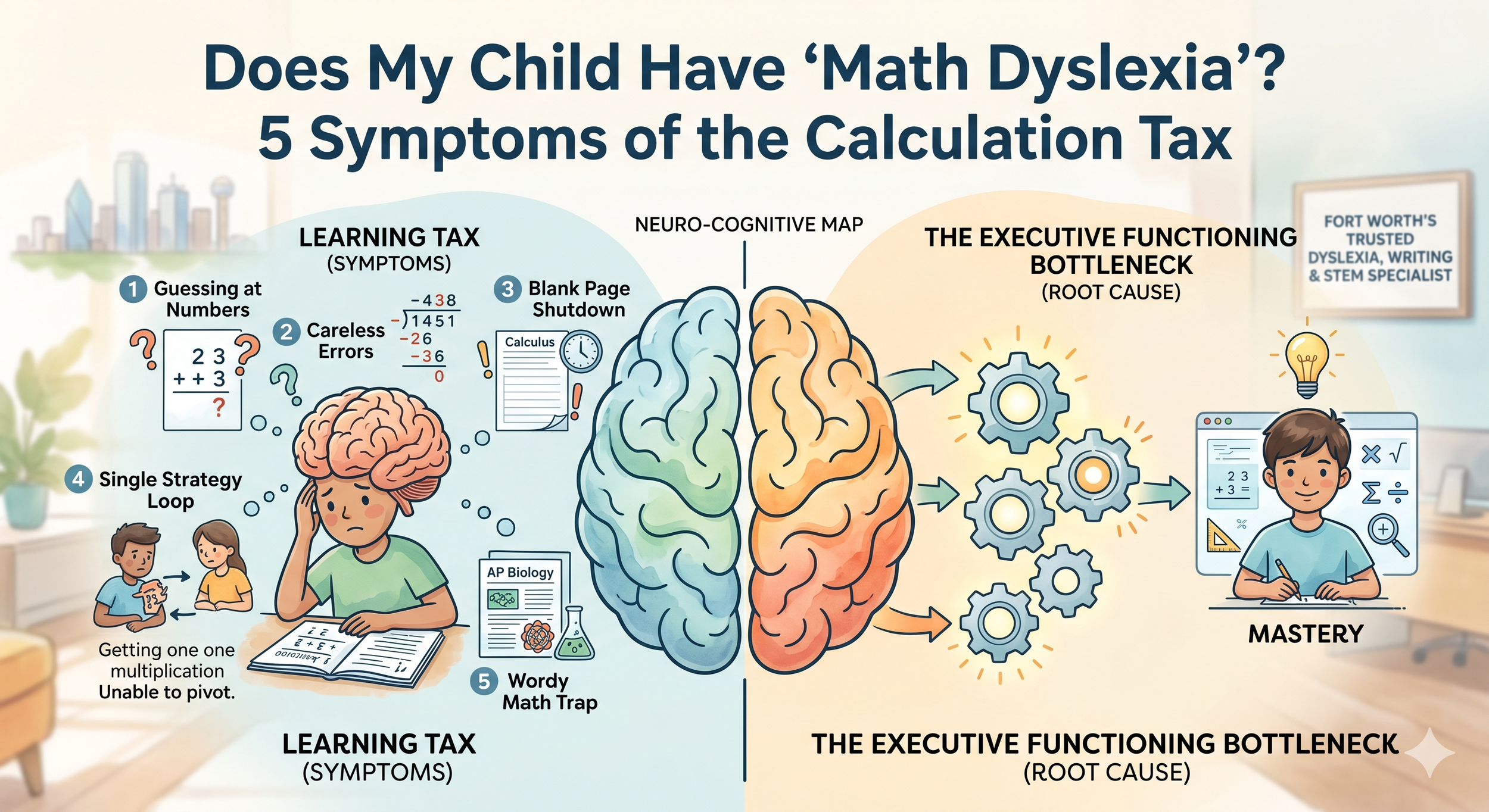
Does My Child Have Dyscalculia? 5 Signs of the Calculation Tax (What Parents Call "Math Dyslexia")
Is your bright child failing math? Discover the 5 hidden symptoms of math dyslexia (dyscalculia) and learn how the Executive Functioning Bottleneck causes the 'Calculation Tax' even in gifted students.
You know your child is brilliant. They can build complex LEGO worlds, explain the entire Marvel timeline from memory, or hold a surprisingly deep conversation about history.
But the moment math homework comes out? The shutter comes down.
If your child is hitting a wall in math — despite being sharp in everything else — you've likely wondered if something more is going on. You may have heard the term Dyscalculia, or what many parents search for as "Math Dyslexia."
At Blossoming Skills, we call it the Calculation Tax. It isn't a lack of intelligence. It's a specific Executive Functioning bottleneck that prevents bright, capable students from showing what they actually know — and traditional tutoring almost never fixes it.
Here are five signs your child is paying the Calculation Tax.
1. The "Small Stuff" Leak — Working Memory Overload
Does your child understand the big logic of a problem but consistently drop the details? They forget to carry the one, miss a negative sign mid-equation, or lose their place in a multi-step problem — even when they "knew how to do it" the night before.
This happens because their Working Memory — the brain's mental scratchpad — is maxed out. They're spending so much energy on high-level logic that the administrative details simply leak out. It looks like carelessness. It isn't.
2. The "Blank Stare" Shutdown — Task Initiation
If your child stares at a page for 20 minutes without writing a single number, they are not being lazy. For a neurodivergent brain, a complex math problem can look like an unclimbable wall. Their internal "start button" gets stuck because they can't identify the very first step — and so they freeze entirely.
This is not a motivation problem. This is a neurological one.
3. The "One-Way Street" Struggle — Cognitive Flexibility
Does your child get locked into one method, even when it clearly isn't working? Math and science require Cognitive Flexibility — the ability to recognize when a strategy is failing and pivot to a different approach. When that mental U-turn is missing, math stops feeling like a solvable puzzle and starts feeling like a personal failure.
4. Finger-Counting and Estimation Gaps — Number Sense
Many students with Dyscalculia struggle with Number Sense — the intuitive ability to "see" quantities and relationships rather than just manipulate abstract symbols. They may still count on their fingers long after their peers have stopped, or struggle to estimate whether an answer is even in the right ballpark. This isn't a study habit problem. It's a foundational wiring difference that requires specialist intervention, not more worksheets.
5. The "Wordy Math" Trap — Literacy Overload
Modern math and science — especially AP Chemistry, Physics, and standardized tests — are surprisingly literacy-heavy. For students with Dyslexia or ADHD, the way math is written and tested in school can feel like a foreign language. They get lost in the wordiness of the problem before they ever get a chance to apply their logical brilliance. Their math brain is strong. The delivery system is working against them.
Why "More Practice" Makes It Worse
Traditional tutoring almost always offers the same solution: more practice. But if your child is paying a Calculation Tax, more practice just means more exposure to the exact experience that's already destroying their confidence.
The bottleneck isn't the content. It's the neurological framework underneath it.
At Blossoming Skills, our STEM Accelerator — led by Mr. Syed, our Senior STEM & Dyscalculia Specialist — doesn't just reteach the syllabus. He watches your child work, identifies the exact moment their Working Memory maxes out, and rebuilds the mental framework from that precise point forward.
The result is students who stop relying on outside help and start owning the material independently.
We work virtually with families across Texas — including Fort Worth, Plano, Frisco, Allen, McKinney, Southlake, Flower Mound, Highland Village, Colleyville, Keller, Grapevine, Richardson, Mansfield, and nationwide — so distance is never a barrier to a math breakthrough.
Ready to Stop the Calculation Tax?
Download the Free Executive Functioning Snapshot — a 5-minute checklist that shows you exactly where your child's bottleneck is happening.
Book a Free 15-Minute Math Clarity Call — We'll talk through your child's specific struggles and tell you honestly whether the STEM Accelerator is the right fit. Free. No pressure. Just clarity.
The ‘Math Tax’: Why Brilliant Students Struggle in STEM (and How to Fix It)
Struggling with AP Calculus or Physics despite having a gift for logic? Learn how Blossoming Skills’ STEM specialist helps neurodivergent learners in Fort Worth outsmart the Learning Tax and achieve the grades their intelligence deserves.
You see the spark when your child talks about engineering, space, or complex logic. You know they are "crazy-smart." But then, the homework comes out. The Algebra equations become a battlefield, the AP Physics word problems lead to shutdowns, and the grades on the portal don't reflect the intelligence you see every day.
In our world, we call this the "Math Tax."
Just like the Writing Tax makes it hard for a dyslexic or dysgraphic student to get their ideas onto paper, the Math Tax is the invisible weight of navigating a "literacy-heavy" STEM curriculum. It’s the gap where high potential meets a teaching style that just wasn't built for a neurodivergent or highly logical brain.
Why "Traditional" Tutoring Often Fails
Most math tutoring in Fort Worth follows the same pattern: a college student or a general tutor sits down and repeats the same classroom instructions, just slower and louder.
But for a student with Dyslexia, ADHD, or a high-level logic-based learning style, the problem isn't a lack of effort—it’s a mismatch of mapping. * The Literacy Gap: Many advanced math and science courses are buried in word-heavy instructions. For a dyslexic student, the energy spent "decoding" the question leaves zero brainpower left to solve the actual math.
The Execution Trap: For students with ADHD or Dysgraphia, the multi-step organization required for AP Calculus or Chemistry can feel like a "brain clog." They know the answer, but they can’t show the work.
Meet the STEM Specialist Approach
At Blossoming Skills, we don’t do "homework help." We provide specialized STEM intervention. We’ve partnered with our Senior STEM Specialist, Mr. Syed, a Doctor of Dental Surgery (DDS) candidate who understands that high-level math is about logic, not just memorization. He doesn't just teach the syllabus; he mentors students through the "why" behind the numbers.
Whether it’s mastering AP Calculus BC, navigating Honors Physics, or tackling the SAT/ACT math section, our approach is built on three pillars:
Logical Deconstruction: Breaking complex theories into visual, logical steps that bypass the "literacy wall."
Strategic Pacing: Teaching students how to manage the "Math Tax" so they don't burn out halfway through a test.
Confidence Restoration: Moving from "I’m bad at math" to "I’m a logical thinker who needs a different map."
Real Transformation: From 500 to 572
We’ve seen the results firsthand. One of our recent students went from "just hoping to pass" to scoring a 572 on his SOL exams—a score the family never thought was possible.
This isn't magic; it’s the result of grades finally matching intelligence. When you remove the barriers and provide the right specialist, a student who was "surviving" starts to thrive.
Is your child paying the Math Tax?
If your child is brilliant in theory but struggling in the classroom, they don't need "more" of the same schoolwork. They need a different bridge.
From Elementary foundations to College-level Calculus, we are here to help Fort Worth students outsmart the Learning Tax and reclaim their academic confidence.
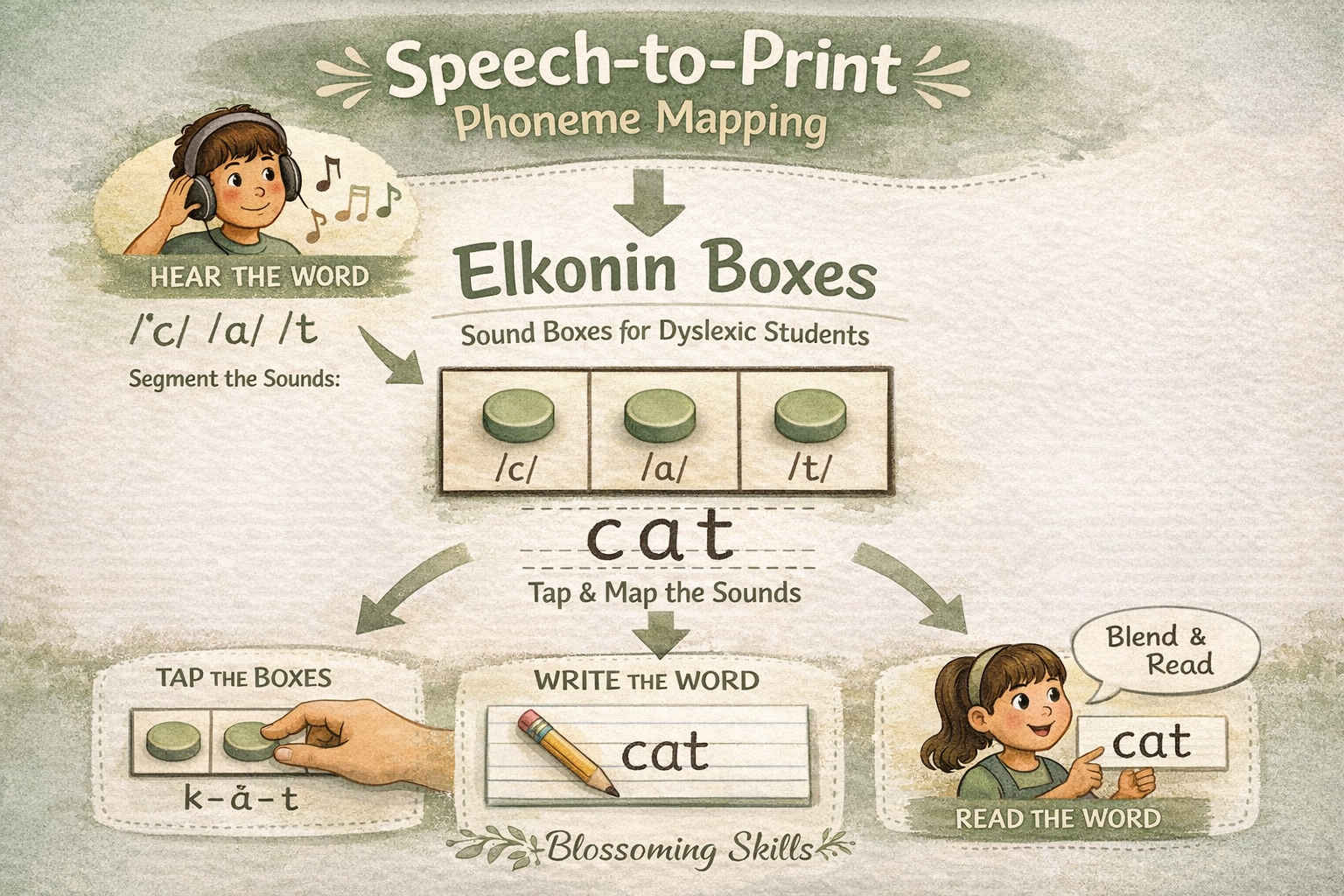
Dysgraphia in Fort Worth: Why Your Child Has "Big Ideas But a Blank Page"
Is your child struggling with reading or writing? Learn the signs of dyslexia and dysgraphia, from "sound positioning" to the "Writing Tax." A must-read for Fort Worth parents seeking expert virtual intervention.
Your child can tell you an elaborate, detailed story with full characters, emotions, and plot twists — completely off the top of their head.
But ask them to write that story down?
Three words. Maybe four. Then the pencil stops.
If this is your child, they are not being dramatic. They are not lazy. They are paying what we call the Writing Tax — and it has a name: Dysgraphia.
What Dysgraphia Actually Is
Dysgraphia is not just bad handwriting. It is a neurological disconnect between the brain's ideas and the hand's ability to execute them on paper.
For children with Dysgraphia, the physical and cognitive demands of writing — forming letters, managing spacing, retrieving spellings, organizing thoughts — all compete for the same limited mental bandwidth at the same time. The system overloads before a single sentence is finished.
5 Signs Your Child May Have Dysgraphia
1. The Stalled Pencil
Your child sits in front of a blank page for 20–30 minutes and writes nothing. The "mental load" of starting — deciding what to write, how to spell it, how to form the letters — is simply too high to launch.
2. Physical Complaints
They say their hand hurts. They use a white-knuckle "death grip" on the pencil. Writing is physically exhausting for them in a way it isn't for their classmates.
3. Mechanical Mix-Ups
You see inconsistent letter sizing, random capital letters mid-sentence, irregular spacing, and poor legibility — even when they are genuinely trying their hardest.
4. The Creative Gap
Brilliant storyteller out loud. Three "safe," simple words on paper. They deliberately choose easy words they know how to spell instead of the words they actually want to use — because writing the real word costs too much effort.
5. Ideas That Disappear Mid-Sentence
They start a sentence, lose track of where they were going, and abandon it. Their working memory cannot hold the idea AND manage the mechanical demands of writing at the same time.
Why Dyslexia and Dysgraphia Often Appear Together
Dyslexia and Dysgraphia are closely related. Both stem from a struggle with the sound-symbol code of written language. If a child hasn't mastered where sounds live inside words (Dyslexia), they cannot reliably retrieve those sounds and map them smoothly onto paper (Dysgraphia).
This is why treating one without addressing the other rarely produces lasting results — and why our Dysgraphia & Writing Intervention is built to address both the reading and writing sides of the same root cause. If your child also struggles with reading, learn more about our 12-Week Reading Breakthrough Program.
What Intervention Actually Looks Like
We use a Speech-to-Print approach that starts with the spoken sounds and systematically builds the bridge to the written page — reducing the cognitive load of writing so your child's real ideas can finally come through.
The goal is not neater handwriting. The goal is a child who can sit down, start a paragraph, and finish it — feeling proud of what they wrote.
Virtual Support for Families Across DFW
I work virtually with families across the DFW Metroplex — including Fort Worth, Southlake, Keller, Colleyville, Arlington, Mansfield,Grapevine, and Prosper — so there's no commute and no disruption to your family's schedule.
Ready to Turn "I Can't Write" Into "Look What I Made"?
Book your free 15-Minute Clarity Call — we'll talk through your child's specific struggles and tell you honestly whether our program is the right fit. Free. No pressure. Just clarity.
Based in Fort Worth, Blossoming Skills Reading Therapy provides virtual 1:1 dysgraphia intervention for families in Argyle, Lewisville, Allen, Highland Village, Plano, Frisco, and across the state of Texas.
Is Orton-Gillingham Actually the “Gold Standard” for Dyslexia? (What Parents Need to Know)
Is Orton-Gillingham the best for dyslexia? Discover why traditional OG "rules" can slow down progress and why pattern-based reading therapy is more effective for struggling readers.
Quick Summary for Parents:
The Challenge: Traditional Orton-Gillingham (OG) programs rely heavily on memorizing complex rules, which creates a working memory bottleneck for bright kids with dyslexia.
The Reality: Fluent reading doesn't happen by reciting rules. It happens through orthographic mapping and automatic pattern recognition.
The Solution: Shifting from rule-heavy memorization to direct sound-to-print mapping allows children to build reading fluency in months rather than years.
If you’ve spent any time searching for help for your struggling reader, you’ve likely heard the name Orton-Gillingham (OG). It’s frequently called the “Gold Standard” for dyslexia. School districts promise it, and tutors tout it as the only way to teach a child with reading difficulties.
But here is a reality many parents face: After two or three years of expensive OG tutoring, their child is still struggling to keep up with grade-level reading.
Why is there such a massive gap between the "Gold Standard" reputation and the actual results? As a reading therapist, I see "OG-fatigued" students every week. Here is why the traditional approach often falls short—and what the science says is actually more effective for fast, permanent progress.
How OG Became the “Gold Standard” (Without the Data)
It might surprise you to learn that while the principles of Orton-Gillingham are backed by science, many of the specific routines have surprisingly little modern research behind them.
OG became the leader because it was the first major movement to stand up against "Balanced Literacy" (the "guessing" method taught in most schools). Because OG was the only alternative that used phonics, it became the default recommendation. It wasn't necessarily the most efficient way for the brain to learn—it was just the only one that wasn't failing completely.
The Problem: The "Working Memory Bottleneck"
The biggest flaw in traditional OG is that it relies heavily on memorizing verbal rules. You’ve probably heard them: "When two vowels go walking..." or complex formulas for syllable division.
For a child with dyslexia, who often struggles with working memory, this is a recipe for disaster.
When a child has to stop and recall a 20-word rule while trying to decode a 4-letter word, their brain "crashes." They are using all their mental energy on the rule and have none left for the reading or the comprehension.
Rules vs. Patterns: Why the Difference Matters
There is a massive difference between learning a rule and recognizing a pattern.
A Rule is a verbal "if/then" statement that requires conscious effort to remember.
A Pattern is something the brain learns to recognize automatically through a process called Orthographic Mapping.
The modern Science of Reading shows that our brains don't actually read by reciting rules. We read by connecting sounds (phonemes) to symbols (graphemes) until the connection becomes an "instant" habit.
By focusing on patterns instead of rules, we clear the cognitive load. This allows the child to read with automaticity—the ability to read words quickly and accurately without having to "solve" them like a math problem.

The "Two-Year Trap": Why Traditional OG Takes So Long
When most parents sign up for a traditional Orton-Gillingham program, they aren't told the fine print: The average length of these programs is often 2 to 3 years.
Because the method is so bogged down in memorizing hundreds of rules and "levels," progress is naturally slow. But here is the most frustrating part: Many children can spend two years in OG and still not be fluent readers. They might be able to "solve" a word if they think about it for 30 seconds, but they aren't reading with ease or confidence.
Progress Doesn't Have to Take Years
Reading is not a natural process for the human brain, but language is. Traditional OG tries to teach reading like a series of equations. When we shift the focus to how the brain naturally processes language and patterns, everything speeds up.
The difference is massive:
The Rule-Based Way: The child sees "knight," remembers a rule about silent 'k,' remembers a rule about 'igh,' and tries to stitch it together. (High effort, low speed).
The Brain-Based Way: The child recognizes the pattern /n/ /ī/ /t/ instantly. The brain "maps" it as a single unit. (Low effort, high speed).
By working with the brain's natural ability to recognize patterns, we can achieve in weeks what traditional tutoring takes years to accomplish.
Related Guides for Parents:
Program Timelines: Why 2-Year Dyslexia Programs Like Barton and Take Flight Stall (And What Works Faster)
Understanding Guessing: Why Smart Kids Guess at Words When Reading (And How to Stop It)
Moving Beyond the "Gold Standard”
At Blossoming Skills Reading Therapy, we skip the 100-year-old scripts and rule bottlenecks. By focusing on evidence-based methods that respect your child's working memory, we build independent, confident readers in a fraction of the time.Book Your Free Reading Breakthrough Call to discuss your child's history and see how our 12-Week program can help.Specialized 1-on-1 reading intervention, parent coaching, and diagnostic reading assessments available virtually across Texas, with local specialist support for families in Fort Worth, Flower Mound, Frisco, Houston, and Nationwide.
What Are Effective Online Reading Intervention Programs for Struggling Readers? (2026 Guide for Parents)
If your smart child is still reading well below grade level — despite years of IEP help, extra tutoring, or school interventions — you’re not alone.
The truth? Many online reading programs look good on the surface but deliver almost zero real progress.
In this 2026 guide, I break down exactly what makes an online reading intervention effective (backed by the Science of Reading), the red flags every parent must watch for (including repeating the same failed approach), and the proven combination that delivers measurable jumps in just 12 weeks.
If your smart, capable child is still reading well below grade level, you’re not alone — and it’s not a lack of effort on their part. Millions of kids struggle with decoding, slow choppy reading, weak phonemic awareness, or multi-syllable words despite years of school help. The good news? The right online reading intervention program can close those gaps faster than you think — often in 12 weeks or less.
But not every online program works. Many apps promise quick fixes yet leave parents frustrated. So what actually makes an online reading intervention effective in 2026?
Here’s the exact checklist every parent needs, backed by the Science of Reading and the International Dyslexia Association.
1. It Must Use Structured Literacy (The Gold Standard)
The most effective programs follow Structured Literacy — an explicit, systematic, multi-sensory approach that directly builds the neural pathways for reading. This is the method recommended by the International Dyslexia Association for dyslexia and related challenges (including ADHD, slow processing, and speech delays).
Look for programs that teach:
Phonological & phonemic awareness (the foundation most struggling readers miss)
Systematic phonics and decoding
Spelling rules and morphology
Fluency and automaticity
Vocabulary and comprehension
Programs built on Orton-Gillingham principles (or “speech-to-print” methods) consistently show the strongest results because they teach reading the way the brain actually learns — not through guesswork or whole-word memorization.
2. Live 1:1 Coaching Beats Self-Paced Apps
Purely app-based programs (even popular ones) can help with extra practice, but they rarely move the needle for kids with significant challenges. The most effective online interventions include live sessions with a trained specialist who can:
Adjust in real time to your child’s responses
Use multi-sensory techniques (seeing, hearing, touching, saying)
Provide immediate feedback and error correction
Research in 2026 continues to show that personalized 1:1 tele-therapy produces faster, more lasting gains than screen-only programs.
3. Intensity + Clear Timeline = Real Progress
Vague “as-needed” tutoring rarely works. The best programs are intensive and time-bound — typically 2–4 sessions per week for 10–12 weeks — so you see measurable jumps (often 1–2+ grade levels) instead of slow, endless “catch-up.”
4. Built-In Parent Support & Ongoing Help
Your child’s progress shouldn’t stop when the program ends. Effective programs equip parents with tools, materials, and coaching so you can reinforce skills at home — and offer unlimited follow-up questions.
5. Proven Results + Transparency
Look for programs that share specific before-and-after data (not just vague testimonials) and stand behind their work with a guarantee.
Red Flags to Avoid in 2026
Generic reading apps with no live teacher
Programs that skip phonological awareness or use “balanced literacy” (whole-word guessing)
Repeating the same intervention approach your child has already tried in school for years (more of what isn’t working)
No progress monitoring or parent involvement
Promises of “cures” or results without any structured method
So… Which Online Program Actually Delivers?
Many excellent evidence-based options exist (Lexia Core5, Wilson Reading System adaptations, Nessy, and various Orton-Gillingham platforms). But for families dealing with dyslexia, ADHD, speech delays, slow processing, or working memory challenges, the programs that consistently stand out combine Structured Literacy + live 1:1 coaching + parent empowerment.
That’s exactly how we designed our 12-Week Speech-to-Print Reading Therapy at Blossoming Skills.
In just 12 weeks, we’ve seen:
A 4th-grade boy with speech delay, working memory issues, and ADHD jump from kindergarten level to full 4th-grade reading (and receive an above-average IQ confirmation)
A 5th-grade boy with years of IEP intervention go up 2 full grade levels, decode multi-syllable words automatically, and say “Reading feels so much easier now!”
A 2nd-grade girl who hated reading gain smooth fluency and suddenly love reading time with her mom
Every family leaves with tools, materials, and my personal support line — because progress doesn’t end after 12 weeks.
And our Progress Promise makes it risk-free: if we don’t see at least one full grade level of growth, I continue working at no extra charge until we do.
Ready for Your Child’s Breakthrough?
If your child is struggling with reading — whether it’s phonological awareness, decoding, fluency, or confidence — you don’t have to keep searching or hoping school will eventually catch up.
The right online reading intervention program can change everything in 12 weeks.
Book your free 30-minute Clarity Calltoday. We’ll talk about your child’s specific challenges, answer every question, and show you exactly how our program can create the same transformation you just read about.
Or explore the real stories from families just like yours: Success Stories & Real Transformations
You’ve already done the hardest part — noticing and caring enough to seek help. Now let’s make reading a joyful, confident skill it should be.
Catherine, Certified Reading Therapist & Founder, Blossoming Skills Reading Therapy, Serving families in Fort Worth, Texas & online nationwide
Explore more real transformations → Success Stories.
Learn more about the program featured in this guide → Our 12-Week Program

Are There Any Reading Therapy Services That Offer Progress Guarantees?
Struggling with dyslexia or slow reading? Honest 2026 review of the top online reading intervention programs + the one with a real Progress Promise guarantee. Fast results for your child.
If you’ve been searching for help for your child’s reading struggles, you’ve probably asked this question:
“Is there any reading therapy that actually guarantees progress?”
The short answer is: Very few do.
Most programs, tutors, and big online platforms won’t put a real guarantee in writing. They know results can vary, so they protect themselves by avoiding promises.
But some services do offer a real guarantee — and it can make all the difference when you’re tired of spending time and money with little to show for it.
What a Real Progress Guarantee Actually Looks Like
A legitimate guarantee usually includes:
A clear, measurable goal (like 1 full grade level improvement)
A specific timeframe (for example, 12 weeks)
A backup plan if the goal isn’t met (free additional sessions, continued support at no cost, etc.)
Anything less than that is usually just marketing talk.
My 12-Week Progress Promise
At Blossoming Skills Reading Therapy, I offer something different because I’ve seen too many families lose hope.
I created the 12-Week Progress Promise so parents like you never have to wonder if the program will work.
Here’s exactly what I guarantee:
Your child will gain at least 1 full grade level in reading in 12 weeks
Or I will keep working with your child for free until we reach that goal
No fine print. No extra fees. Just real results or continued support at no cost.
This isn’t a gimmick — it’s possible because I use proven structured literacy methods, live 1:1 sessions, weekly parent coaching, and personalized plans that actually fit your child.
Most families see strong improvement well before the 12 weeks are up — less guessing, more confidence, and reading that finally starts to click.
Why Most Programs Won’t Offer a Guarantee
They simply can’t. Many are completely automated, use generic lesson plans, or don’t provide enough one-on-one support. When results aren’t consistent, they can’t risk making a promise.
My program is different because it’s highly personal, intensive, and built on years of real-world success with dyslexic and struggling readers.
Ready to See What a Real Guarantee Feels Like?
If you’re tired of slow progress and broken promises, I invite you to book a free 15-minute Reading Breakthrough Call.
During this call we’ll talk about your child’s specific needs, and I’ll honestly tell you whether my program with the Progress Promise is the right fit.
Spots are limited each month — don’t wait until your child falls further behind.
Here is the link for more information on my 12 week program.

What Are the Most Effective Online Reading Intervention Programs for Struggling Readers in 2026?
Looking for the best online reading programs for struggling readers and dyslexia? Here’s my honest 2026 review of what actually works — plus why my 12-Week Progress Promise Program delivers the fastest results with a real guarantee.
If your child is struggling with reading, you’ve probably searched for “online reading programs for dyslexia” more times than you can count.
The good news? There are now more options than ever. The bad news? Not all of them actually work — especially for kids with dyslexia or severe reading difficulties.
I’m Catherine Mitchell, a certified reading therapist in Fort Worth, and I’ve tested, researched, and used many of these programs with hundreds of families. Here’s my honest breakdown of what actually works in 2026 — and which one I personally recommend for the fastest, most lasting results.
What Makes an Online Reading Program Truly Effective?
Before we look at specific programs, here’s what research (and my 20+ years of experience) shows really matters:
Structured Literacy (not just “fun games”)
Multisensory teaching (seeing + hearing + touching)
Explicit, step-by-step instruction
Progress tracking and parent support
Real human support (not 100% automated)
Top Online Reading Programs Compared (2026)
1. Lexia Core5 / Lexia PowerUp Pros: Research-backed, adaptive, good for schools. Cons: Very screen-heavy, limited parent coaching, no live teacher. Best for: Mild struggles or school support.
2. Reading Eggs / Reading Eggspress Pros: Fun for younger kids, colorful. Cons: Too game-like for true dyslexia; doesn’t follow Orton-Gillingham principles. Best for: Very young beginning readers (not strong for dyslexia).
3. Barton Reading & Spelling System Pros: Excellent Orton-Gillingham based program. Cons: Parent must teach it (no live lessons), expensive materials. Best for: Families who want to tutor at home.
4. My 12-Week Progress Promise Program (Blossoming Skills) This is the one I created because nothing else gave families the results they needed.
Here’s what sets it apart:
100% live 1:1 Zoom sessions with me (not pre-recorded)
Structured Literacy + multisensory methods
Weekly parent coaching so you know exactly how to help at home
Real progress tracking every 4 weeks
My Progress Promise: 1+ grade level growth in 12 weeks — or I keep working for free until we reach the goal
Most families see their child go from guessing and avoiding reading to reading chapter books with confidence in just 12 weeks.
Which One Should You Choose?
If your child has mild reading struggles and you want something quick and cheap → start with Lexia or Reading Eggs.
If your child has dyslexia or has already tried other programs without success → the 12-Week Progress Promise Program is the one that consistently delivers the biggest transformation.
Ready to See Real Change?
The free checklist on my shop page is a great place to start today (no cost, instant download).
But if you’re ready for the fastest, most supported results, book a free 15-minute Reading Breakthrough Call with me. We’ll talk about your child’s specific needs and I’ll honestly tell you if my program is the right fit.
Book Your Free Reading Breakthrough Call button
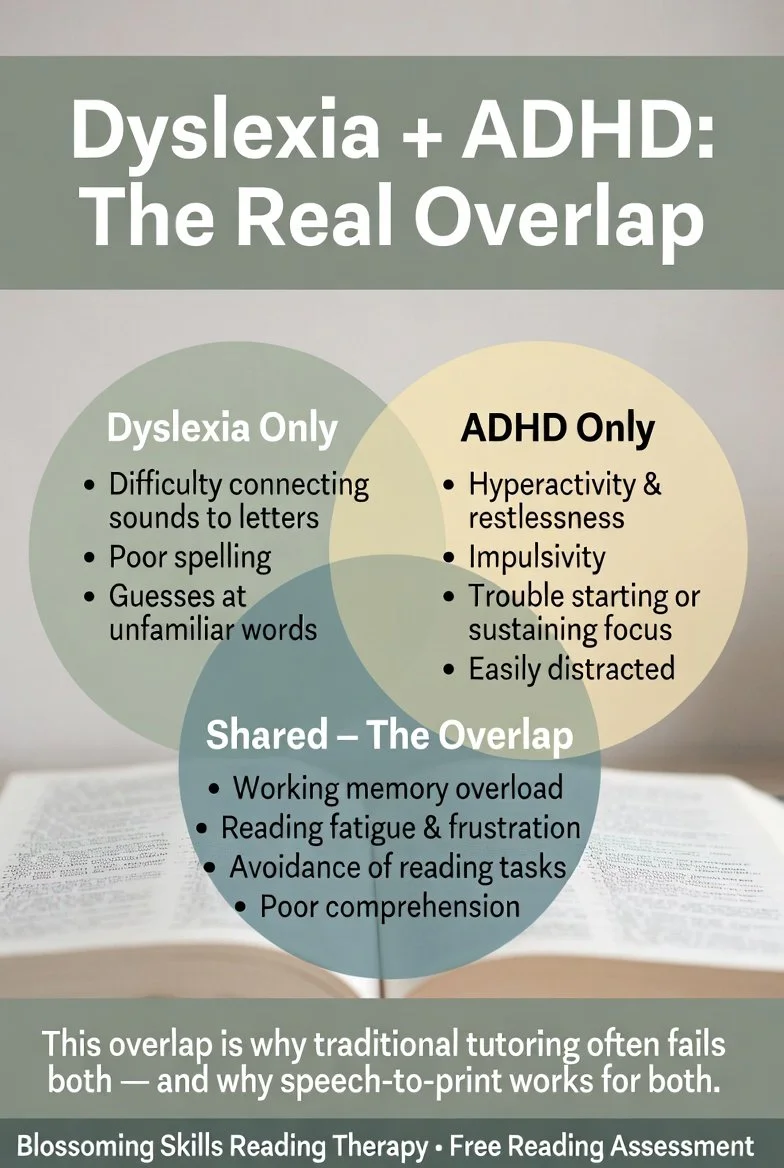
Dyslexia + ADHD: How the Two Overlap and the One Approach That Actually Helps Both (2026 Parent Guide)
Your smart child can talk for hours about their favorite topic but freezes when it’s time to read? Up to 45% of children with ADHD also have dyslexia — and when the two overlap, reading becomes mentally exhausting in ways most schools and tutors never address.
Discover exactly how dyslexia and ADHD connect in the brain, why standard phonics and Orton-Gillingham programs often fall short, and the one structured literacy method (starting with spoken language) that finally helps both reading and attention at the same time. Real 12-week results + simple at-home tips inside.
Ready to stop guessing? Download your Free Reading Assessment Checklist and book a no-pressure Breakthrough Call today.
Your bright 9-year-old can rattle off every fact about dinosaurs, build intricate Lego creations for hours, and tell hilarious stories at the dinner table… but the moment a book comes out, everything falls apart. They guess at words, skip lines, melt down over homework, and can’t sit still long enough to practice. You’ve heard “They just need to try harder” from teachers and “It’s probably ADHD” from the pediatrician. Meanwhile, you’re exhausted from searching for answers that actually work.
If this sounds familiar, you’re not alone — and it’s not your imagination. Dyslexia and ADHD frequently travel together. Research shows that up to 45% of children with ADHD also have dyslexia (or another learning disability), while 25–40% of children with dyslexia have co-occurring ADHD. These aren’t just two separate labels slapped on the same child. They share real brain-based overlaps that make reading feel like torture and attention feel impossible.
The good news? There is one proven approach that targets the root cause for both conditions at the same time — without forcing your child to endure boring drills or overwhelming worksheets. It’s the exact method we’ve used at Blossoming Skills Reading Therapy to help hundreds of kids go from guessing every other word and dreading reading time to confidently reading chapter books and actually enjoying it… often with noticeable improvements in focus and confidence too.
In this guide, we’ll break down exactly how dyslexia and ADHD overlap, why traditional tutoring and school phonics programs usually fail kids who have both, and the structured literacy method (starting with spoken language) that delivers real, measurable progress in as little as 12 weeks. Plus, you’ll get 5 simple at-home strategies you can try tonight and clear next steps if you’re ready for faster results.
Ready to stop guessing what will help? Let’s dive in.
Dyslexia vs. ADHD — How They’re Different
At first glance, dyslexia and ADHD can look like completely separate issues. And in many ways, they are:
Aspect Dyslexia ADHD Core Challenge Word reading, decoding, spelling Attention, impulse control, executive function Brain Area Affected Phonological processing (sound-to-letter)Working memory, focus regulation, prefrontal cortex Typical Signs Guessing words, poor spelling, slow reading Fidgeting, interrupting, losing homework Strengths Often Seen Big-picture thinking, creativity, verbal skills Energy, out-of-the-box ideas, hyperfocus on interests
Dyslexia is a language-based learning difference — the brain wires itself differently for connecting sounds to letters. ADHD is a neurodevelopmental difference in self-regulation and attention. They don’t cause each other.
But here’s where it gets tricky: when they co-occur (which happens far more often than chance), the symptoms feed off each other and create a perfect storm that schools and standard tutoring rarely address.
How Dyslexia and ADHD Overlap — The Hidden Connection Most Parents (and Schools) Miss
The real overlap isn’t always obvious on the surface. It lives in the brain’s working memory and processing speed systems — the mental “workspace” your child uses every time they try to read.
Here’s what it actually looks like for many families:
Guessing at words or skipping lines — The decoding effort is so exhausting (dyslexia) that attention wanders after just a few seconds (ADHD).
Poor reading fluency and comprehension — By the time they sound out one sentence, they’ve forgotten what the paragraph was about.
Homework meltdowns and avoidance — Reading tasks overload working memory, so focus collapses and frustration explodes.
Executive function struggles — Planning, starting, and sticking with reading practice feels impossible when the brain is already working overtime just to decode.
Recent studies (including 2025 research on genetic and cognitive overlaps) confirm that both conditions often share weaknesses in the brain networks responsible for holding sounds in mind while connecting them to print. That’s why your child can focus perfectly on building Legos or playing video games but completely shuts down during reading.
See our earlier post: Why Your Smart Child Guesses at Words (Even After Phonics) — this exact pattern shows up constantly in kids with dyslexia, ADHD, or both.
Why Traditional Tutoring and Phonics Programs Often Fail Kids with Both Dyslexia and ADHD
If you’ve tried tutoring, extra phonics workbooks, or even Orton-Gillingham-based programs and seen little lasting change, you’re not doing anything wrong. Most standard approaches treat the two conditions separately — and that’s exactly why they fall short for kids who have both.
Common pitfalls we hear from parents every week:
Pure phonics drills feel repetitive and boring → ADHD brain disengages within minutes.
Visual-only or “print-first” methods overload working memory → the child can’t hold sounds long enough to blend them.
No built-in parent coaching or short, predictable routines → progress stalls at home.
One-size-fits-all pacing → either too fast (frustrates ADHD) or too slow (bores the dyslexic brain).
The result? Months (or years) of effort with minimal gains, damaged confidence, and parents who feel helpless.
The One Approach That Helps Both — Structured Literacy Starting with Spoken Language
Here’s what actually works: structured literacy that begins with what your child already does well — talking and listening — then carefully builds the bridge to print.
This is called linguistic phonics or speech-to-print instruction. Instead of staring at letters and trying to guess the sounds (the way most school programs and tutoring do it), we start with the spoken word your child already knows perfectly, then show them how those sounds map onto letters.
Why this single approach is magic for both dyslexia and ADHD:
It builds automatic word recognition fast — Once decoding becomes effortless, working memory is freed up. Attention improves because reading stops feeling like mental torture.
Multisensory and predictable routines keep the ADHD brain engaged without overwhelming it.
Short, intensive sessions + simple home practice plans fit real family life (no printing 50 worksheets or fighting over flashcards).
Parent coaching is built in every week — so you know exactly how to reinforce skills at home in ways that actually stick.
At Blossoming Skills Reading Therapy, this is the exact method we’ve refined over years of 1:1 online sessions. Research from the International Dyslexia Association and multiple studies on co-occurring conditions backs it strongly: explicit, systematic structured literacy produces the biggest gains — even when ADHD is present. And because we start with spoken language, kids see progress quickly, which builds the motivation and focus that ADHD brains need.
Real Results: What 12 Weeks Looks Like for a Child with Dyslexia + ADHD
Here’s what families typically see in our program (anonymized from real clients):
Weeks 1–4: The guessing drops dramatically. Your child starts blending sounds more confidently. Meltdowns over reading homework decrease because sessions feel predictable and successful.
Weeks 5–8: Fluency begins to emerge. They read short sentences without finger-pointing or skipping words. Teachers often comment first: “His attention during reading group is so much better!”
Weeks 9–12: Automatic word recognition kicks in. Chapter books become possible. One mom told us: “My son went from hiding books to asking to read bedtime stories — and his teacher said his focus during independent work has improved across the board.”
We back every client with our 12-Week Progress Promise: measurable growth of at least one full grade level in reading, or we continue working with you at no extra cost.
Read more: What to Expect in a 12-Week Dyslexia Reading Program
5 Simple Ways to Support Your Child at Home Right Now (While You Explore Professional Help)
You don’t have to wait for professional help to start making a difference. Try these speech-to-print-friendly activities tonight:
Sound Talk Before Reading — Before opening a book, say the word out loud together (“This word is ‘because’ — /b/ /e/ /k/ /u/ /z/”), then show the letters. This builds the exact brain pathway that’s weak in dyslexia.
3-Minute Word Chains — Change one sound at a time: cat → hat → bat → bag. Keep it fast and fun — perfect for short ADHD attention spans.
Echo Reading — You read a sentence expressively, your child echoes it. Builds fluency without the decoding overload.
No-Print Spelling — Say a word, have your child tap out the sounds on the table (one finger per sound), then write it. No worksheets needed.
Movement Breaks with Purpose — After 10 minutes of focused reading, do 2 minutes of jumping jacks or wall pushes — then come back. The physical reset helps ADHD brains refocus.
These tips help. But for most families dealing with the overlap, consistent 1:1 structured literacy is what finally moves the needle.
When (and How) to Get the Right Help for Dyslexia + ADHD
It’s time to seek specialized support when:
Reading avoidance is affecting self-esteem or friendships
Homework battles are nightly
Progress has stalled despite extra help at school
Questions to ask any provider:
Do you use structured literacy that starts with spoken language?
How do you accommodate attention challenges?
What does progress measurement look like in the first 12 weeks?
Do you offer parent coaching?
Online 1:1 sessions work especially well for busy families and kids with ADHD — no commuting, flexible scheduling, and all materials are provided digitally.
Conclusion
Dyslexia and ADHD overlapping isn’t a life sentence of struggle. The connection is real — but so is the solution. When you address the shared root with the right structured literacy approach, both reading skills and attention can improve together.
You’ve already taken the hardest step by researching this deeply. Now imagine your child confidently reading aloud at family game night, finishing homework without tears, and actually believing “I’m a good reader.”
Ready to stop guessing what will work and start seeing real change?
Download your Free Reading Assessment Checklist right here and book your no-pressure Breakthrough Call today. In just 15 minutes we’ll map out exactly how your child can gain 1+ years in reading — even with ADHD. No sales pitch, just clarity and a clear plan tailored to your family.
You’ve got this — and we’re here to help every step of the way.
Frequently Asked Questions
Can a child have both dyslexia and ADHD? Yes — they co-occur in up to 45% of cases. The two conditions are separate but frequently overlap due to shared brain-based challenges.
Does ADHD make dyslexia worse? It can make reading practice harder because attention and working memory are affected, but the right intervention addresses both at once.
What is the best reading program for dyslexia and ADHD? Structured literacy that begins with spoken language (speech-to-print) has the strongest evidence for kids with both conditions.
Does medication for ADHD help with reading, too? Medication can improve focus and make practice easier, but it doesn’t teach the brain how to decode. The best results come from combining medication (when appropriate) with targeted reading therapy.
How is your program different from tutoring? We use intensive, research-backed structured literacy with weekly parent coaching and a 12-Week Progress Promise — not generic homework help.
Is online reading therapy effective for kids with ADHD? Yes — many families actually prefer it. Short, focused 1:1 sessions with built-in movement and no travel keep attention high.
How long until we see progress? Most families notice easier decoding and better focus within the first 4–6 weeks; measurable grade-level growth often shows by week 12.
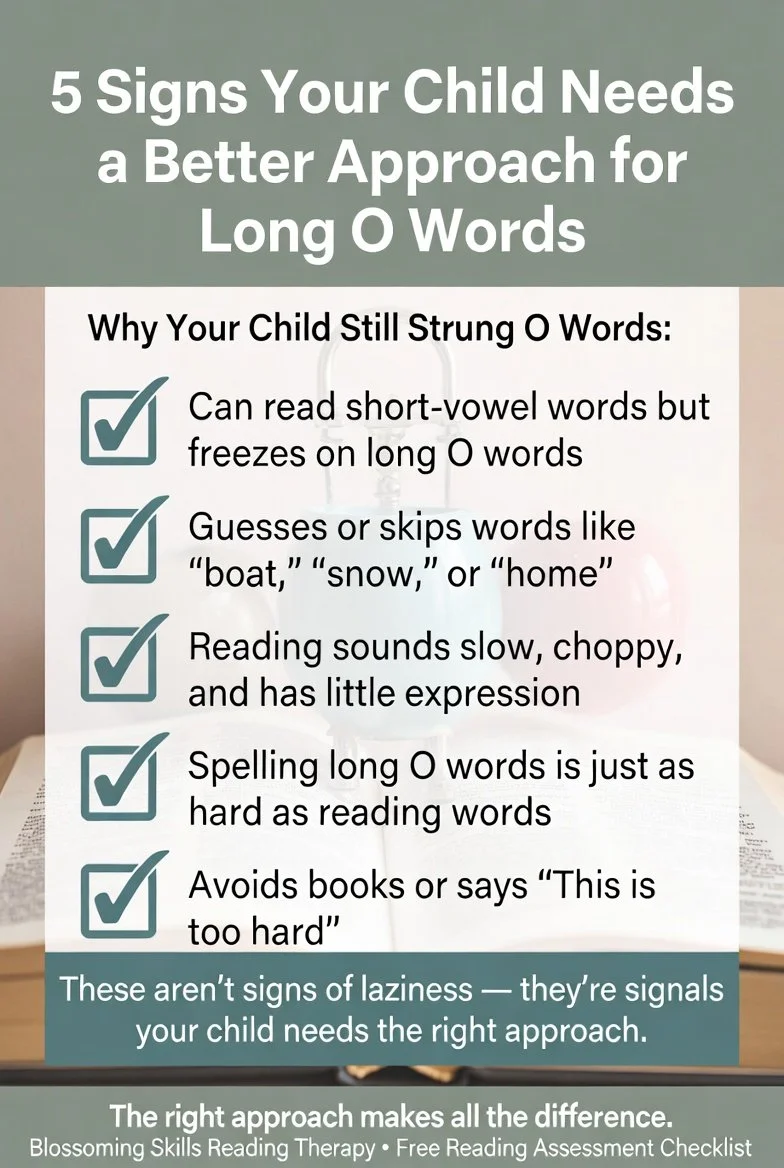
Why Your Child Still Struggles with Long O Words
Your child can sound out simple CVC words like “cat” and “dog”… but completely freezes or guesses on long O words like boat, snow, home, hope, or remote?
You’re not alone — and it’s not because they’re not trying hard enough.
In this post I explain exactly why long O spelling patterns cause so much trouble and how the speech-to-print approach finally builds strong orthographic mapping, automatic recognition, and confident fluency (with real 12-week results).
Plus simple at-home tips and how my Long O Phonics Practice Packet or full Reading Therapy program can help your child blossom fast.
Download your Free Reading Assessment Checklist and book a no-pressure Breakthrough Call today.
If your child can sound out “cat,” “dog,” and “run” pretty well… but completely freezes or guesses when they hit words like “boat,” “snow,” “home,” “toad,” or “go,” you are seeing one of the most common (and frustrating) roadblocks in early reading.
You’ve probably heard “They just need more practice” or “They’ll get it eventually.” But weeks and months go by and those long O words are still tripping them up — making reading slow, choppy, and exhausting.
I’ve been right where you are. As a former special education teacher and a mom whose own daughter struggled with these exact patterns, I watched the same cycle play out with hundreds of families… until I switched to speech-to-print instruction.
In this guide, I’ll show you exactly why long O words are so tricky, why traditional phonics often isn’t enough, and the speech-to-print approach that finally builds automaticity and smooth fluency. You’ll also get simple at-home strategies and learn how my Advanced Code: Long O Phonics Practice Packet and full Reading Therapy program can create real breakthroughs.
Why Long O Words Are Especially Difficult
Long O has more spellings than almost any other vowel sound:
oa → boat, coat, road
ow → snow, blow, grow
o_e → home, bone, rope
oe → toe, Joe, doe
ou → soul, dough (and a few more exceptions)
This is called the advanced code. Short vowels are fairly consistent, but long O forces the brain to sort through multiple possibilities every single time. For a struggling reader — especially one with dyslexia or weak orthographic mapping — that extra mental work is exhausting.
The result? Guessing, skipping words, losing expression, and growing frustration.
The Real Problem: Lack of Strong Orthographic Mapping
Most phonics programs teach kids to “look for the vowel team” or memorize rules. That works okay for some kids… but not for the ones who really struggle.
What actually creates fluent reading is orthographic mapping — the brain’s ability to permanently store a word so it can be recognized instantly without sounding it out every time.
Speech-to-print instruction is far more effective because it starts with the sound your child already knows perfectly (/ō/) and shows them exactly how that sound maps to different letter patterns. This builds the strong brain connections that traditional “print-first” methods often miss.
Traditional Phonics vs. Speech-to-Print for Long O Words
Here’s the difference that actually matters:
AspectTraditional PhonicsSpeech-to-Print ApproachStarting PointShow the letters first (oa, ow, o_e)Start with the spoken sound /ō/MethodMemorize rules and exceptionsBuild sound-to-letter mappingPractice StyleWorksheets and flashcardsMultisensory sound-first activitiesSpeed of AutomaticitySlow — lots of guessingFast — builds permanent word storageFluency OutcomeOften stays choppySmooth, confident reading
This is why your child may “know” the rule but still can’t read the word quickly in a real book.
5 Signs Your Child Needs a Better Approach for Long O Words
They can read short-vowel words but freeze on long O words
They guess or skip words like “boat,” “snow,” or “home”
Reading sounds slow and choppy with little expression
Spelling long O words is just as hard as reading them
They avoid books or say “This is too hard”
These aren’t signs of laziness — they’re signals your child needs the right kind of practice.
Simple Ways to Start Building Fluency at Home
You don’t have to wait for professional help to start making progress. Try these speech-to-print-friendly activities tonight:
Sound-First Word Building — Say the word out loud (“This word is /ō/ /k/ = oak”), then build it with letter tiles.
Vowel Team Sorting — Sort words by sound first, then by spelling.
Word Chains — Change one sound at a time (boat → coat → goat → goal).
Echo Reading — You read a sentence with expression, your child echoes it.
For even faster results, many families start with my Advanced Code: Long O Phonics Practice Packet. It includes everything you need — sound-first word lists, games, sentence practice, and activities designed specifically for the tricky long O patterns. Parents tell me their kids actually ask to use these packs because they finally feel successful.
👉 Shop the Long O Phonics Practice Packet here
What Real Progress Looks Like in 12 Weeks
With consistent speech-to-print practice (either through the Phonics Packs or full therapy), here’s what most families see:
Weeks 1–4: Much less guessing on long O words. Decoding becomes more accurate. Weeks 5–8: Fluency starts improving — reading sounds smoother and more natural. Weeks 9–12: Automatic recognition kicks in. Your child reads long O words in context with confidence and expression.
This is exactly why I offer the 12-Week Progress Promise in my full 1:1 Reading Therapy program: measurable growth of at least one full grade level — or we continue working with you at no extra cost.
Ready for Your Child to Finally Blossom?
If long O words (or other vowel teams) are still holding your child back, they don’t need more of the same. They need the right approach.
Download your Free Reading Assessment Checklist right now and book a no-pressure Breakthrough Call. In just 15 minutes we’ll map out exactly where the breakdown is happening and the fastest path forward — whether that starts with the Long O Phonics Pack or moves into full therapy.
Your child’s reading story is about to change — and I’d be honored to help them blossom.
Frequently Asked Questions
Why are long O words so much harder than short vowels? Long O has multiple spellings (oa, ow, o_e, etc.), so the brain has to sort through more possibilities.
Will my child eventually “get it” with more practice? Not if the method doesn’t match how their brain learns. Speech-to-print builds permanent mapping much faster.
Can I use the Phonics Pack without full therapy? Absolutely! Many families start with the Long O packet for quick wins and add therapy later if needed.
How long until we see real fluency? Most families notice easier decoding within 4–6 weeks and smooth, confident reading by week 12.
Is this only for dyslexia? No — it works beautifully for any struggling reader, including kids with ADHD or those who just never clicked with school phonics.