
Dyslexia Specialist in Colleyville, TX
You see what happens when reading enters the room.
The pause before they answer.
The way they avoid looking at the page.
The frustration that starts before the homework even begins.
The relief when someone else offers to read it for them.
And maybe the hardest part is that this has gone on long enough for your child to start expecting reading to be hard.
That expectation changes things.
It changes how they approach school.
It changes what they avoid.
It changes what they are willing to try on their own.
Blossoming Skills Reading Therapy provides private, 1-on-1 online dyslexia and reading intervention for students in Colleyville, TX, including families in Grapevine-Colleyville ISD, private schools, charter schools, and homeschool programs.
We use a Speech-to-Print approach that connects spoken language directly to print, helping students build stronger decoding, word recognition, spelling, and fluency skills.
Your child should not have to keep organizing their life around avoiding reading.
Reading Should Not Be the Thing That Makes Your Child Feel Small.
1 in 5 Students have dyslexia 1-on-1 Every session, live K– 12 All grade levels served
Why Colleyville Families Reach Out
You Already Know This Is More Than a Rough Patch
Maybe the reading struggles started small.
A few words that would not stick.
Spelling that never seemed to settle.
A child who began avoiding reading aloud.
Homework that somehow became the hardest part of the day.
Then the years moved on, and the problem did not.
You have asked questions. You have waited for intervention to help. You may have hoped that maturity, extra practice, or another school year would finally make reading easier.
But something in you keeps saying this is more than a rough patch.
That instinct matters.
When reading continues to stay this hard, the issue is not just the assignment in front of your child. It is the pattern underneath it — the guessing, the slow word reading, the difficulty blending, the spelling that does not hold, the dependence on someone else to get through the text.
Blossoming Skills works with families throughout Grapevine-Colleyville ISD, including students from Colleyville Elementary, Bransford Elementary, Glenhope Elementary, Colleyville Middle School, and Colleyville Heritage High School.
The school may be different.
The pattern is often the same.
Reading has stayed hard for too long, and the family is ready to understand why.
When Reading Starts Taking Over More Than Reading
At some point, the struggle stops staying contained to books.
It starts showing up in homework, tests, written directions, science, social studies, and anything else that depends on getting through text independently.
The child begins relying more on someone else to read the page first. They may start avoiding certain assignments, rushing through work, or doing whatever they can to keep the difficulty from being noticed.
And the longer that goes on, the more the reading problem can start shaping the entire school day.
That is why I do not look at this as simply needing more practice.
If your child has already had intervention and reading is still this difficult, the next step should be finding out what is actually breaking down and teaching from there.
The goal is not to help your child manage the struggle better. The goal is to make the struggle smaller.
Many families reach this point after they have already tried to help.
There may have been school intervention, tutoring, repeated phonics practice, extra reading at home, or a dyslexia program that seemed promising at first.
And yet the same problems are still there.
The guessing.
The slow decoding.
The words that do not stick.
The spelling that seems to disappear from one week to the next.
That is when I start looking beyond how much help a child has received and focus on what kind of instruction they have been receiving.
Blossoming Skills uses a Speech-to-Print approach. We begin with spoken language and teach children how the sounds they already use every day connect to letters and spelling patterns in print.
Reading and spelling are taught together, so the child is building stronger connections between what they hear, what they say, and what they see on the page.
If the old path keeps leading to the same place, it may be time to take a different one.
When More Reading Help Still Hasn’t Changed the Reading
Most reading programs begin with rules, labels, and memorized phonics patterns. Speech-to-Print starts with what your child already has: spoken language.
Students learn to notice the sounds in words, then connect those sounds to the letters and patterns that represent them. Reading and spelling develop together — because they should.
This builds flexible readers instead of guessers — students who can work through unfamiliar words instead of freezing, skipping, or relying on memorized rules that don't always work.
For example, instead of just memorizing that "ea says long e," students learn that the same spelling pattern can represent different sounds:
team /ee/ sound ("teem")
bread /eh/ sound ("bred")
break /ay/ sound ("brayk")
Same spelling pattern. Three different sounds. Speech-to-Print teaches students to navigate this — rather than freeze.
Your Child’s Reading Plan Should Start With Your Child
Every student begins with a comprehensive reading assessment so I can see exactly where reading is breaking down.
I look at phonemic awareness, phonological awareness, decoding, word recognition, nonsense-word reading, fluency, spelling, writing, and comprehension.
From there, I determine where instruction needs to begin and what needs the most attention first.
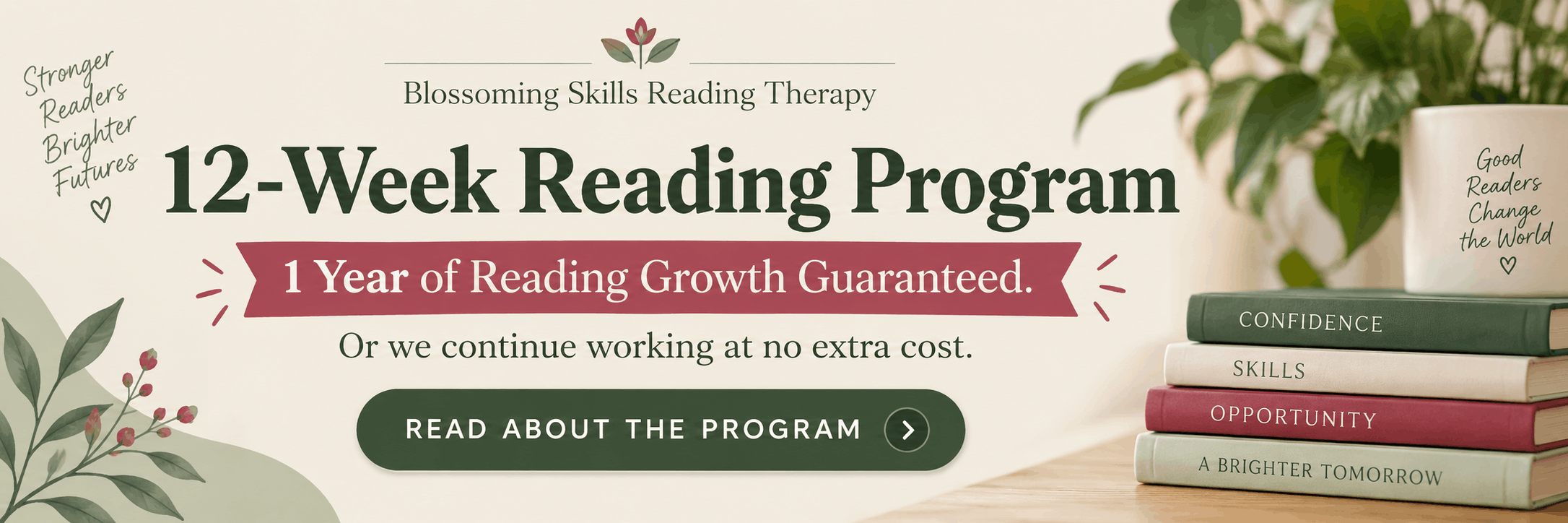
The 12-week program is built around your child’s reading profile, not a preset sequence.
Parents are trained throughout the program too, so you know what to practice at home, how to respond when your child gets stuck, and how to keep progress moving between sessions and after the program ends.
Because after everything your child has already been through, “we think they’re improving” is not enough. I measure the growth — and I stand behind it.
At the end of the 12 weeks, your child is reassessed so we can clearly compare where they started with where they are now.
I guarantee at least one full grade level of reading growth. If that growth is not there, I continue working with your child at no additional cost until the goal is reached.
What Changes When Reading Finally Starts Working
The change is not just a number on a report.
It is your child getting through a sentence without stopping at every other word.
It is reading directions and knowing what to do next.
It is opening a science or history assignment and reaching the content instead of getting stuck on the text.
It is less guessing. Less hesitation. Less dependence on someone else to read first.
And over time, reading begins to take up less space in the day.
Less space in homework.
Less space in school.
Less space in the worry that has been following your family for too long.
That is the kind of progress we achieve and it’s guaranteed.
Reading Therapy for Colleyville Students
Blossoming Skills Reading Therapy serves families throughout Colleyville and the surrounding Grapevine-Colleyville area, including students in GCISD, private schools, charter schools, and homeschool programs.
We work with families connected to Colleyville Elementary, Bransford Elementary, Glenhope Elementary, Colleyville Middle School, Colleyville Heritage High School, and other schools throughout Grapevine-Colleyville ISD.
Because sessions are live online, Colleyville families can access individualized dyslexia and reading intervention from home without adding another drive across Tarrant County.
Whether your child is in public school, private school, charter school, or homeschool, the goal is the same: understand why reading is still difficult and give them instruction that directly addresses the skills that have not become automatic.
For families searching for a dyslexia specialist in Colleyville, TX, the first step is understanding exactly what is getting in the way.