
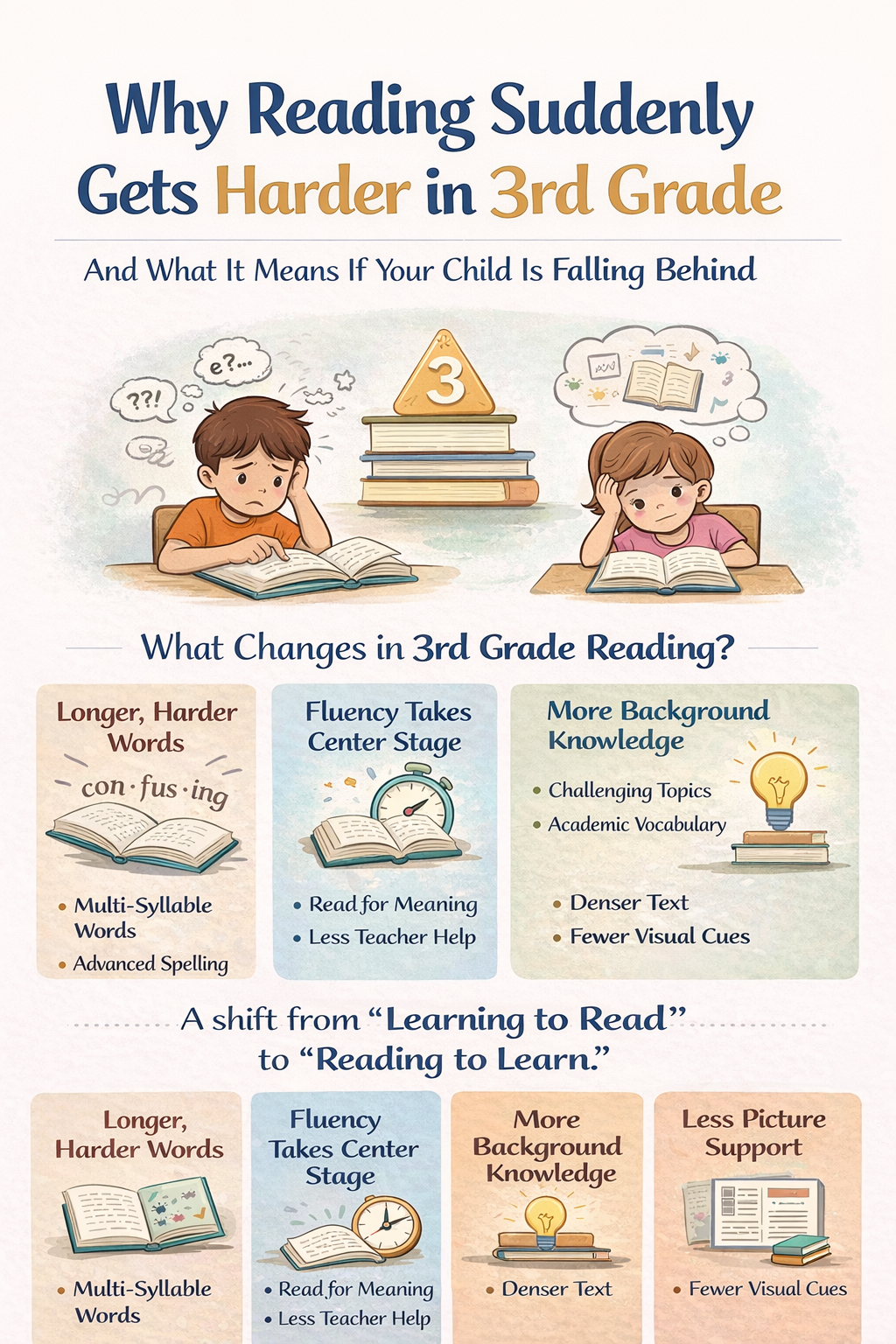
Why Reading Suddenly Gets Harder in 3rd Grade (And What to Do If Your Child Is Falling Behind)
Reading often feels harder in 3rd grade because the demands change. Text becomes longer, vocabulary grows more complex, and fluency becomes essential for comprehension. If your child suddenly seems to be falling behind, the issue may not be motivation — it may be foundational decoding and automaticity gaps that are now being exposed.
Many parents tell me the exact same story:
“My child did okay in 1st and 2nd grade… but 3rd grade hit and everything fell apart.”
Homework that used to take 15 minutes now drags on for an hour. Reading time turns into tears and meltdowns. Your once-confident child starts saying, “I’m just not smart” or “I hate reading.”
If this is your child right now, please know — you are not failing, and your child is not broken. This is incredibly common, and there’s a real reason it happens.
The Big Shift in 3rd Grade
In early grades, kids are “learning to read.” Books are short, pictures help, and teachers give lots of support.
Starting in 3rd grade, everything changes. Kids are now expected to “read to learn.” They have to pull information from longer chapter books, science texts, and social studies with almost no help.
This new stage requires:
Fast, automatic word reading
Strong fluency
The ability to understand and remember what they just read
When those skills have small gaps, reading suddenly feels exhausting and overwhelming.
Why Most Phonics Programs Make It Worse
Here’s something most parents don’t realize:
A lot of traditional reading programs teach kids to memorize phonics rules and all their exceptions, then try to apply them while reading.
This puts a huge load on working memory — and that’s simply not how brains are wired to learn.
When a child has to stop and think about rules on almost every word, there’s almost no brainpower left for actually understanding the story. That’s why so many kids can “know their phonics” but still guess, slow down, or melt down.
The Better Way: Speech-to-Print
My brand new packets use a completely different approach called speech-to-print.
Instead of memorizing confusing rules and exceptions, kids learn to map sounds to letters the natural way the brain actually processes language. This reduces cognitive overload and makes reading start to feel automatic and easy.
You’re Not Too Late
The great news? Most kids who hit this wall catch up quickly once they get the right kind of support.
Ready to Help Your Child Move Forward?
Here are the easiest next steps you can take today:
1. Download my Free Struggling Reader Checklist. Find out exactly what’s holding your child back (takes just 2 minutes)
2. Grab my brand new Long E Packet The perfect starting point for building strong speech-to-print skills (currently on special launch pricing)
3. Book a Free Reading Clarity Call. Let’s talk about your child’s specific situation and make a clear plan
You’ve got this, mama. Your child’s reading story isn’t over — it’s just entering a new chapter, and the right support can make all the difference.
Catherine Mitchell Blossoming Skills Reading Therapy www.blossomingskillsreadingtherapy.net
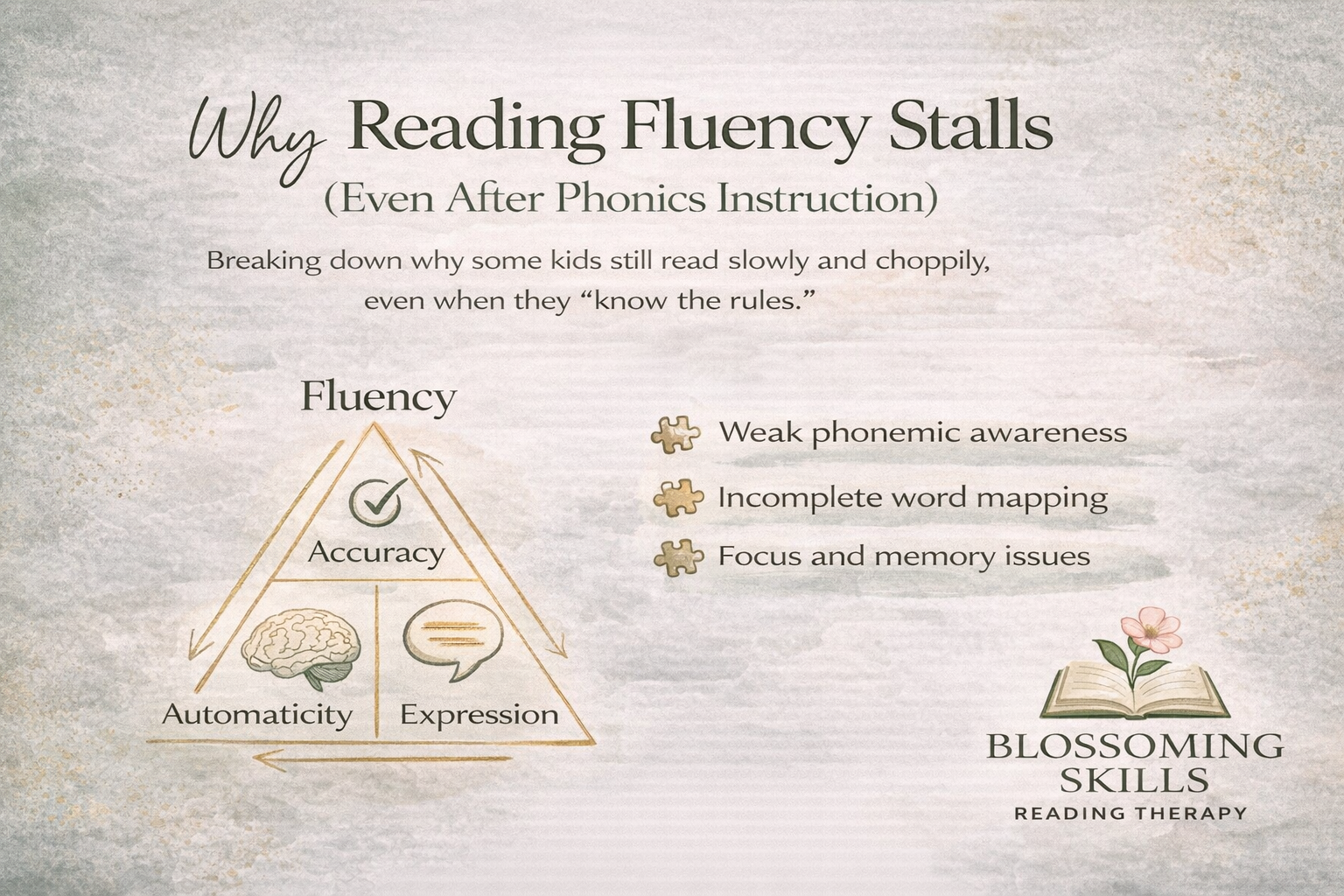
Why Reading Fluency Stalls (Even After Phonics Instruction)
Why is your child still reading slowly even after phonics instruction? If decoding is accurate but fluency hasn’t developed, the problem is rarely “they just need to read more.” Reading fluency stalls when automaticity, phonemic awareness, orthographic mapping, or working memory are fragile. In this article, you’ll learn the real reasons fluency plateaus — and what actually helps struggling readers move from effortful decoding to confident, automatic reading.
If your child can sound out words…
but still reads slowly, choppily, or with little expression…
You’re not imagining it.
Fluency can stall — even after phonics instruction.
And the reason is rarely “they just need to read more.”
Let’s break down what’s really happening.
What Is Reading Fluency — Really?
Fluency is not just speed.
True fluency includes:
Accuracy (reading words correctly)
Automaticity (reading without effortful decoding)
Prosody (natural phrasing and expression)
Cognitive endurance (sustaining attention across text)
Speed is a symptom of automaticity.
When automaticity is fragile, speed never fully develops.
1. Weak Phonemic Awareness (Even If Phonics Was Taught)
A child can be taught phonics patterns and still have shaky phonemic awareness underneath.
If they:
Struggle to quickly segment sounds
Blend slowly
Need extra time to hold sounds in memory
Have difficulty manipulating sounds in words
Then decoding remains effortful.
Effortful decoding means the brain is working too hard at the word level.
When that happens, there’s not enough cognitive space left for smooth reading.
Fluency stalls.
2. Incomplete Orthographic Mapping
Orthographic mapping is how words become permanently stored in long-term memory.
If this process isn’t solid:
Words don’t “stick”
The same word feels new each time
The child decodes it over and over again
This is where spelling matters more than most people realize.
Spelling strengthens the brain’s sound-to-print connections.
When spelling is weak, word recognition stays slow.
Fluency cannot outgrow unstable word storage.
3. Overloaded, Rule-Heavy Instruction
Some reading instruction focuses heavily on:
Memorizing rules
Remembering exceptions
Managing multi-step decoding strategies
Large sight word lists
For children with working memory weaknesses, ADHD, or processing differences, this creates cognitive overload.
Fluency requires freed working memory.
If reading feels procedural — “step one, step two, apply the rule” — it won’t feel automatic.
And automaticity is what drives fluency.
4. Fluency Is Measured… But Not Taught
Many schools measure words per minute.
But measuring is not the same as teaching.
Effective fluency instruction includes:
Guided repeated reading
Modeling prosody
Phrase marking
Accuracy-first rereading
Short passages practiced intensively
Immediate corrective feedback
Without structured practice, fluency rarely improves on its own.
5. ADHD and Working Memory Weakness
This is often overlooked.
If your child:
Loses their place while reading
Stares off during longer passages
Forgets what they just read
Struggles to copy information accurately
This may reflect cognitive load — not effort.
Fluency is fragile when attention and working memory are fragile.
Standardized tests amplify this because they require sustained, single-pass performance with no scaffolding.
That doesn’t mean progress isn’t happening.
It means endurance hasn’t caught up yet.
6. Text That Is Too Difficult
If a child is constantly reading grade-level text independently before automaticity is stable, they will look permanently disfluent.
They need:
Controlled text
Supported ramping
Repeated success
Gradual release
You build fluency by reducing strain — not by increasing pressure.
7. Processing Speed Differences
Some children process language more slowly.
This does not reflect intelligence.
It means automaticity takes longer to consolidate.
When speed is pushed too early, anxiety increases and comprehension drops — which actually slows progress further.
So What Actually Moves Fluency Forward?
Instead of “read more,” effective intervention includes:
Strengthening phonemic awareness
Integrating spelling with reading
Reducing cognitive overload
Structured repeated reading
Modeling expression
Short, focused practice bursts
Accuracy before speed
Fluency improves when decoding becomes effortless.
Effortless reading doesn’t happen through exposure alone.
It happens through intentional, brain-aligned instruction.
If Your Child Can Decode but Isn’t Fluent…
Fluency hasn’t failed.
The system is still integrating.
When the right supports are in place, automaticity builds — and once it does, fluency begins to shift in a noticeable way.
If you’re wondering whether your child’s fluency has stalled — or if something deeper is happening — you don’t have to figure it out alone.
You can learn more about my structured, root-cause reading intervention here:
Or schedule a consultation to discuss your child’s specific profile:
Homepage
Catherine Mitchell
www.blossomingskillsreadingtherapy.net
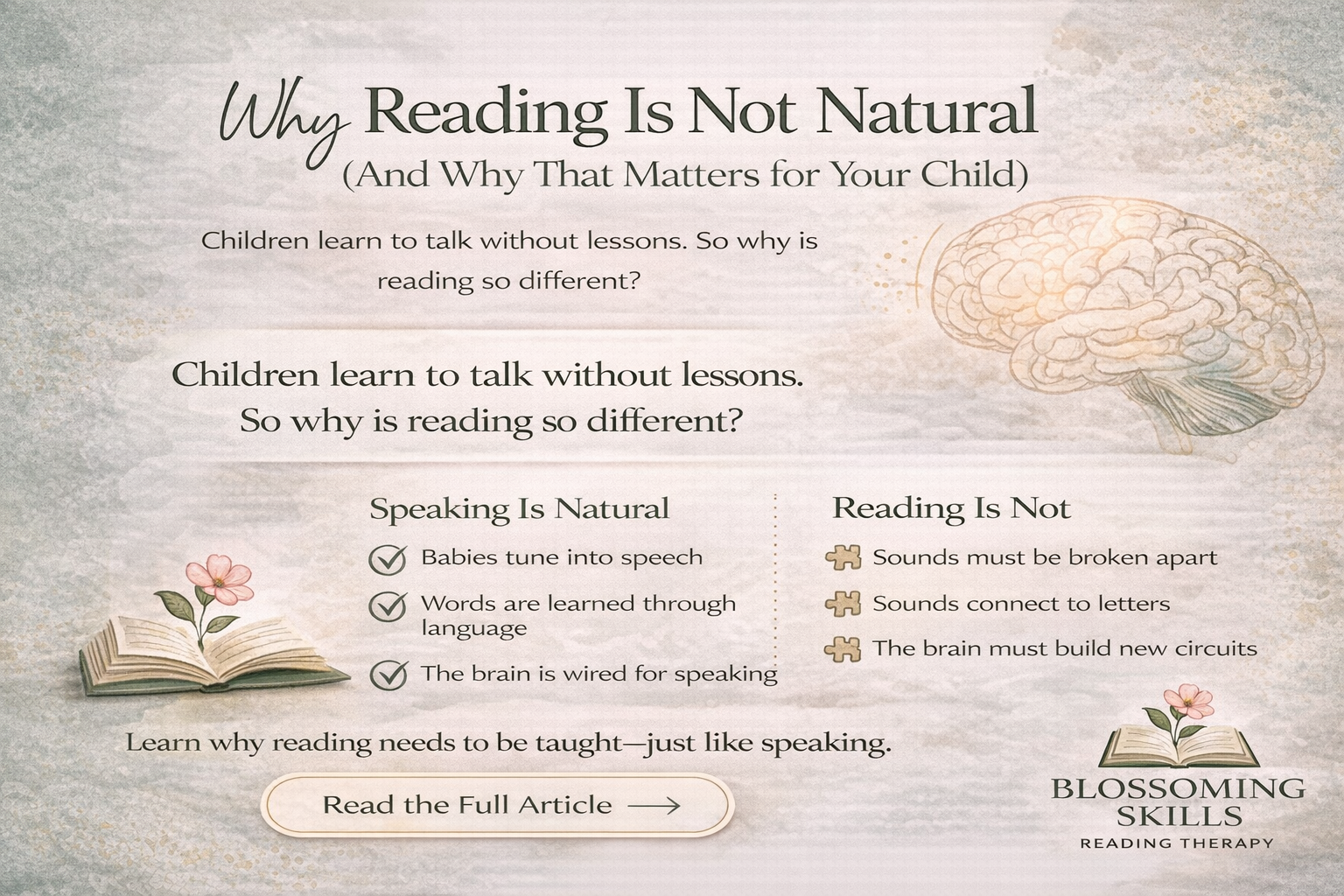
Why Reading Is Not Natural (And Why That Matters for Your Child)
Why isn’t reading natural for many children — especially struggling readers? While speaking develops automatically, reading requires explicit, structured instruction that aligns with how the brain maps sounds to letters. When children are taught through memorization, guessing strategies, or rule-heavy phonics, progress often stalls. Learn why reading must be taught differently — and what brain-aligned instruction actually looks like for dyslexia and reading difficulties.
Many parents assume reading develops the way speaking does.
Children learn to talk without formal instruction. So when reading doesn’t develop easily, it feels confusing.
But here’s the truth:
Reading is not natural.
It must be taught — and taught in a way that aligns with how the brain actually learns language.
Understanding this changes everything.
Speaking Is Natural. Reading Is Not.
Humans are biologically wired for spoken language.
Babies are born with brains prepared to:
hear speech sounds
detect patterns in language
imitate and produce words
build vocabulary naturally through conversation
Reading is different.
Reading requires the brain to:
break spoken words into individual sounds
connect those sounds to letters
blend those sounds back into words
store those words for automatic recognition
The brain must build a new system that does not exist automatically.
What Happens When Reading Is Taught Out of Order
When reading instruction does not match how the brain processes language, students often:
memorize words instead of decoding
guess based on the first letter
rely on picture clues
struggle to remember phonics rules
read slowly and choppily
feel overloaded during reading
This is not a motivation issue.
It is an instructional alignment issue.
Why Phonics Rules Alone Don’t Solve the Problem
Many children are taught reading through phonics rules.
The challenge?
English contains many spelling patterns with multiple exceptions.
When students try to hold:
the rule
the exceptions
and the word
…all at the same time, working memory becomes overloaded.
Overload leads to hesitation.
Hesitation leads to guessing.
Guessing becomes a habit.
Why Memorizing Words Creates Bigger Problems
Some instruction relies heavily on memorizing sight words.
Memorization is not the same as automatic reading.
When students memorize many words:
they begin memorizing unfamiliar words
they skip decoding
they avoid sounding out
they struggle when text becomes more complex
This often shows up later as:
stalled progress
slow fluency
weak spelling
difficulty transferring skills to real books
The Brain Learns Through Speech First
The brain processes spoken language before written language.
Effective reading instruction builds from that foundation.
Instead of starting with memorization, instruction should:
Strengthen awareness of individual sounds in words
Connect those sounds to spellings
Build smooth, continuous blending
Develop automatic word recognition
Train fluency directly
This approach aligns reading with how the brain naturally stores language.
Why Some Children Struggle More Than Others
Some children:
process sounds less clearly
have weaker phonemic awareness
struggle with working memory
become overwhelmed by complex rule systems
need more direct fluency coaching
When instruction does not match their learning profile, progress slows.
When instruction aligns with the brain, progress accelerates.
What Automatic Reading Actually Looks Like
Automatic reading is not speed.
It is:
accurate decoding
smooth blending
effortless word recognition
strong spelling connections
comprehension that improves because decoding is easier
When the brain no longer has to work so hard to read each word, meaning becomes accessible again.
What Parents Should Watch For
If your child:
guesses at words
reads slowly despite knowing phonics
forgets patterns they have been taught
struggles to transfer skills into real books
understands language well but struggles when reading independently
…it may not be about effort.
It may be about alignment.
The Bottom Line
Reading is not natural.
It requires:
structured instruction
sound-to-spelling connections
fluency coaching
and a method that matches how the brain processes language
When instruction aligns with the brain, reading becomes less effortful, more automatic, and more confident.
If your child is not progressing, the question is not “How much more practice?”
The better question is:
Is the method aligned with how the brain actually learns to read?
Schedule a free Reading Breakthrough Call: https://calendar.app.google/SFCcnF8k5WytCiFeA
www.blossomingskillsreadingtherapy.net
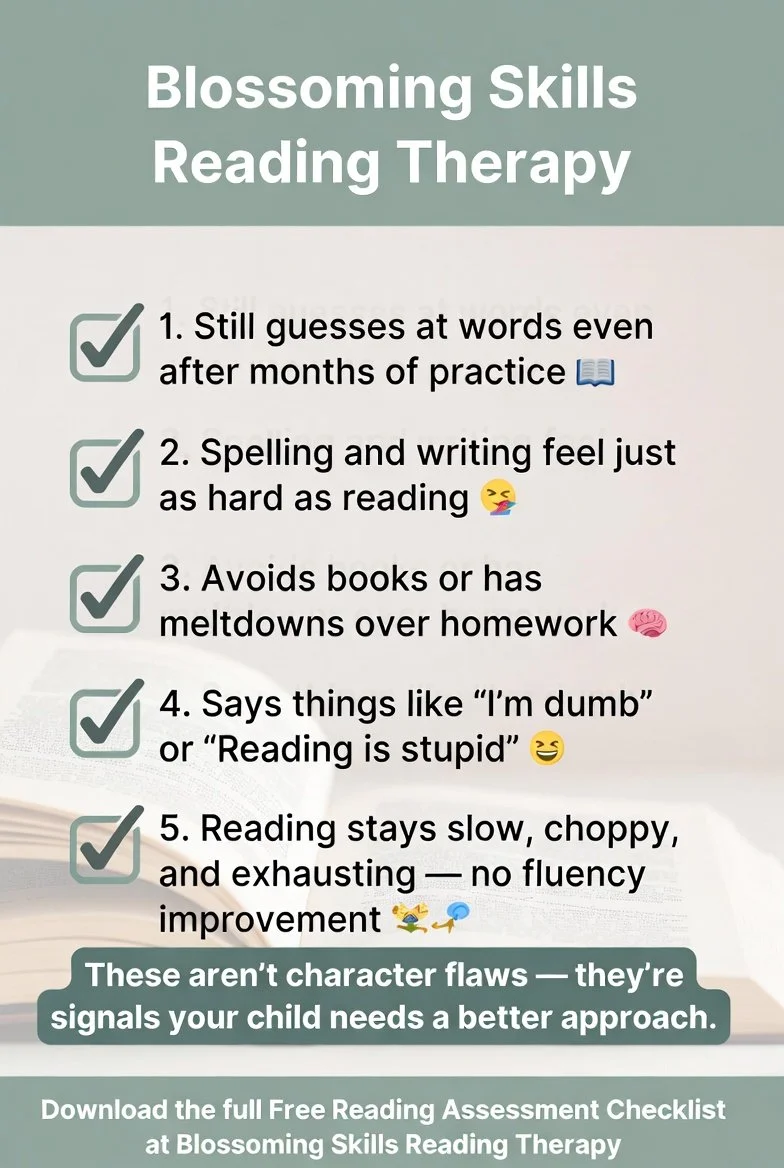
Why Your Child Still Struggles After Orton Gillingham Tutoring
Why is your child still struggling after Orton-Gillingham tutoring? If your child has dyslexia or ongoing reading difficulties despite months or years of structured phonics instruction, you’re not alone. Many struggling readers learn rules but never develop automatic word recognition or fluent decoding in real text. In this article, we explore why Orton-Gillingham doesn’t work for every child — and how speech-to-print, brain-aligned reading instruction can rebuild confidence and lasting reading progress.
If you’re here because your child has dyslexia or is struggling to read, you’re in the right place. I share practical, research-based strategies that rebuild the reading pathway — without overwhelming rules or guesswork.
For step-by-step dyslexia reading help at home, including monthly toolkits and live coaching, start with the Reading Clarity Membership.
You did everything they told you.
You found the program. You paid for the tutor. You followed every suggestion.
But here you are.
Months, maybe even years, later.
And your child still struggles to read.
If that sounds familiar, please know something important:
You’re not alone. And it’s not your fault.
The Method Isn’t Always the Miracle
Orton-Gillingham. It’s a name that comes up again and again. It’s been around for decades. People talk about it like it’s the gold standard.
But what happens when it doesn’t work?
Because for a lot of kids... it doesn’t.
Not completely. Not consistently. Sometimes, not at all.
You may have heard:
“Just give it more time.”
“Every child moves at their own pace.”
“It’s evidence-based.”
But time keeps passing. And your child is still stuck on the basics.
So now what?
Why Doesn’t It Work for Every Kid?
Let’s talk about the method for a second.
Orton-Gillingham focuses heavily on phonics, breaking down words, rules, patterns.
And sure, that works for some learners.
But not all.
Some kids don’t learn best by memorizing dozens of rules with dozens of exceptions.
They don’t need more drills. They need clarity. Something that makes actual sense.
There’s a moment where parents start to notice...
“My child can say the sounds out loud, but they still can’t read the word.”
Or...
“They practiced this all week, but today it’s like they’ve never seen it before.”
It’s not that your child isn’t trying. It’s not that they’re lazy. It’s not that you’re not doing enough at home.
It’s that the approach doesn’t match how their brain learns.
There’s Another Way
Instead of starting with letters and trying to force sounds onto them...
What if we started with spoken language?
That’s what speech-to-print methods do.
Kids already know how to talk. They understand sounds. They use them all day, every day.
So when reading instruction connects to what they already know, the confusion fades.
We stop giving them 10 different spelling rules they can’t remember.
We stop asking them to memorize sight words that don’t follow the rules.
We just teach them how the code works, in a way that’s actually usable.
Why So Many Kids Hit a Wall with Phonics Rules
Some kids can memorize 20 spelling rules and use them just fine. But others? They sit there staring at a word like “enough” or “could,” and nothing about it makes sense. That’s because phonics-heavy systems are often built around patterns and too often, English doesn’t follow those patterns. These kids try to remember the rules, then the exceptions, then the exceptions to the exceptions. And somewhere along the way, they just shut down. It's not because they’re lazy. It's because their brain doesn’t store and recall language that way. That’s why you may see your child read a word correctly one day and totally blank on it the next. They’re not forgetting. They never actually understood it in a way that stuck.
Speech-to-print helps remove that confusion by making the connection between spoken sounds and written letters much more direct. It’s not “memorize and hope”, it’s understand and apply. And that changes everything.
If You’re Feeling Tired, That Makes Sense
Parents don’t get told this stuff. Not in schools. Not in most tutoring centers.
You’re led to believe that Orton-Gillingham is the answer.
And if it’s not working, the problem must be with your child.
But the problem is the method doesn’t work for everyone.
And honestly? That’s okay.
No single program is perfect.
But you deserve to know there’s another option, one that’s simpler, quicker, and yes, often more effective.
The Warning Signs That It’s Not a Fit
If you’re not sure yet, pay attention to these things:
● Is your child making real progress, or just going through the motions?
● Do they dread reading time, even with help?
● Can they sound out words in isolation, but not in a book?
● Are they still guessing at words they’ve seen a hundred times?
If these sound familiar... trust your gut. You don’t need more time in the same system.
You might just need a better fit.
The Hidden Cost of Waiting
One of the hardest things to admit as a parent is that something’s not working. We don’t want to pull our child out of a program everyone else seems to trust. We don’t want to be the difficult one. So we wait. A few more months. Another semester. Maybe next year it will click. But all the while, your child is falling further behind and worse, they’re internalizing the struggle. They start thinking something is wrong with them. That they’re “not smart” or “just bad at reading.” That pain shows up later in school avoidance, low confidence, or even behavior changes.
And here’s the thing: the longer we wait, the harder it is to rebuild that self-trust. Yes, finding a better method takes effort. But staying in the wrong one comes at a cost too, one we don’t always see until it’s already deep. Acting now isn’t just about reading. It’s about preserving how your child sees themselves.
There’s Hope, Really
The most heartbreaking part is seeing how many parents blame themselves.
You wonder:
“Did I wait too long?”
“Should I be doing more at home?”
“Maybe my child just isn’t a reader.”
Please hear this:
You didn’t fail. And your child isn’t broken.
They just haven’t been taught in a way that clicks with their brain yet.
That can change.
Let’s Try Something That Actually Works
You’ve waited long enough.
If the rules and routines haven’t worked, if the flashcards feel endless, if your child is still stuck, you don’t have to keep going in circles.
There’s a better way.
We teach kids in a way that respects how they think, how they speak, how they understand.
And when that happens... things shift.
They stop resisting.
They start reading.
And maybe for the first time, they believe they can do it.
You don’t need years of tutoring. You need the right method.
Let’s talk. Fill out the contact form or send a message. We’re here when you’re ready.
If your budget is tapped out from paying for tutoring that didn't work, don't give up. Our [Summer Internship Program] offers our highly effective Speech-to-Print therapy at a fraction of the cost.
👉 catherine@blossomingskillsreadingtherapy.net