
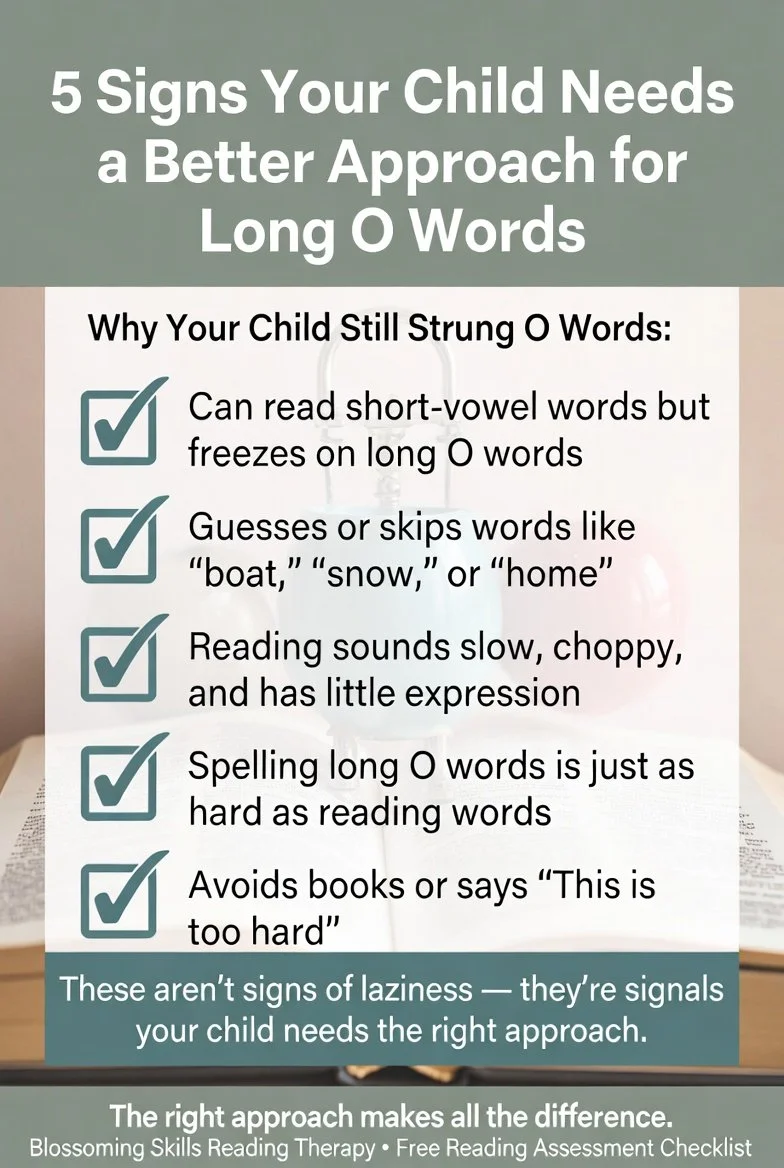
Why Your Child Still Struggles with Long O Words
Your child can sound out simple CVC words like “cat” and “dog”… but completely freezes or guesses on long O words like boat, snow, home, hope, or remote?
You’re not alone — and it’s not because they’re not trying hard enough.
In this post I explain exactly why long O spelling patterns cause so much trouble and how the speech-to-print approach finally builds strong orthographic mapping, automatic recognition, and confident fluency (with real 12-week results).
Plus simple at-home tips and how my Long O Phonics Practice Packet or full Reading Therapy program can help your child blossom fast.
Download your Free Reading Assessment Checklist and book a no-pressure Breakthrough Call today.
If your child can sound out “cat,” “dog,” and “run” pretty well… but completely freezes or guesses when they hit words like “boat,” “snow,” “home,” “toad,” or “go,” you are seeing one of the most common (and frustrating) roadblocks in early reading.
You’ve probably heard “They just need more practice” or “They’ll get it eventually.” But weeks and months go by and those long O words are still tripping them up — making reading slow, choppy, and exhausting.
I’ve been right where you are. As a former special education teacher and a mom whose own daughter struggled with these exact patterns, I watched the same cycle play out with hundreds of families… until I switched to speech-to-print instruction.
In this guide, I’ll show you exactly why long O words are so tricky, why traditional phonics often isn’t enough, and the speech-to-print approach that finally builds automaticity and smooth fluency. You’ll also get simple at-home strategies and learn how my Advanced Code: Long O Phonics Practice Packet and full Reading Therapy program can create real breakthroughs.
Why Long O Words Are Especially Difficult
Long O has more spellings than almost any other vowel sound:
oa → boat, coat, road
ow → snow, blow, grow
o_e → home, bone, rope
oe → toe, Joe, doe
ou → soul, dough (and a few more exceptions)
This is called the advanced code. Short vowels are fairly consistent, but long O forces the brain to sort through multiple possibilities every single time. For a struggling reader — especially one with dyslexia or weak orthographic mapping — that extra mental work is exhausting.
The result? Guessing, skipping words, losing expression, and growing frustration.
The Real Problem: Lack of Strong Orthographic Mapping
Most phonics programs teach kids to “look for the vowel team” or memorize rules. That works okay for some kids… but not for the ones who really struggle.
What actually creates fluent reading is orthographic mapping — the brain’s ability to permanently store a word so it can be recognized instantly without sounding it out every time.
Speech-to-print instruction is far more effective because it starts with the sound your child already knows perfectly (/ō/) and shows them exactly how that sound maps to different letter patterns. This builds the strong brain connections that traditional “print-first” methods often miss.
Traditional Phonics vs. Speech-to-Print for Long O Words
Here’s the difference that actually matters:
AspectTraditional PhonicsSpeech-to-Print ApproachStarting PointShow the letters first (oa, ow, o_e)Start with the spoken sound /ō/MethodMemorize rules and exceptionsBuild sound-to-letter mappingPractice StyleWorksheets and flashcardsMultisensory sound-first activitiesSpeed of AutomaticitySlow — lots of guessingFast — builds permanent word storageFluency OutcomeOften stays choppySmooth, confident reading
This is why your child may “know” the rule but still can’t read the word quickly in a real book.
5 Signs Your Child Needs a Better Approach for Long O Words
They can read short-vowel words but freeze on long O words
They guess or skip words like “boat,” “snow,” or “home”
Reading sounds slow and choppy with little expression
Spelling long O words is just as hard as reading them
They avoid books or say “This is too hard”
These aren’t signs of laziness — they’re signals your child needs the right kind of practice.
Simple Ways to Start Building Fluency at Home
You don’t have to wait for professional help to start making progress. Try these speech-to-print-friendly activities tonight:
Sound-First Word Building — Say the word out loud (“This word is /ō/ /k/ = oak”), then build it with letter tiles.
Vowel Team Sorting — Sort words by sound first, then by spelling.
Word Chains — Change one sound at a time (boat → coat → goat → goal).
Echo Reading — You read a sentence with expression, your child echoes it.
For even faster results, many families start with my Advanced Code: Long O Phonics Practice Packet. It includes everything you need — sound-first word lists, games, sentence practice, and activities designed specifically for the tricky long O patterns. Parents tell me their kids actually ask to use these packs because they finally feel successful.
👉 Shop the Long O Phonics Practice Packet here
What Real Progress Looks Like in 12 Weeks
With consistent speech-to-print practice (either through the Phonics Packs or full therapy), here’s what most families see:
Weeks 1–4: Much less guessing on long O words. Decoding becomes more accurate. Weeks 5–8: Fluency starts improving — reading sounds smoother and more natural. Weeks 9–12: Automatic recognition kicks in. Your child reads long O words in context with confidence and expression.
This is exactly why I offer the 12-Week Progress Promise in my full 1:1 Reading Therapy program: measurable growth of at least one full grade level — or we continue working with you at no extra cost.
Ready for Your Child to Finally Blossom?
If long O words (or other vowel teams) are still holding your child back, they don’t need more of the same. They need the right approach.
Download your Free Reading Assessment Checklist right now and book a no-pressure Breakthrough Call. In just 15 minutes we’ll map out exactly where the breakdown is happening and the fastest path forward — whether that starts with the Long O Phonics Pack or moves into full therapy.
Your child’s reading story is about to change — and I’d be honored to help them blossom.
Frequently Asked Questions
Why are long O words so much harder than short vowels? Long O has multiple spellings (oa, ow, o_e, etc.), so the brain has to sort through more possibilities.
Will my child eventually “get it” with more practice? Not if the method doesn’t match how their brain learns. Speech-to-print builds permanent mapping much faster.
Can I use the Phonics Pack without full therapy? Absolutely! Many families start with the Long O packet for quick wins and add therapy later if needed.
How long until we see real fluency? Most families notice easier decoding within 4–6 weeks and smooth, confident reading by week 12.
Is this only for dyslexia? No — it works beautifully for any struggling reader, including kids with ADHD or those who just never clicked with school phonics.
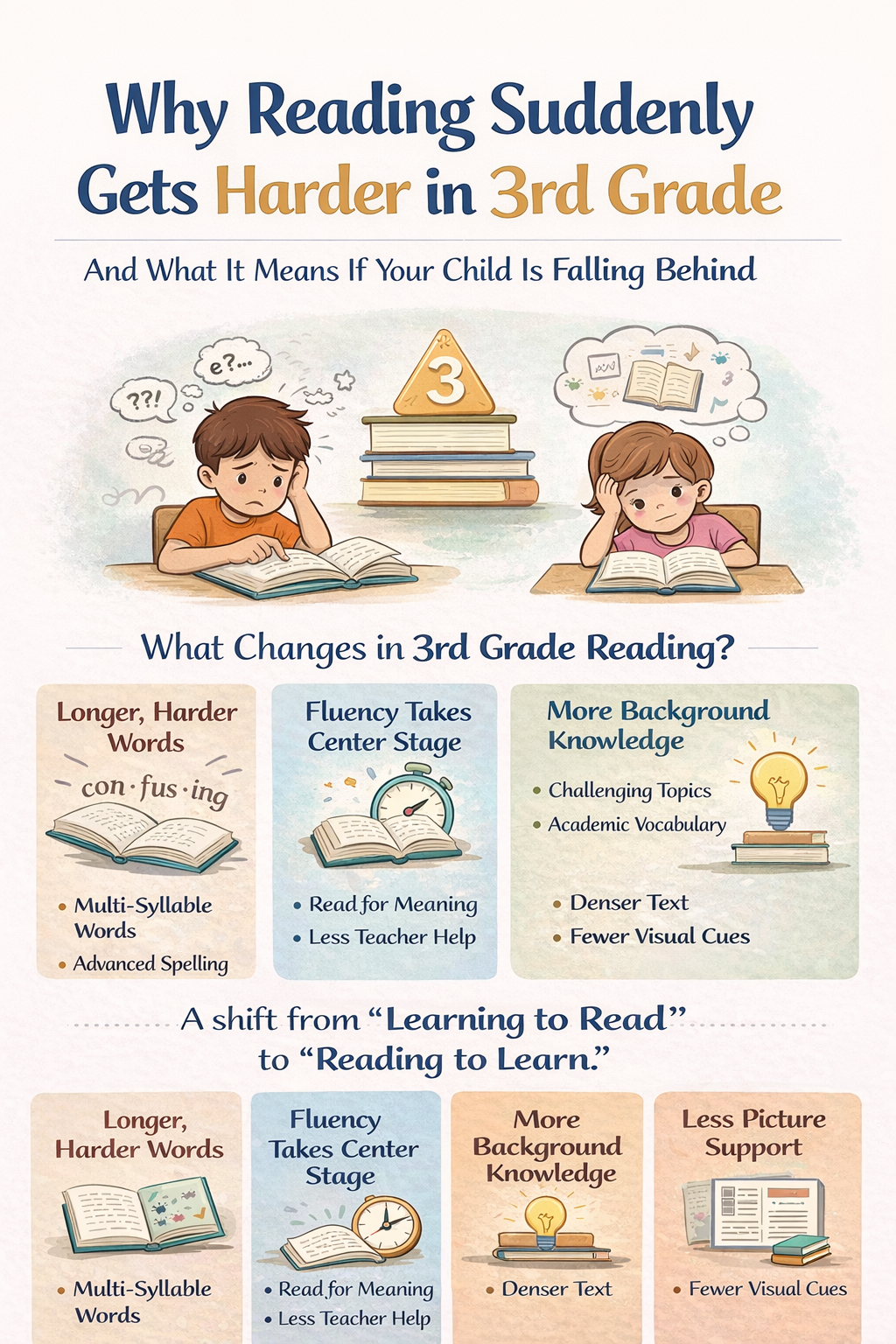
Why Reading Suddenly Gets Harder in 3rd Grade (And What to Do If Your Child Is Falling Behind)
Reading often feels harder in 3rd grade because the demands change. Text becomes longer, vocabulary grows more complex, and fluency becomes essential for comprehension. If your child suddenly seems to be falling behind, the issue may not be motivation — it may be foundational decoding and automaticity gaps that are now being exposed.
Many parents tell me the exact same story:
“My child did okay in 1st and 2nd grade… but 3rd grade hit and everything fell apart.”
Homework that used to take 15 minutes now drags on for an hour. Reading time turns into tears and meltdowns. Your once-confident child starts saying, “I’m just not smart” or “I hate reading.”
If this is your child right now, please know — you are not failing, and your child is not broken. This is incredibly common, and there’s a real reason it happens.
The Big Shift in 3rd Grade
In early grades, kids are “learning to read.” Books are short, pictures help, and teachers give lots of support.
Starting in 3rd grade, everything changes. Kids are now expected to “read to learn.” They have to pull information from longer chapter books, science texts, and social studies with almost no help.
This new stage requires:
Fast, automatic word reading
Strong fluency
The ability to understand and remember what they just read
When those skills have small gaps, reading suddenly feels exhausting and overwhelming.
Why Most Phonics Programs Make It Worse
Here’s something most parents don’t realize:
A lot of traditional reading programs teach kids to memorize phonics rules and all their exceptions, then try to apply them while reading.
This puts a huge load on working memory — and that’s simply not how brains are wired to learn.
When a child has to stop and think about rules on almost every word, there’s almost no brainpower left for actually understanding the story. That’s why so many kids can “know their phonics” but still guess, slow down, or melt down.
The Better Way: Speech-to-Print
My brand new packets use a completely different approach called speech-to-print.
Instead of memorizing confusing rules and exceptions, kids learn to map sounds to letters the natural way the brain actually processes language. This reduces cognitive overload and makes reading start to feel automatic and easy.
You’re Not Too Late
The great news? Most kids who hit this wall catch up quickly once they get the right kind of support.
Ready to Help Your Child Move Forward?
Here are the easiest next steps you can take today:
1. Download my Free Struggling Reader Checklist. Find out exactly what’s holding your child back (takes just 2 minutes)
2. Grab my brand new Long E Packet The perfect starting point for building strong speech-to-print skills (currently on special launch pricing)
3. Book a Free Reading Clarity Call. Let’s talk about your child’s specific situation and make a clear plan
You’ve got this, mama. Your child’s reading story isn’t over — it’s just entering a new chapter, and the right support can make all the difference.
Catherine Mitchell Blossoming Skills Reading Therapy www.blossomingskillsreadingtherapy.net
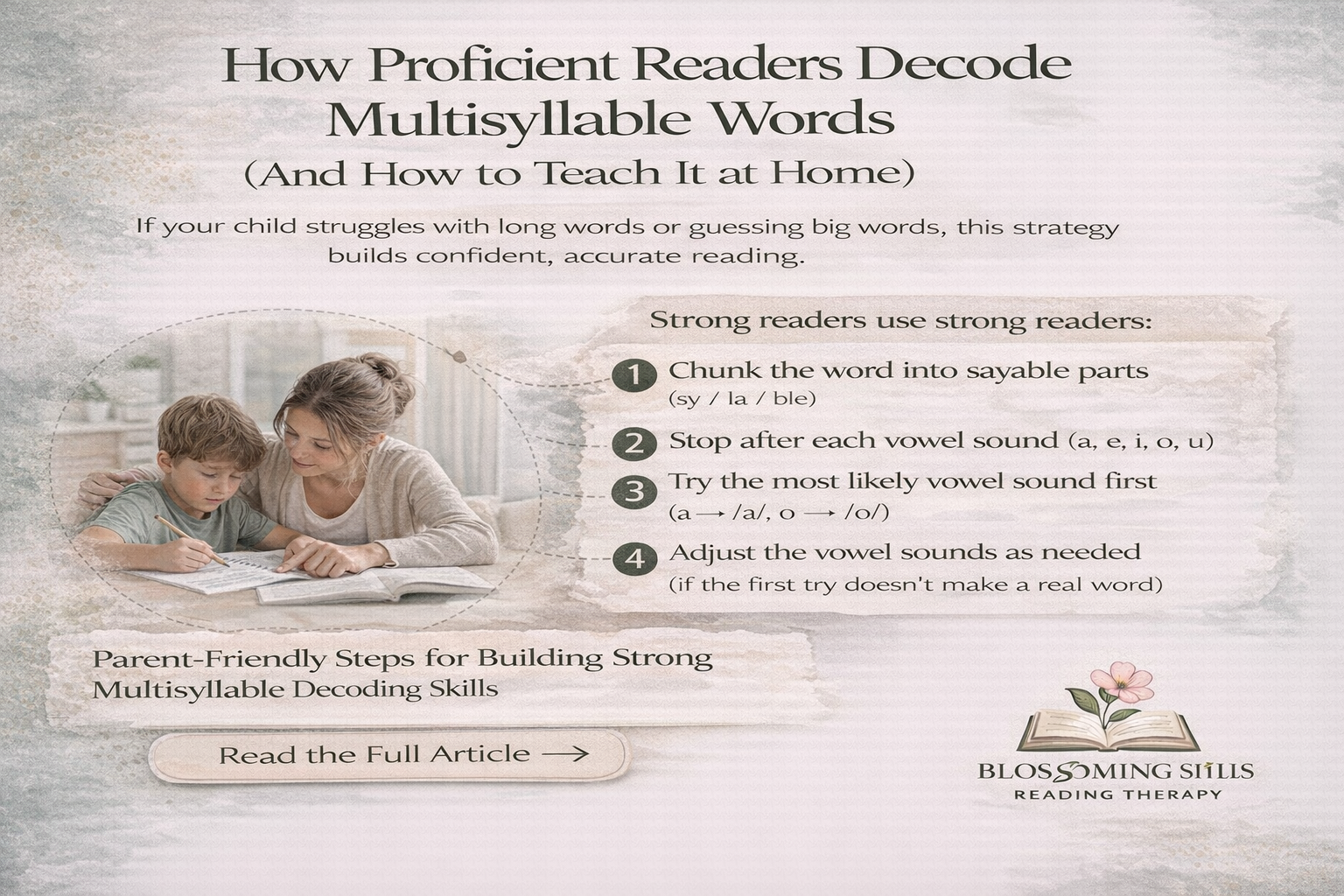
How Proficient Readers Decode Multisyllable Words (And How to Teach It at Home)
Does your child freeze on long words, guess instead of decoding, or shut down when reading multisyllable words? Many struggling readers — especially those with dyslexia — never develop a reliable system for breaking apart and decoding longer words. Proficient readers use a fast, sound-based chunking process that builds automatic word recognition without memorizing complex syllable rules. In this article, you’ll learn exactly how strong readers decode multisyllable words — and how to teach this brain-aligned strategy at home to build fluency, accuracy, and lasting reading confidence.
If your child struggles with long words, freezes on multisyllable words, or guesses instead of decoding, you’re not alone. This is one of the most common reasons parents seek reading help — especially for children with dyslexia patterns or slow reading progress.
The good news is that proficient readers use a reliable decoding process for unfamiliar words, and you can teach that same strategy at home — without relying on complicated rules or syllable labels.
Let’s walk through what strong readers naturally do and how to build that sound-to-print pathway for your struggling reader.
CHECK OUT MY NEW PHONICS PACKS HERE
How Strong Readers Approach Unfamiliar Words
Proficient readers don’t sound out long words letter-by-letter. Instead, their brains do something faster and more systematic:
Chunk the word into sayable parts
Stop after a vowel sound
Try the most likely vowel sound first
Adjust the vowel sound if the word isn’t recognized
Confirm the word by listening for meaning
This is the process the brain uses to decode new words — and it works whether the word is two syllables or five.
Why Multisyllable Words Are Hard for Struggling Readers
Many struggling readers haven’t built a stable sound-to-print system. That means when they hit a bigger word, they don’t have a dependable method to fall back on.
You might see:
slow, choppy decoding
shutting down on long words
guessing based on the first letters
relying on context instead of decoding
weak spelling that doesn’t match reading ability
This is especially common for dyslexic and neurodivergent learners, because their brains need clearer sequencing and stronger phoneme-to-grapheme mapping.
A Real-Life Decoding Example (What a Proficient Reader Does)
Imagine seeing a word you’ve never heard before:
mecrolithin
Even without knowing the meaning, proficient readers usually do this:
1) Find a chunk you can say
You instinctively avoid impossible consonant starters.
You grab a sayable unit like:
me / cro / lith / in
2) Stop after a vowel sound
Each chunk ends right after the vowel sound.
3) Try the most common vowel sound first
me (short e or long e?)
cro (could be “crow” or “crah”)
lith (usually short i)
in (short i)
4) Adjust only the vowels if needed
If it doesn’t sound like a real word, you test another vowel sound:
mee-CRO-lith-in → meh-CRO-lith-in
That’s not guessing.
That’s systematic vowel testing within chunks.
Why This Strategy Works
Reading follows a specific brain pathway:
speech → sounds → letters → words → meaning
Proficient readers start with sounds first, not visual memorization.
They decode from speech-to-print, then confirm meaning once the word is recognized.
That’s why this approach also supports spelling and writing — because it builds a clear internal map of how words are spelled.
Why Common School Methods Often Don’t Help
Many schools teach multisyllable reading using strategies that sound good but don’t match how strong readers decode unfamiliar words:
memorizing syllable types
labeling vowels before reading the word
searching for rules and exceptions
using morphology first
leaning on context to “figure it out”
The problem is simple:
A child can’t use meaning or context until they can say the word accurately.
Without a sound-based method, guessing becomes the fallback.
How to Teach Multisyllable Decoding at Home (Parent-Friendly Steps)
You don’t need a complicated program. You need a clear, repeatable routine.
Step 1: Teach “Stop After the Vowel”
Say:
“Let’s take one chunk. Stop after the vowel sound.”
This trains the brain to grab sayable units instead of panicking at a long word.
Step 2: Try the Most Likely Vowel Sound First
Not a long list of rules — just the first most common sound.
Examples:
a → /a/ then /ae/
o → /o/ then /oe/
ow → /oe/ or /ow/ (grow / how)
Step 3: If It Doesn’t Sound Right, Adjust the Vowel
Say:
“That didn’t sound like a word you know. Let’s try the next vowel sound.”
This keeps your child systematic instead of starting over or guessing.
Step 4: Blend + Check for Recognition
After a full attempt ask:
“Does that sound like a real word you’ve heard before?”
If yes, lock it in.
If not, test another vowel sound and try again.
This Strategy Improves Spelling Too
When kids decode in chunks and test vowels, they aren’t just reading — they’re building spelling automaticity.
This is why sound-to-print decoding helps spelling stick far better than memorizing lists.
If Your Child Is Guessing on Big Words, This Is the Fix
Guessing isn’t a motivation issue.
It’s a strategy gap.
Kids guess when they don’t have a reliable system.
When you teach this sound-based decoding method, guessing fades and confidence grows.
Want the Step-by-Step System for Your Child’s Pattern?
If you’re here because your child has dyslexia or is struggling to read, you’re in the right place. I share practical, research-based strategies that rebuild the reading pathway — without overwhelming rules or guesswork.
For step-by-step dyslexia reading help at home, including monthly toolkits and live coaching, start with the Reading Clarity Membership.
Inside Reading Clarity, I teach parents how to:
chunk multisyllable words without syllable labels
teach vowel sounds in the right order
rebuild the missing sound-to-print pathway
support dyslexic and neurodivergent learners effectively at home
You don’t need more random practice.
You need the right practice in the right order.
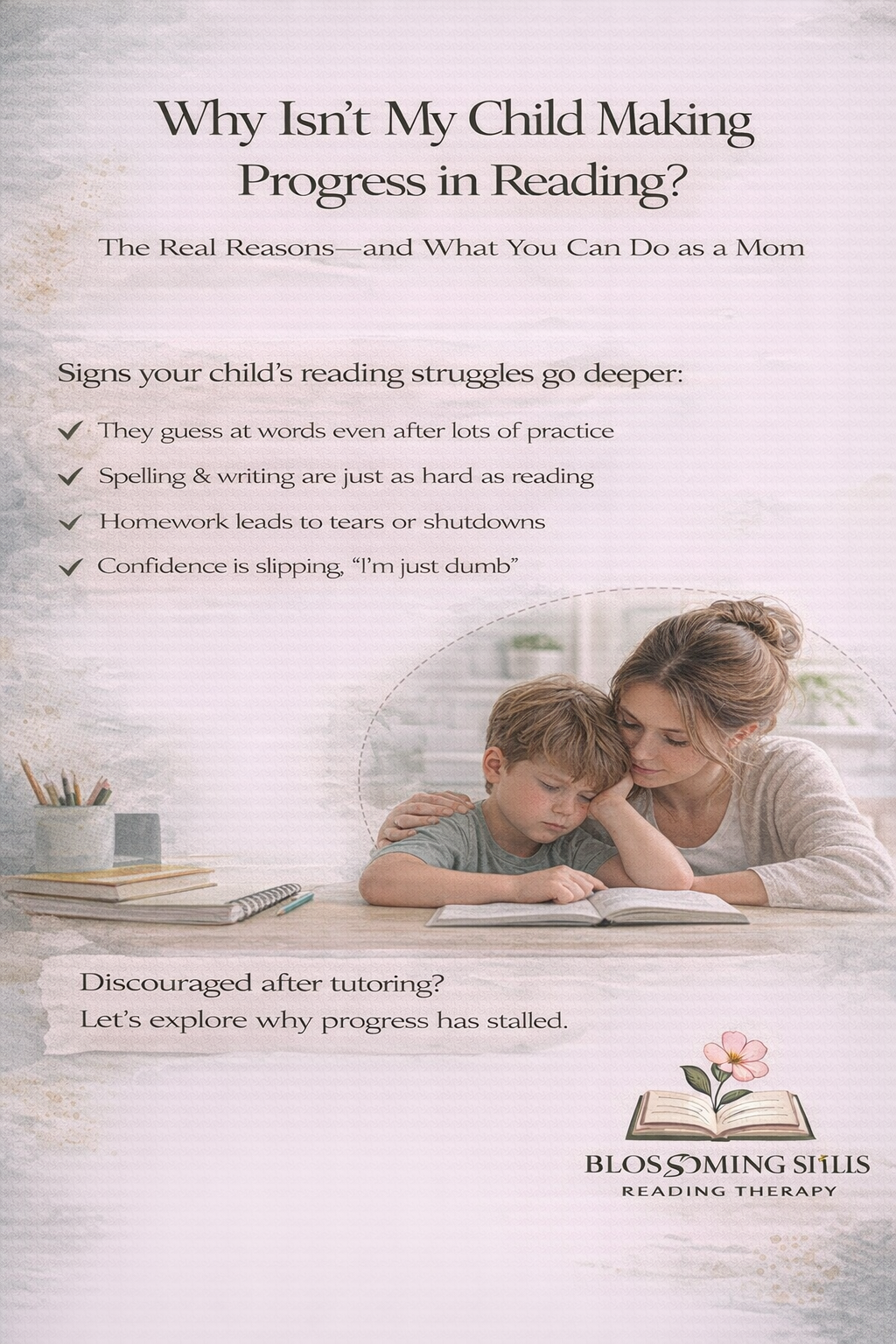
Why Isn’t My Child Making Progress in Reading?
Why isn’t my child making progress in reading—even after tutoring, phonics practice, and extra help at home? If your child is still guessing at words, struggling with spelling, or losing confidence, the issue may not be effort. Many struggling readers and children with dyslexia need sound-to-print instruction that builds real brain connections, not memorization or rule overload. In this article, you’ll discover the hidden reasons reading progress stalls—and what moms can do to help their child build fluent, confident reading skills.
The Real Reasons—and What You Can Do as a Mom
If you’re a mom whose child is still struggling to read, even after months (or years) of tutoring, you’re not alone.
Every week, I talk to parents who have tried everything—flashcards, apps, after-school help—only to watch their child’s confidence sink lower and lower.
So, what’s really going on?
The Hidden Struggles Behind Reading Failure
Dyslexia and reading difficulties aren’t caused by a lack of effort, intelligence, or love at home.
Most struggling readers have a brain that processes language differently—and surface-level tips or more “drill and kill” just don’t work.
Top signs your child’s reading struggles go deeper:
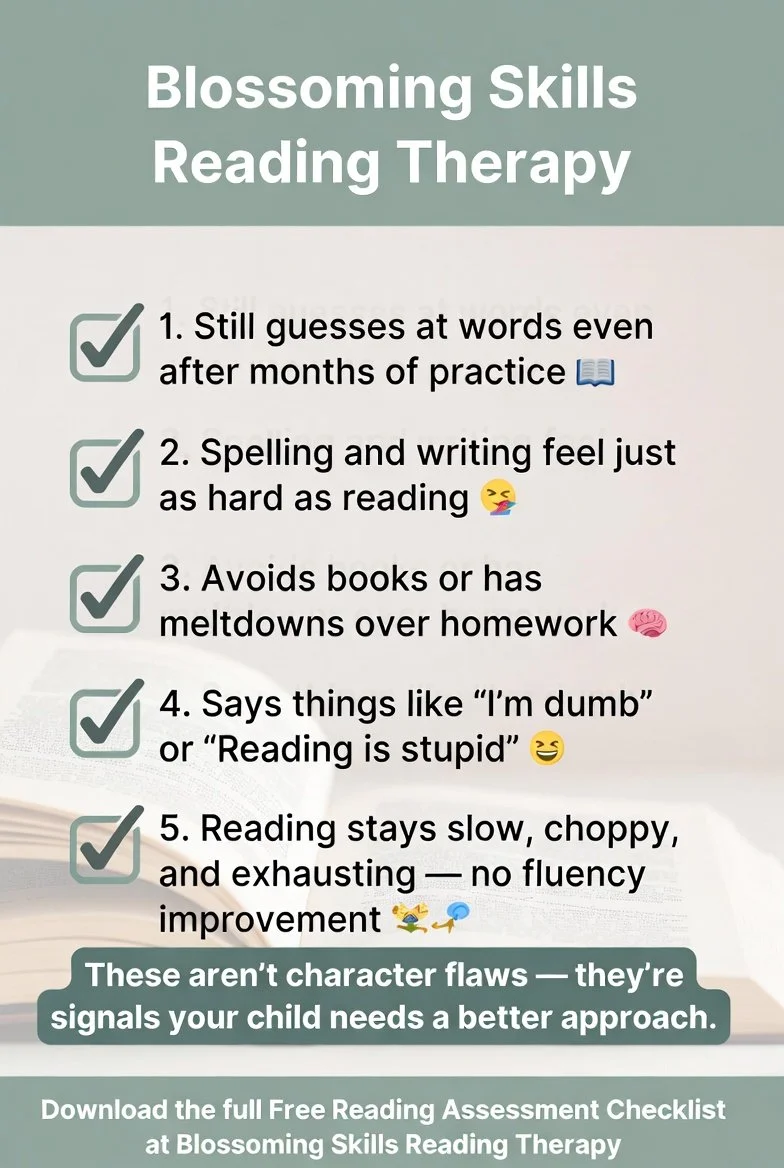
They guess at words or sound them out incorrectly, even after lots of practice
Spelling and writing are just as hard as reading
Homework is a daily battle, with tears or shutdowns
Their confidence is slipping, and they may say things like, “I’m just dumb”
Why Popular Approaches Often Miss the Mark
Many programs (even expensive, well-known ones) focus on memorization or visual tricks—asking kids to memorize sight words, rules, or word shapes.
But research shows that for children with dyslexia, the most effective path is building strong connections between spoken language and print—a method known as “speech-to-print.”
Speech-to-print instruction teaches reading the way the brain naturally learns language:
Start with what your child already knows—spoken words and sounds
Systematically connect those sounds to written letters and patterns
Practice reading and spelling in a way that feels logical, not overwhelming
Real Progress—Not Just More Practice
At Blossoming Skills Reading Therapy, we use a speech-to-print approach that’s backed by brain science and tailored for each child.
Here’s what makes our process different:
Short, focused sessions that respect your child’s mental bandwidth
No overloading of working memory—we avoid overwhelming rules or rote memorization
Personalized support and encouragement for families, not just kids
A real guarantee: Your child will make at least 1 grade level of reading progress in just 12 weeks—or your money back
What Other Moms Are Saying
“My son was significantly behind in reading until we found Catherine. We had tried tutoring before with no progress. I decided to try again and I’m so glad I did!”
—Parent of a Blossoming Skills Student
“She’s not a tutor, she’s a skilled reading therapist with the skills, knowledge, heart, and understanding to teach any child who learns differently, like my son.”
—Homeschool Parent
What Can You Do Next?
If you’re tired of seeing your child work so hard for so little progress, it’s time for a new approach—one that honors both the science and your family’s emotional journey.
Download my free Honest Parent Guide to Dyslexia Programs to see clear, research-backed comparisons of the most popular interventions, real parent stories, and the details of our unique guarantee.
[Download Your Free Guide]
or
Visit: www.blossomingskillsreadingtherapy.net
You don’t have to keep guessing. Real reading progress—and real hope—are possible.
Why Your Child Still Struggles After Orton Gillingham Tutoring
Why is your child still struggling after Orton-Gillingham tutoring? If your child has dyslexia or ongoing reading difficulties despite months or years of structured phonics instruction, you’re not alone. Many struggling readers learn rules but never develop automatic word recognition or fluent decoding in real text. In this article, we explore why Orton-Gillingham doesn’t work for every child — and how speech-to-print, brain-aligned reading instruction can rebuild confidence and lasting reading progress.
If you’re here because your child has dyslexia or is struggling to read, you’re in the right place. I share practical, research-based strategies that rebuild the reading pathway — without overwhelming rules or guesswork.
For step-by-step dyslexia reading help at home, including monthly toolkits and live coaching, start with the Reading Clarity Membership.
You did everything they told you.
You found the program. You paid for the tutor. You followed every suggestion.
But here you are.
Months, maybe even years, later.
And your child still struggles to read.
If that sounds familiar, please know something important:
You’re not alone. And it’s not your fault.
The Method Isn’t Always the Miracle
Orton-Gillingham. It’s a name that comes up again and again. It’s been around for decades. People talk about it like it’s the gold standard.
But what happens when it doesn’t work?
Because for a lot of kids... it doesn’t.
Not completely. Not consistently. Sometimes, not at all.
You may have heard:
“Just give it more time.”
“Every child moves at their own pace.”
“It’s evidence-based.”
But time keeps passing. And your child is still stuck on the basics.
So now what?
Why Doesn’t It Work for Every Kid?
Let’s talk about the method for a second.
Orton-Gillingham focuses heavily on phonics, breaking down words, rules, patterns.
And sure, that works for some learners.
But not all.
Some kids don’t learn best by memorizing dozens of rules with dozens of exceptions.
They don’t need more drills. They need clarity. Something that makes actual sense.
There’s a moment where parents start to notice...
“My child can say the sounds out loud, but they still can’t read the word.”
Or...
“They practiced this all week, but today it’s like they’ve never seen it before.”
It’s not that your child isn’t trying. It’s not that they’re lazy. It’s not that you’re not doing enough at home.
It’s that the approach doesn’t match how their brain learns.
There’s Another Way
Instead of starting with letters and trying to force sounds onto them...
What if we started with spoken language?
That’s what speech-to-print methods do.
Kids already know how to talk. They understand sounds. They use them all day, every day.
So when reading instruction connects to what they already know, the confusion fades.
We stop giving them 10 different spelling rules they can’t remember.
We stop asking them to memorize sight words that don’t follow the rules.
We just teach them how the code works, in a way that’s actually usable.
Why So Many Kids Hit a Wall with Phonics Rules
Some kids can memorize 20 spelling rules and use them just fine. But others? They sit there staring at a word like “enough” or “could,” and nothing about it makes sense. That’s because phonics-heavy systems are often built around patterns and too often, English doesn’t follow those patterns. These kids try to remember the rules, then the exceptions, then the exceptions to the exceptions. And somewhere along the way, they just shut down. It's not because they’re lazy. It's because their brain doesn’t store and recall language that way. That’s why you may see your child read a word correctly one day and totally blank on it the next. They’re not forgetting. They never actually understood it in a way that stuck.
Speech-to-print helps remove that confusion by making the connection between spoken sounds and written letters much more direct. It’s not “memorize and hope”, it’s understand and apply. And that changes everything.
If You’re Feeling Tired, That Makes Sense
Parents don’t get told this stuff. Not in schools. Not in most tutoring centers.
You’re led to believe that Orton-Gillingham is the answer.
And if it’s not working, the problem must be with your child.
But the problem is the method doesn’t work for everyone.
And honestly? That’s okay.
No single program is perfect.
But you deserve to know there’s another option, one that’s simpler, quicker, and yes, often more effective.
The Warning Signs That It’s Not a Fit
If you’re not sure yet, pay attention to these things:
● Is your child making real progress, or just going through the motions?
● Do they dread reading time, even with help?
● Can they sound out words in isolation, but not in a book?
● Are they still guessing at words they’ve seen a hundred times?
If these sound familiar... trust your gut. You don’t need more time in the same system.
You might just need a better fit.
The Hidden Cost of Waiting
One of the hardest things to admit as a parent is that something’s not working. We don’t want to pull our child out of a program everyone else seems to trust. We don’t want to be the difficult one. So we wait. A few more months. Another semester. Maybe next year it will click. But all the while, your child is falling further behind and worse, they’re internalizing the struggle. They start thinking something is wrong with them. That they’re “not smart” or “just bad at reading.” That pain shows up later in school avoidance, low confidence, or even behavior changes.
And here’s the thing: the longer we wait, the harder it is to rebuild that self-trust. Yes, finding a better method takes effort. But staying in the wrong one comes at a cost too, one we don’t always see until it’s already deep. Acting now isn’t just about reading. It’s about preserving how your child sees themselves.
There’s Hope, Really
The most heartbreaking part is seeing how many parents blame themselves.
You wonder:
“Did I wait too long?”
“Should I be doing more at home?”
“Maybe my child just isn’t a reader.”
Please hear this:
You didn’t fail. And your child isn’t broken.
They just haven’t been taught in a way that clicks with their brain yet.
That can change.
Let’s Try Something That Actually Works
You’ve waited long enough.
If the rules and routines haven’t worked, if the flashcards feel endless, if your child is still stuck, you don’t have to keep going in circles.
There’s a better way.
We teach kids in a way that respects how they think, how they speak, how they understand.
And when that happens... things shift.
They stop resisting.
They start reading.
And maybe for the first time, they believe they can do it.
You don’t need years of tutoring. You need the right method.
Let’s talk. Fill out the contact form or send a message. We’re here when you’re ready.
If your budget is tapped out from paying for tutoring that didn't work, don't give up. Our [Summer Internship Program] offers our highly effective Speech-to-Print therapy at a fraction of the cost.
👉 catherine@blossomingskillsreadingtherapy.net