
Why Your Child Still Struggles with Long O Words
Your child can sound out simple CVC words like “cat” and “dog”… but completely freezes or guesses on long O words like boat, snow, home, hope, or remote?
You’re not alone — and it’s not because they’re not trying hard enough.
In this post I explain exactly why long O spelling patterns cause so much trouble and how the speech-to-print approach finally builds strong orthographic mapping, automatic recognition, and confident fluency (with real 12-week results).
Plus simple at-home tips and how my Long O Phonics Practice Packet or full Reading Therapy program can help your child blossom fast.
Download your Free Reading Assessment Checklist and book a no-pressure Breakthrough Call today.
If your child can sound out “cat,” “dog,” and “run” pretty well… but completely freezes or guesses when they hit words like “boat,” “snow,” “home,” “toad,” or “go,” you are seeing one of the most common (and frustrating) roadblocks in early reading.
You’ve probably heard “They just need more practice” or “They’ll get it eventually.” But weeks and months go by and those long O words are still tripping them up — making reading slow, choppy, and exhausting.
I’ve been right where you are. As a former special education teacher and a mom whose own daughter struggled with these exact patterns, I watched the same cycle play out with hundreds of families… until I switched to speech-to-print instruction.
In this guide, I’ll show you exactly why long O words are so tricky, why traditional phonics often isn’t enough, and the speech-to-print approach that finally builds automaticity and smooth fluency. You’ll also get simple at-home strategies and learn how my Advanced Code: Long O Phonics Practice Packet and full Reading Therapy program can create real breakthroughs.
Why Long O Words Are Especially Difficult
Long O has more spellings than almost any other vowel sound:
oa → boat, coat, road
ow → snow, blow, grow
o_e → home, bone, rope
oe → toe, Joe, doe
ou → soul, dough (and a few more exceptions)
This is called the advanced code. Short vowels are fairly consistent, but long O forces the brain to sort through multiple possibilities every single time. For a struggling reader — especially one with dyslexia or weak orthographic mapping — that extra mental work is exhausting.
The result? Guessing, skipping words, losing expression, and growing frustration.
The Real Problem: Lack of Strong Orthographic Mapping
Most phonics programs teach kids to “look for the vowel team” or memorize rules. That works okay for some kids… but not for the ones who really struggle.
What actually creates fluent reading is orthographic mapping — the brain’s ability to permanently store a word so it can be recognized instantly without sounding it out every time.
Speech-to-print instruction is far more effective because it starts with the sound your child already knows perfectly (/ō/) and shows them exactly how that sound maps to different letter patterns. This builds the strong brain connections that traditional “print-first” methods often miss.
Traditional Phonics vs. Speech-to-Print for Long O Words
Here’s the difference that actually matters:
AspectTraditional PhonicsSpeech-to-Print ApproachStarting PointShow the letters first (oa, ow, o_e)Start with the spoken sound /ō/MethodMemorize rules and exceptionsBuild sound-to-letter mappingPractice StyleWorksheets and flashcardsMultisensory sound-first activitiesSpeed of AutomaticitySlow — lots of guessingFast — builds permanent word storageFluency OutcomeOften stays choppySmooth, confident reading
This is why your child may “know” the rule but still can’t read the word quickly in a real book.
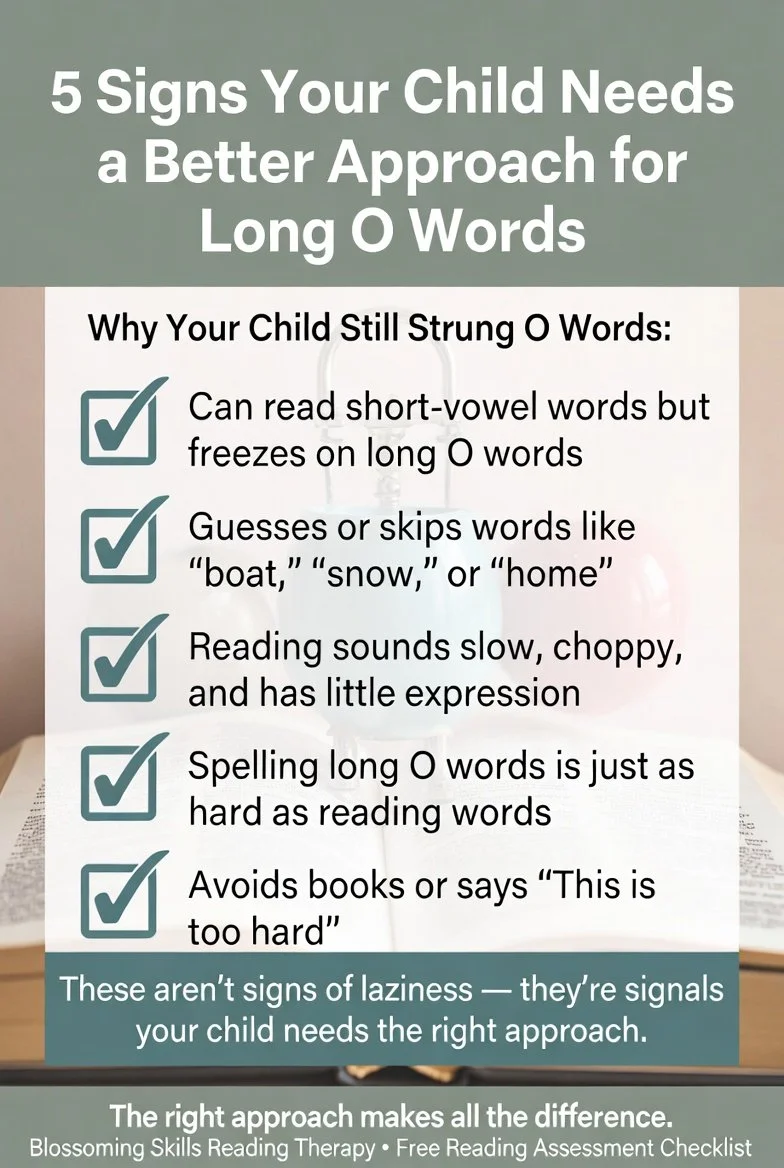
5 Signs Your Child Needs a Better Approach for Long O Words
They can read short-vowel words but freeze on long O words
They guess or skip words like “boat,” “snow,” or “home”
Reading sounds slow and choppy with little expression
Spelling long O words is just as hard as reading them
They avoid books or say “This is too hard”
These aren’t signs of laziness — they’re signals your child needs the right kind of practice.
Simple Ways to Start Building Fluency at Home
You don’t have to wait for professional help to start making progress. Try these speech-to-print-friendly activities tonight:
Sound-First Word Building — Say the word out loud (“This word is /ō/ /k/ = oak”), then build it with letter tiles.
Vowel Team Sorting — Sort words by sound first, then by spelling.
Word Chains — Change one sound at a time (boat → coat → goat → goal).
Echo Reading — You read a sentence with expression, your child echoes it.
For even faster results, many families start with my Advanced Code: Long O Phonics Practice Packet. It includes everything you need — sound-first word lists, games, sentence practice, and activities designed specifically for the tricky long O patterns. Parents tell me their kids actually ask to use these packs because they finally feel successful.
👉 Shop the Long O Phonics Practice Packet here
What Real Progress Looks Like in 12 Weeks
With consistent speech-to-print practice (either through the Phonics Packs or full therapy), here’s what most families see:
Weeks 1–4: Much less guessing on long O words. Decoding becomes more accurate. Weeks 5–8: Fluency starts improving — reading sounds smoother and more natural. Weeks 9–12: Automatic recognition kicks in. Your child reads long O words in context with confidence and expression.
This is exactly why I offer the 12-Week Progress Promise in my full 1:1 Reading Therapy program: measurable growth of at least one full grade level — or we continue working with you at no extra cost.
Ready for Your Child to Finally Blossom?
If long O words (or other vowel teams) are still holding your child back, they don’t need more of the same. They need the right approach.
Download your Free Reading Assessment Checklist right now and book a no-pressure Breakthrough Call. In just 15 minutes we’ll map out exactly where the breakdown is happening and the fastest path forward — whether that starts with the Long O Phonics Pack or moves into full therapy.
Your child’s reading story is about to change — and I’d be honored to help them blossom.
Frequently Asked Questions
Why are long O words so much harder than short vowels? Long O has multiple spellings (oa, ow, o_e, etc.), so the brain has to sort through more possibilities.
Will my child eventually “get it” with more practice? Not if the method doesn’t match how their brain learns. Speech-to-print builds permanent mapping much faster.
Can I use the Phonics Pack without full therapy? Absolutely! Many families start with the Long O packet for quick wins and add therapy later if needed.
How long until we see real fluency? Most families notice easier decoding within 4–6 weeks and smooth, confident reading by week 12.
Is this only for dyslexia? No — it works beautifully for any struggling reader, including kids with ADHD or those who just never clicked with school phonics.